Close

Who We Are

Strategic Plan

Board of Directors

Staff

Annual Reports

Overview

Transition Services

Sample Daily Schedule

Facilities Tour

Overview

Measuring Success

Success Stories

For Caregivers

For Professionals

Fees for Service

Apply

Corporate Partners

Planned Giving

Donate

Wishing Well

Summer Solstice 2027

Exploring Mental Health 2026

Crisis Intervention Team Training

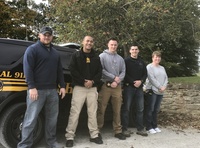
Crisis Intervention Team Training The Trumbull County Mental Health and Recovery Board (TCMHRB) and the Ohio Chapter of the National Alliance on Mental Illness sponsored Crisis Intervention Team (CIT) training for 21 law enforcement officers in early October. Candace Carlton, our Quality Improvement and Compliance Director, and John Myers, CIT Program Coordinator, arranged for four deputies who cover our jurisdiction to visit Hopewell as part of their training.

CIT programs educate law enforcement about local resources, treatment, and supportive services for people experiencing mental health crises. Trainees learn about helping people with mental illness, addiction, and developmental disabilities, and learn and practice skills needed to de-escalate different situations. According to Mr. Myers, “Research has established CIT’s effectiveness in developing better understanding of mental illness, improved crisis response, increased jail diversion, increased continuity with treatment providers in the community, and improved safety for officers as well as the persons they are called upon to deal with, and the larger community.”

Hopewell staff have been thoroughly trained in CIT responses, including verbal de-escalation. Candace explained, “When someone is in crisis, our policy is not to physically restrain residents unless someone’s life is in danger. If a resident is not responding to staff intervention, we follow established protocols and call for law enforcement when necessary. We must keep the other residents and staff safe.”

After an incident, staff members debrief the witnesses and anyone else involved. Candace said, “Some residents have had previous negative experiences with the police and we encourage them to process their feelings. We have observed that when a CIT trained deputy is involved, the aftermath is less traumatic for everyone.”

The site visit was a win-win situation for everyone. Of the four visitors, only one had been to Hopewell in the past. Candace explained our treatment approach and the population we serve, and took the deputies on a tour of the farm to familiarize them with our facilities. “The deputies now know what to expect when they respond to a call from Hopewell,” said Candace. “More importantly, when we ask for a CIT trained deputy, we know that residents will be treated with compassion and respect.

2018 Annual Report

2018 marked Hopewell’s twenty-third year of providing healing and hope for people with serious mental illness. It was also a significant year of change and progress as we work to secure the future of this remarkable organization.

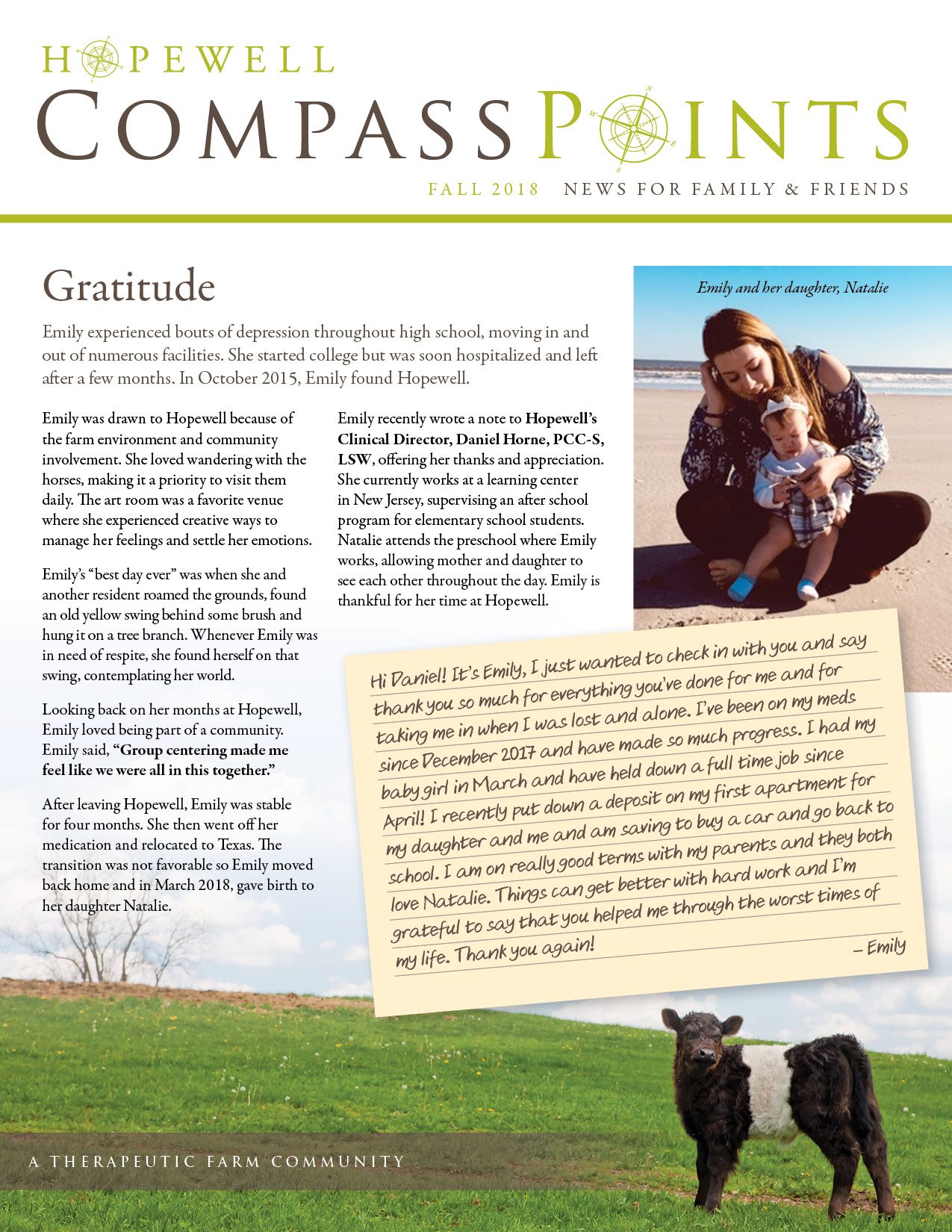
Fall 2018: Gratitude

Emily experienced bouts of depression throughout high school, moving in and out of numerous facilities. She started college but was soon hospitalized and left after a few months. In October 2015, Emily found Hopewell.

Our Team, Our Passions

Meet Matt Kalas, Hopewell’s new farm manager, who joined our staff in August. You could say that farming is in his blood.

“I grew up on a dairy farm with 125 cows in North Bloomfield,” said Matt. “Now that my dad has retired from farming, my two brothers and I grow corn, soy, and wheat. We’ve got 300 acres, about half of which is used for hunting and fishing.”

After 22 years at KraftMaid, Matt was looking for a change and a new challenge. He has immersed himself in learning all aspects of the farm and the Hopewell community. As part of the treatment program, resident work crews assume the major responsibilities for daily operations. “What’s new for me is putting the residents’ needs at the forefront of decision making. If they don’t benefit from something we’re doing on the farm, we may have to do things differently. We really want residents to be more involved in work crews, but the most important thing is to enjoy what they’re doing.”

He continued, “We have made some changes to make it easier for residents to participate. We had a small flock of sheep – the lambs are cute but as sheep mature they tend to avoid people. We sold the sheep and purchased some miniature goats and residents love them! We have traditionally used draft horses to help with farm work but we no longer have enough work for them to stay healthy. Residents were afraid of them because they are so big. We found new homes for the draft horses and are bringing in smaller horses or ponies, which will be easier for residents to work with. The pigs have moved to the barn and the residents are finding them easier to deal with.”

Residents enjoy working with baby animals, but they know that they are not pets. Some are raised for food, such as our Belted Galloway cows, which have been iconic at Hopewell. According to Matt, Belted Galloway are slow to mature and their meat is not as flavorful. Over time we will substitute Angus beef cattle to provide better quality meat.

Matt also oversees the gardens, which provide produce for the Hopewell kitchen. Residents enjoy working together in the gardens, harvesting and using the vegetables. Expanded gardens and more types of produce are planned for the spring.

Maple sugaring, a favorite winter activity, will continue. “We have a great sugar house and we will still produce Hopewell’s famous maple syrup, just on a smaller scale. It will be for sale to the public at the Hopewell Farm and Craft Market,” said Matt.

Matt is very pleased that he joined the Hopewell staff. “All day, I get to do what I love – farming – and working with residents is new for me. I am impressed with how they want to learn and how much they enjoy working as a team.” At the end of a long hard day, you would think it’s time for a nap, but not for Matt. He goes home to his family, second job and first love. . . working on his family farm.

Thanks, Matt, for joining our team and brining your passion and inspiration to Hopewell.

8th Annual Exploring Mental Health Event October 10, 2018

Hopewell presents the 8th Annual David Cutler Conservatory Exploring Mental Health lecture, “Public Perceptions of Mental Illness and Violence,” with Phillip J. Resnick, MD. The event will be held on Wednesday, October 10, at the Cleveland Racquet Club (29825 Chagrin Blvd. in Pepper Pike). A reception with hors d’oeuvres and wine begins at 5:30 pm and the program will begin promptly at 6:15 pm. The public is welcome to attend in celebration of Mental Health Awareness Week. Tickets are $25 per person and must be purchased in advance.

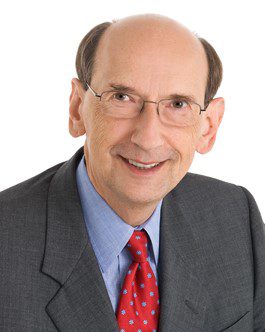
Dr. Phillip Resnick, is a professor of psychiatry and Director, Division of Forensic Psychiatry at Case School of Medicine in Cleveland, Ohio. Dr. Resnick served as a consultant on many high profile cases, including those of Jeffrey Dahmer, Susan Smith, Timothy McVeigh and Andrea Yates. He is a past president of the American Academy of Psychiatry and the Law and has published over 200 articles and book chapters. Internationally recognized, Dr. Resnick has lectured in 49 states and 24 countries.

For more information or to purchase tickets, call the Hopewell Development Office at 440-247-0912. Kindly RSVP by Monday, October 1.

Meet the Crews of Our Work-Based Therapy Program

As a therapeutic farm community, Hopewell is a working farm complete with livestock, gardens, sugaring and more. Our work crews help residents discover their strengths, experience new roles, learn new skills, gain job readiness and build self-esteem. The crews meet five mornings a week, and in July, I ventured out to Mesopotamia to take a closer look.

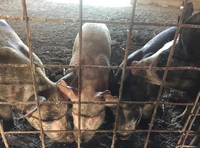
My first stop was the barns to observe the Farm Crew, led by Bruce McAllester. A few residents were cleaning the horse stalls, which is Mike’s favorite job. He introduced me to Brandie, the miniature pony, and mentioned that she does tricks. JC, a horse trainer before coming to Hopewell, taught Brandie how to curtsy. The crew also feeds and cares for chickens, sheep and cows. Upon leaving, I was drawn to piglet noises in another barn and was met by four sweet noses and muddy feet. What a perfect day so far.

The Gardening Crew spends the morning outside watering, tending the large vegetable garden and weeding the smaller flower beds. Brandon loves gardening, not for the physical work but for the satisfaction of accomplishment. Cindy Wagner said the best growers this summer are yellow squash and cucumbers. Vegetables are used in the Hopewell meals and sold at the Farm & Craft Market, along with dried herbs.

Inside the cottages, the Housekeeping Crew was busy cleaning floors and bathrooms, organizing clean linens, and stocking supplies. Celeste Hein has three dedicated residents who find this work grounding and the routine adds structure to their day.

Rounding off my morning was lunch and observing the Kitchen Crew. Leader Jennifer Miller supervises residents who prepare the salad bar, bake muffins and wash dishes. Ben, the chief dish washer, works until everything is clean and put away. Depending on skill level, some residents follow recipes and prepare meals while others set up the dining hall.

After a delicious meal of chicken salad pita and yellow squash soup, I returned back to the Development Office in Chagrin Falls, grateful for being a part of the Hopewell community. If you would like to tour the farm, please contact athompson@hopewell.cc or call 440.247.0912.

Summer 2018: Christina’s Emotional Journey

Christina arrived at Hopewell in August 2016. She grew up in Syracuse, New York, and resided as a nun at the Monastery of the Blessed Sacrament on Cleveland’s west side for 18 years…

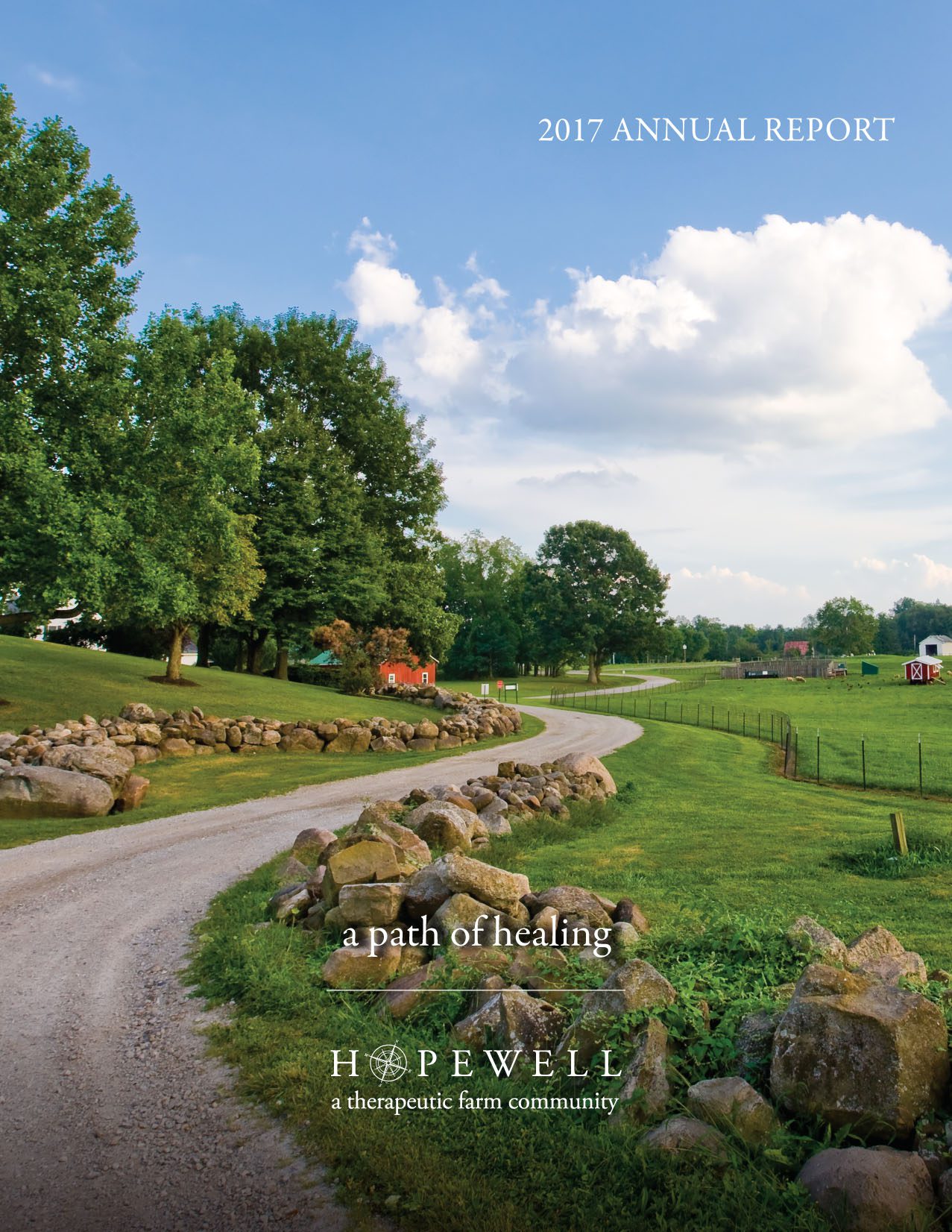
Hopewell’s 2017 Annual Report Highlights 22 Years of Providing Care to Adults with Serious Mental Illness.

Hopewell’s 2017 Annual Report Traces 22 Years of Accomplishments at the Ohio Therapeutic Farm Community

Cleveland, Ohio—(July 9, 2018) Hopewell residential therapeutic farm community has just published its 2017 annual report featuring the therapeutic farm community’s twenty-second year of service to people with serious mental illness.

“In the life of a community such as Hopewell, continuity is just as important as positive change. The therapeutic community that Clara T. Rankin founded in 1993 stays true to the core mission that was adopted at that time,” said Chloe Rankin Seelbach, President of the Board of Directors. Hopewell’s beauty is reflected throughout the report with pictures of its landscape, buildings, people and animals.

Hopewell’s 2017 financials are included as well as a list of donors. Hopewell is a nonprofit, private-pay mental health facility. According to the report, philanthropic funding allows Hopewell to offer reduced fees to many residents and families each year.

This annual report captures Hopewell as a true working farm, one of only five residential therapeutic farm communities in the United States and the only one in Ohio. A wide range of therapies are featured at Hopewell including a nature studies group, equine-assisted learning, interpersonal relationship skills, spirituality, art, music and meditation.

Don Bernardo, Hopewell’s director of development, said, “In addition to celebrating our accomplishments, the 2017 Annual Report helps express our gratitude to our generous donors for supporting our mission, our work and Hopewell’s commitment to advances in mental health care.”

Download the annual report at www.hopewellcommunity.org/news/category/annual-report.

About Hopewell

Hopewell is a 300-arce residential therapeutic working farm located in Mesopotamia, Ohio, where adults with schizophrenia, schizoaffective disorder, bipolar disorder and major depression learn to manage their mental illness and return to independent life. Hopewell is the only therapeutic farm community in Ohio. It is ODMHAS-licensed and CARF-accredited. Hopewell is a member of the National Alliance on Mental Illness and the American Residential Treatment Association. Information, tours and assessments are available by contacting Laura Scarnecchia, LPCC, Clinical Manager, at 440.426.2009 or by email at admissions@hopewell.cc.

Visit www.hopewellcommunity.org for more information.

2017 Outcomes Report

Please read Hopewell’s 2017 Outcomes Report.

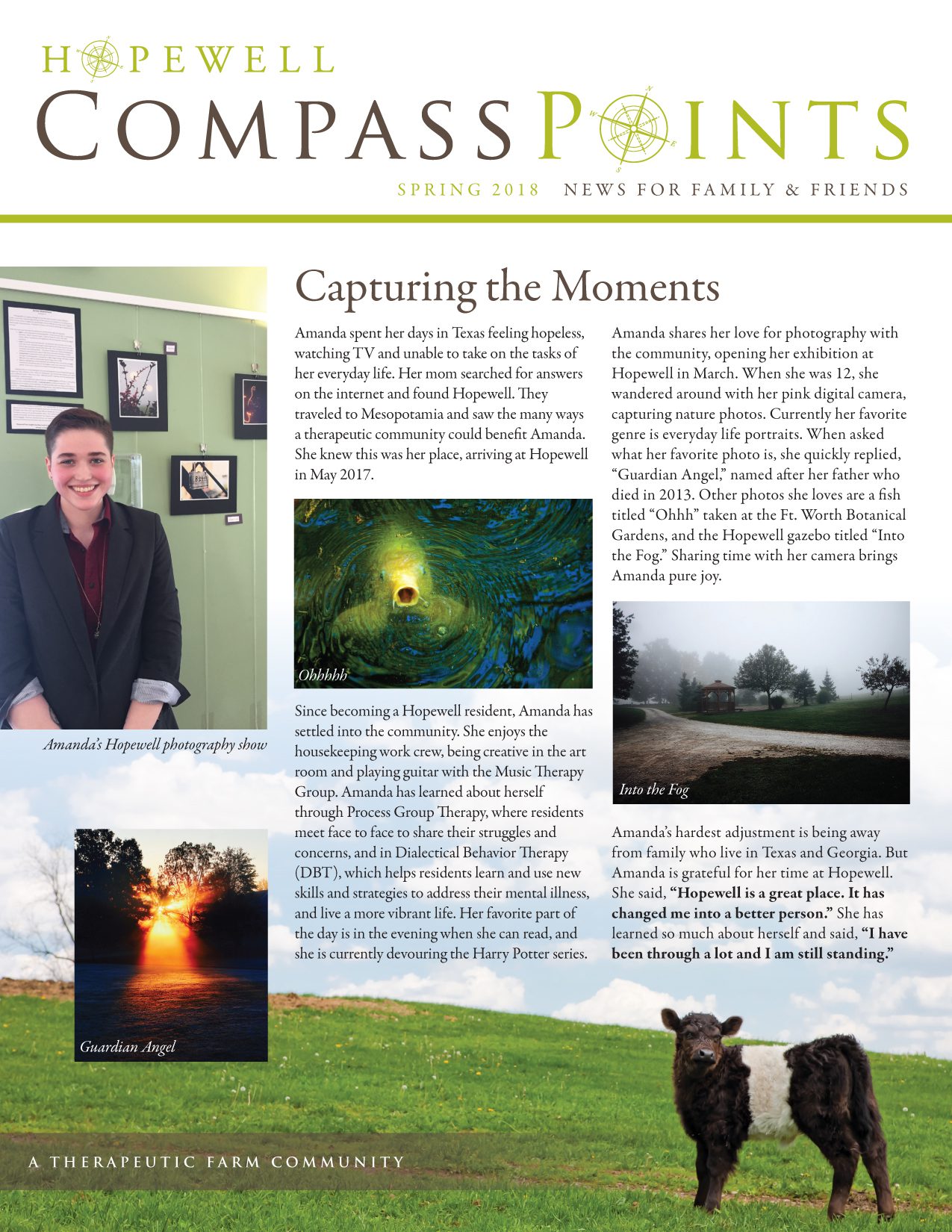
Spring 2018: Capturing the Moments

Amanda spent her days in Texas feeling hopeless, watching TV and unable to take on the tasks of her everyday life. Her mom searched for answers on the internet and found Hopewell. They traveled to Mesopotamia and saw the many ways a therapeutic community could benefit Amanda. She knew this was her place, arriving at Hopewell in May 2017.

DONATE