Close

Who We Are

Strategic Plan

Board of Directors

Staff

Annual Reports

Overview

Transition Services

Sample Daily Schedule

Facilities Tour

Overview

Measuring Success

Success Stories

For Caregivers

For Professionals

Fees for Service

Apply

Corporate Partners

Planned Giving

Donate

Wishing Well

Exploring Mental Health 2025

Summer Solstice 2026

Hopewell Transition Program

Supporting the Move Toward Independent Living

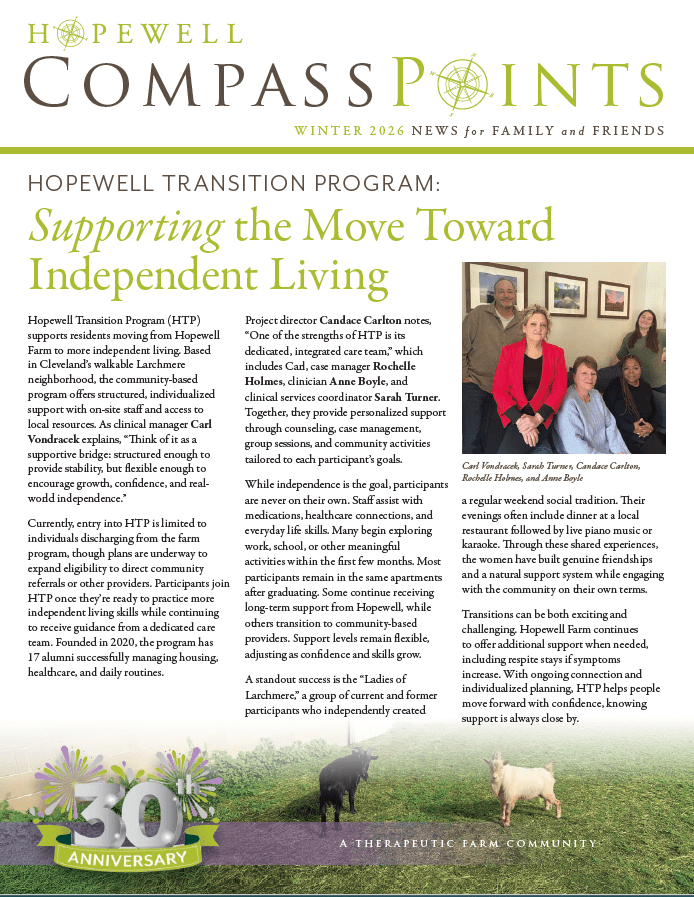
Hopewell Transition Program (HTP) supports residents moving from Hopewell Farm to more independent living. Based in Cleveland’s walkable Larchmere neighborhood, the community-based program offers structured, individualized support with on-site staff and access to local resources. As clinical manager Carl Vondracek explains, “Think of it as a supportive bridge: structured enough to provide stability, but flexible enough to encourage growth, confidence, and realworld independence.”

Currently, entry into HTP is limited to individuals discharging from the farm program, though plans are underway to expand eligibility to direct community referrals or other providers. Participants join HTP once they’re ready to practice more independent living skills while continuing to receive guidance from a dedicated care team. Founded in 2020, the program has 17 alumni successfully managing housing, healthcare, and daily routines. Project director Candace Carlton notes, “One of the strengths of HTP is its dedicated, integrated care team,” which includes Carl, clinician Anne Boyle, and clinical services coordinator Sarah Turner. Together, they provide personalized support through counseling, case management, group sessions, and community activities tailored to each participant’s goals.

While independence is the goal, participants are never on their own. Staff assist with medications, healthcare connections, and everyday life skills. Many begin exploring work, school, or other meaningful activities within the first few months. Most participants remain in the same apartments after graduating. Some continue receiving long-term support from Hopewell, while others transition to community-based providers. Support levels remain flexible, adjusting as confidence and skills grow.

A standout success is the “Ladies of Larchmere,” a group of current and former participants who independently created a regular weekend social tradition. Their evenings often include dinner at a local restaurant followed by live piano music or karaoke. Through these shared experiences, the women have built genuine friendships and a natural support system while engaging with the community on their own terms.

Transitions can be both exciting and challenging. Hopewell Farm continues to offer additional support when needed, including respite stays if symptoms increase. With ongoing connection and individualized planning, HTP helps people move forward with confidence, knowing support is always close by.
EMDR Therapy at Hopewell

By Heidi Moser, MSEd, LPCC, Hopewell Clinician

In working with residents and their families, I have discovered that many people have heard of EMDR but tend not to know much about it unless they have engaged in EMDR therapy previously. EMDR stands for Eye Movement Desensitization and Reprocessing. The therapy was developed by Dr. Francine Shapiro in the late 1980s. EMDR therapy utilizes the technique of bilateral stimulation (BLS) of varying speeds to assist with the reprocessing of traumatic memories. While EMDR therapy does not erase painful memories, it can help clients become desensitized to them and adopt healthier beliefs about themselves and the world around them.

BLS can take the form of eye movements, tapping, vibration, or sounds that engage the right and left sides of the body and consequently, both hemispheres of the brain. It mimics the eye movements that occur during the REM cycle of sleep when the brain continues its activity during an altered state of consciousness, however clients engaging in EMDR therapy are fully awake and aware. Research has demonstrated the effectiveness of both EMDR therapy and BLS in the treatment of trauma.

EMDR therapy is based on the adaptive information processing (AIP) model, also developed by Dr. Shapiro, which posits that the brain has a natural capacity to adapt, similar to the body’s ability to heal. According to the AIP model, memory networks are created in the brain – memories that share certain characteristics. An EMDR therapist guides clients in targeting key memories in the “same network” and reprocessing those memories using BLS.  Through this process, clients can gain more adaptive responses to traumatic memories.

A client does not need to be diagnosed with post-traumatic stress disorder (PTSD) to benefit from EMDR therapy. EMDR therapy is appropriate for anyone grappling with issues that involve negative beliefs about themselves, others, or the world. Oftentimes, present issues are rooted in past experiences and the core beliefs that develop out of those experiences.

EMDR therapists assist clients in uncovering these negative beliefs, which are frequently unconscious and deeply held, and working to identify and take on healthier ways of thinking. While cognitive-based, “top-down” therapies, like CBT, also focus on changing negative thinking patterns, EMDR therapy is considered a “bottom-up” therapy, concerned with the somatic nature of trauma and how past experiences impact the nervous system.

Presently, Hopewell has three clinicians who are EMDR trained, which means they have completed the foundational training in EMDR therapy as designated by the EMDR International Association (EMDRIA). This training involves 20 hours of instruction, 20 hours of supervised practicum, and 10 hours of consultation. Residents at the farm who are interested in EMDR therapy are encouraged to speak to any one of Hopewell’s EMDR trained clinicians. EMDR therapy is an invaluable adjunct to Hopewell’s community-as-therapy program.

Winter 2026 Newsletter

Hopewell has exciting updates in this new year.  Learn more about Hopewell Transition Program, which supports residents moving from Hopewell Farm to more independent living, meet new board members, and buy your tickets for our Summer Solstice event.

DONATE