Close

Who We Are

Strategic Plan

Board of Directors

Staff

Annual Reports

Overview

Transition Services

Sample Daily Schedule

Facilities Tour

Overview

Measuring Success

Success Stories

For Caregivers

For Professionals

Fees for Service

Apply

Corporate Partners

Planned Giving

Donate

Wishing Well

Summer Solstice 2027

Exploring Mental Health 2026

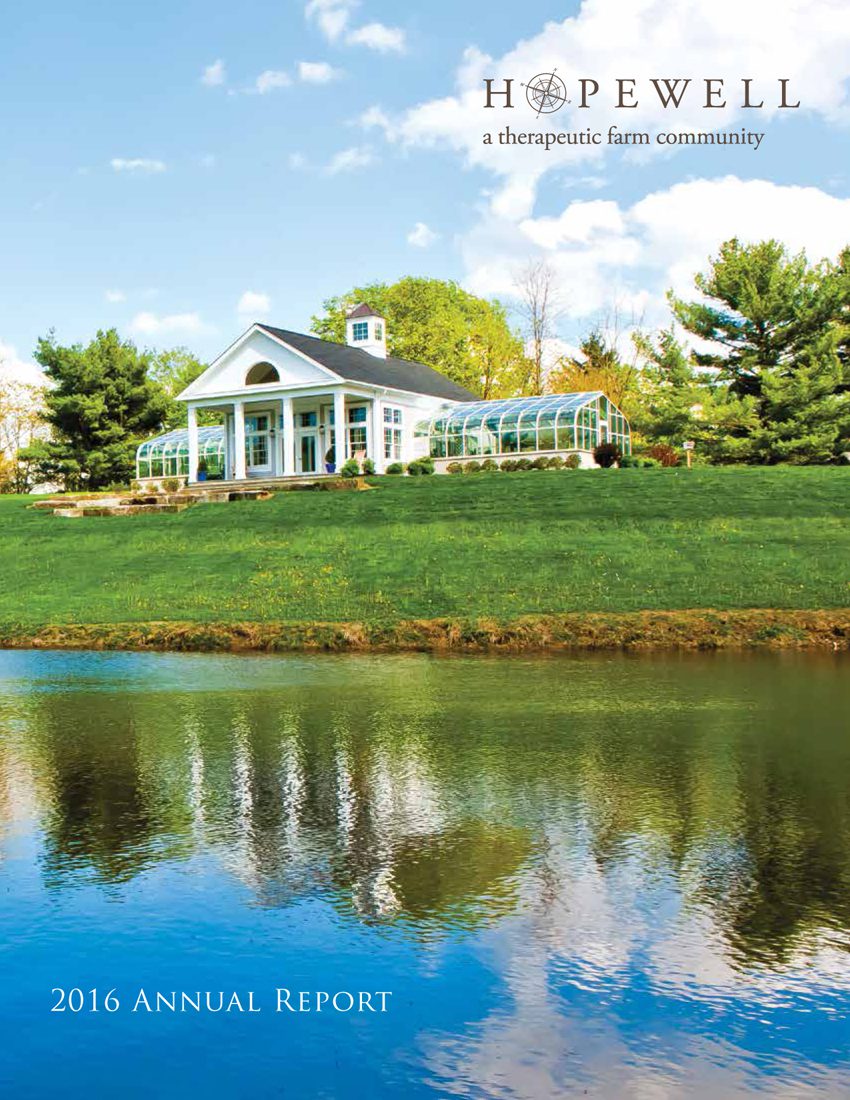
Hopewell’s 2016 Annual Report Traces 21 Years of Accomplishments at the Ohio Therapeutic Farm Community

Hopewell’s 2016 Annual Report Traces 21 Years of Accomplishments at the Ohio Therapeutic Farm Community

Places Spotlight on Hopewell’s Holistic Process for Residents with Serious Mental Illness—the key to the success of the Hopewell Model.

Cleveland, Ohio—(July 11, 2017) Hopewell residential therapeutic farm community has just published its 2016 annual report featuring the Hopewell Model as well as 2016 highlights and achievements between 1993 and 2015, according to Rick Karges, Hopewell executive director/CEO.

“We are happy to share this report and the story of Hopewell from its first residential client to the development of a formal art therapy program and release of Clara Rankin’s book,” said Karges. “The annual report includes a timeline covering Hopewell’s highlights over the years. Hopewell’s beauty is reflected throughout the report with pictures of its landscape, buildings, people and animals.”

Hopewell’s 2016 financials are included as well as a list of donors. Hopewell is a nonprofit, private-pay mental health facility. According to the report, 95% of residents receive fee assistance. A success rate exceeding 70% has been achieved among past residents.

This annual report captures Hopewell as a true working farm, one of only five residential therapeutic farm communities in the United States and the only one in Ohio. A wide range of therapies are featured at Hopewell including a nature studies group, equine-assisted learning, interpersonal relationship skills, spirituality, art, music and meditation.

“We are excited to feature the Hopewell Model through our annual report,” Karges said. “We wish to express our gratitude to our sponsors for supporting our mission, our work and Hopewell’s commitment to advances in mental health care.”

Download the annual report at www.hopewellcommunity.org/news/category/annual-report .

About Hopewell

Hopewell is a 300-arce residential therapeutic working farm located in Mesopotamia, Ohio, where adults with schizophrenia, schizoaffective disorder, bipolar disorder and major depression learn to manage their mental illness and return to independent life. Hopewell is the only therapeutic farm community in Ohio. It is ODMHAS-licensed and CARF-accredited. Hopewell is a member of the National Alliance on Mental Illness and the American Residential Treatment Association. Information, tours and assessments are available by contacting Laura Scarnecchia, LPCC, Clinical Manager, at 440.426.2009 or by email at admissions@hopewell.cc Visit www.hopewellcommunity.org.

Hopewell 2016 Outcomes Report Shows High Rate of Resident Satisfaction, As Well As Improvement in Psychological Functioning

Mesopotamia, OH (June 21, 2017)—The 2016 Hopewell Outcomes Report is available for review by interested healthcare professionals, families and individuals who may be evaluating residential options for adults dealing with severe mental illness.

With support from The Margaret Clark Morgan Foundation and in consultation with Hiram College faculty, Hopewell began a systematic data collection program of outcomes research to guide its efforts to help the seriously mentally ill. As part of this program, Hopewell tracks attendance and participation of each resident on a daily basis and collects periodic systematic measurements of each resident’s progress. The data recorded includes participation in work crews, therapeutic clinical groups, social activities, exercise and community meetings.

Measures

According to Rick Karges, Hopewell executive director/CEO, “Hopewell typically has improved Global Assessment of Functioning (GAF) assessments more than 20% (9 points) for both men and women residents, while generating a resident satisfaction rating of 91%.”

When residents are admitted to Hopewell, a baseline of information is collected for assessing outcomes, including GAF scores, Individual Service Plan goals, Diagnostic Assessment information, medications, living situation, gender and diagnosis. Every three months, residents are administered Hopewell Satisfaction Surveys, Brief Psychiatric Rating Scales, Camberwell Assessment of Needs, Quality of Life Assessment and Hopewell Outcomes Worksheets. The GAF is completed at admission, periodically throughout the resident’s stay and at discharge.

Length of Stay and Phase System

Evaluating the appropriate length of stay, in close consultation with the resident and his/her family, is one of the primary ongoing tasks of the Hopewell staff. Length of stay averages: Autism Spectrum Disorders, 18 months; mood disorders, 6-9 months; schizophrenia/schizoaffective disorders, 20 months. Length of stay is sometimes short of optimal because of individual circumstances. The overall average length of stay at Hopewell is 6-9 months.

Hopewell’s system for encouraging and rewarding socially positive behaviors is a four-phase system where new admits start at the entry phase, the most restricted in terms of privileges. Starting at the entry phase allows the newly admitted to be safe in the community while the staff and other residents get to know them. Residents earn the right to move into other phases by higher levels of attendance and participation in community activities, and attention to activities of daily living, such as eating, bathing, dressing, toileting, transferring (walking) and continence. Utilization of basic social values and modeling of behaviors for other residents are needed to move from entry phase to phase 1, 2, 3 and eventually transitional phase.

Preliminary Study Implications

Preliminary results indicate that measurable improvements are being experienced by most of the residents at Hopewell. The observed improvements include a general reduction in negative psychiatric symptoms, an improvement in overall social functioning and a greater readiness for community reintegration. Specific examples of improvements include successful integration of residents into their homes and families while securing employment, advancing their education and building new social relationships.

With a foundation in nature, the therapeutic farm setting offers a safe, tranquil and work-based environment. Hopewell is able to successfully incorporate concepts of the mind-body-spirit philosophy found in early “moral-based treatment” to provide a modern recovery-based healing model. In conjunction with effective medication, this research supports the conviction that Hopewell and similar therapeutic communities can, in fact, effectively generate measurable and positive recovery results for individuals experiencing serious mental illnesses.

Summary/Findings

“Hopewell 2016 outcomes report documents the treatment benefits of Hopewell,” said Karges. “Ongoing studies and data collection will continue to explore and refine these impressions, which in turn will drive future modifications to our treatment model. Our conclusion at this point is that, factoring in costs and other issues, Hopewell offers a financially advantageous and powerful alternative for delivering highly effective treatment to those with serious mental illness, and that persons with serious mental illness can optimistically and realistically, with help, look forward to self-satisfying and socially effective lives.”

About Hopewell

Hopewell is a 300-acre residential working farm located in Mesopotamia, Ohio, where adults with schizophrenia, schizoaffective disorder, bipolar disorder and major depression learn to manage their mental illness and return to independent life. Hopewell is the only therapeutic farm community in Ohio. It is ODMHAS-licensed and CARF-accredited. Hopewell is a member of the National Alliance on Mental Illness and the American Residential Treatment Association. Information, tours and assessments are available by contacting Laura Scarnecchia, Clinical Manager, at 440.426.2009 or by email at lscarnecchia@hopewell.cc. Visit www.hopewellcommunity.org.

Spring 2017: A Path of Healing

On April 10th three years ago, Phillip S. was admitted to Hopewell. What began with a series of near-devastating challenges has become a positive, productive path of healing for this talented 30-year-old.

Hopewell Promotes Tours, Assessments and Farm Market Visits During May Mental Health Awareness Month

Mesopotamia, Ohio (April 20, 2017) Hopewell therapeutic farm for people with mental illness is promoting tours and assessments for residential candidates along with trips to its Farm & Craft Market during Mental Health Awareness Month in May, according to Rick Karges, Executive Director/CEO.

“Here is a chance for people to visit Hopewell. Persons seeking help or their caregivers can determine whether Hopewell is the right place for them. People in northeast Ohio can take a ride in country and visit our farm including our Farm & Craft Market,” said Karges. “The proceeds from market sales help to support our residents and the breakthrough work we do to find better ways to deal with mental illness.” The market is open Thursday through Sunday from 12 to 4 p.m.

Outcomes studies since 2006 have shown the effectiveness of Hopewell’s program, a model that incorporates a bio-psycho-social orientation to promote wellness and sustained recovery. The healing power of nature, meaningful work and community – along with a caring and high-quality staff – have led to Hopewell’s unique model of mental health care that successfully promotes self-worth, self-confidence and a greater independence for adults dealing with mental illness.

The “Hopewell Model” actually is a newer version of an old methodology called “moral treatment.” Dating back to the early 1800’s in Europe, the concept of moral treatment focused on treating individuals with equality and respect within the context of a healthy living and learning environment. People with mental illness are able to express their feelings and views freely, as well as actively participate in decisions affecting their lives. This is the basis of today’s “therapeutic community.”

A shopping trip to Hopewell Farm & Craft Market will not be something you will soon forget. Please take a scenic drive and visit this market for one-of-a-kind gifts that teach invaluable skills and healing.

“One of the many ways Hopewell encourages treatment and healing is through arts and a structured work environment,” said Karges. “These two aspects perfectly align with healing on the therapeutic farm and are highlights in the Farm & Craft Market.”

All of the wares on sale are handmade by or with assistance from Hopewell residents. Natural materials from the farm are used as much as possible. These include dried herbs, flowers, rock, slate, wood, feathers and more. Some of the other items that can be purchased include birdhouses, artwork, jewelry, candles and organic soap. Depending on the season, eggs and syrup can also be found.

About Hopewell

Hopewell is a 300-acre residential working farm located in Mesopotamia, Ohio, where adults with schizophrenia, bipolar disorder and major depression learn to manage their mental illness and return to independent life. Hopewell is the only therapeutic farm community in Ohio. It is ODMHAS-licensed and CARF-accredited. Hopewell is a member of the National Alliance on Mental Illness and the American Residential Treatment Association. Information, tours and assessments are available by contacting Laura Scarnecchia, clinician/admissions coordinator, at 440.426.2009 or by email at lscarnecchia@hopewell.cc. Visit www.hopewellcommunity.org.
17th Annual Summer Solstice Event to Honor Sandy and Sally Cutler

Hunting Valley, Ohio – The 17th annual Summer Solstice benefit event will take place on Friday, June 16, 2017, from 6:00 to 11:00 pm in Hunting Valley. Proceeds support Hopewell, Ohio’s only therapeutic farm community for adults with mental illness. The event will honor Sandy and Sally Cutler. Long-time supporters of Hopewell, the Cutlers built the David Cutler Conservatory at Hopewell in their son’s memory. Each year, they help underwrite Hopewell’s popular Exploring Mental Health Series. Sally also served as Honorary Chair of “The Campaign for Hopewell – Planting Seeds of Promise,” a three-year comprehensive campaign that ended in 2016. Hawthorn, PNC Family Wealth® will be the event’s Presenting Sponsor for the 17th consecutive year.

Known as a “Hunting Valley Block Party,” Summer Solstice will be held at the estate of Honorary Chairs Brian and Gretchen Colleran. Event Chair is Mary Joyce. Corporate Chair is Joseph Verciglio of BakerHostetler. Special Guest Speaker will be Terry Piteo Trela.

This unique benefit features exciting silent and live auctions that showcase unique experiences, getaways, antiques and collectibles. BidPal allows guests to browse auction items and bid from their smart phones. Dinner by Marigold Catering will be served under the stars!

Corporate and individual sponsorship opportunities are available through May 19 to be included in the program. RSVP deadline for individual tickets is May 26; these tickets begin at $225 and include parking, cocktails and dinner. For more information, to purchase tickets or make a donation, call 440-247-0912 or visit www.hopewellcommunity.org/events.

Hopewell is a 300-acre working farm in rural Mesopotamia, Ohio, where adults with schizophrenia, bipolar disorder or major depression learn to manage their mental illness and return to independent life. Hopewell is ODMHAS-licensed and CARF-accredited and is a member of NAMI and ARTA. Proceeds from Summer Solstice provide fee assistance for families with limited financial resources. Each year, fee assistance is provided for 95 percent of Hopewell’s residential clients. To learn more, visit www.hopewellcommunity.org.

Hopewell Featured on HBO Vice News Tonight

Mesopotamia, Ohio (March 14, 2017) Hopewell Residential Therapeutic Farm was featured by HBO as part of Episode 59 on its well-known HBO VICE Tonight series. Hopewell was positioned as a viable option to meeting the shortage of psychiatric beds in the United States, according to Rick Karges, Hopewell Executive director.

“The segment runs for five minutes and covers the Hopewell approach to healing and effective therapies,” said Karges, “The episode captures numerous sights found on the 300 acre farm, interviews with therapists and close ups of our residents.”

The entire HBO VICE Tonight video can be viewed above.

“We appreciate the coverage from HBO. It accurately captures the essence of Hopewell and why it is a best option for persons dealing with serious mental illness,” Karges concluded.

About Hopewell

Hopewell is a 300-acre residential working farm located in Mesopotamia, Ohio, where adults with schizophrenia, bipolar disorder and major depression learn to manage their mental illness and return to independent life. Hopewell is the only therapeutic farm community in Ohio. It is ODMHAS-licensed and CARF-accredited. Hopewell is a member of National Alliance on Mental Illness and the American Residential Treatment Association. Information and assessments are available by contacting Laura Scarnecchia, clinician/admissions coordinator at 440.426.2009. Visit www.hopewellcommunity.org

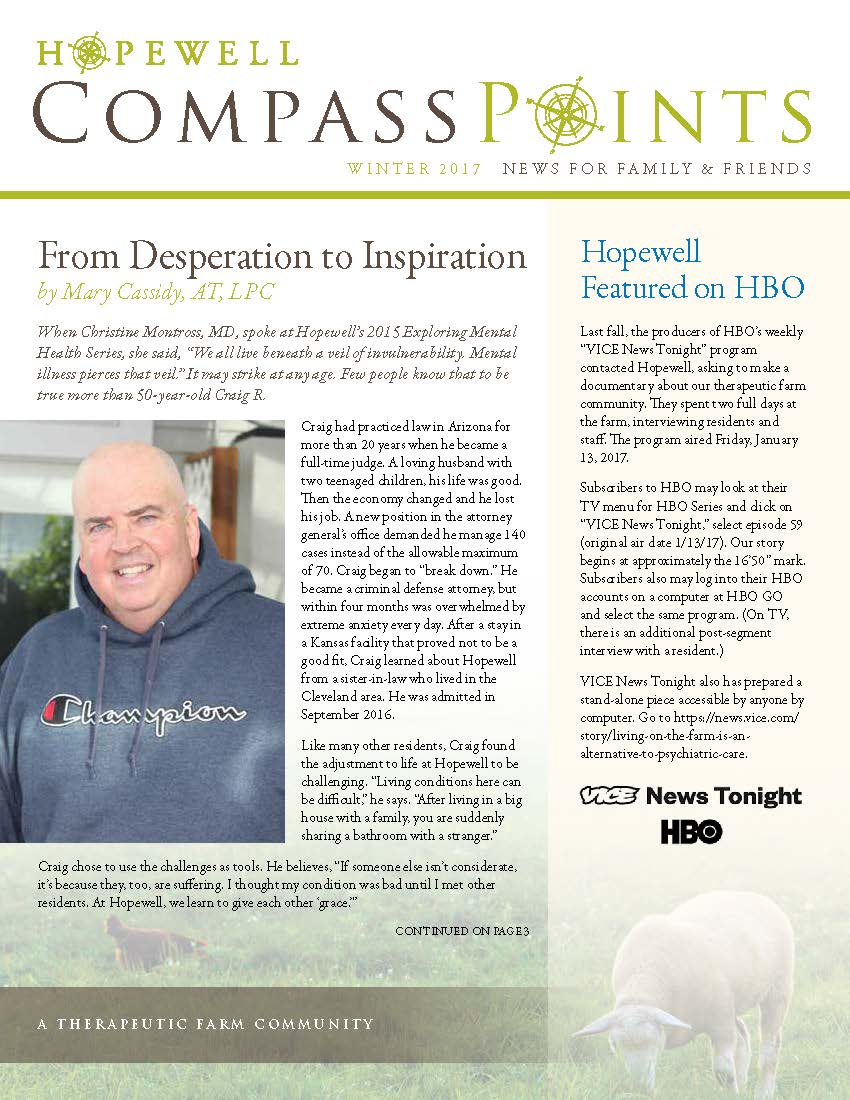
Winter 2017: From Desperation to Inspiration

When Christine Montross, MD, spoke at Hopewell’s 2015 Exploring Mental Health Series, she said, “We all live beneath a veil of vulnerability. Mental illness pierces that veil.” It may strike at any age. Few people know that to be true more than 50-year-old Craig R.

Craig had practiced law in Arizona for more than 20 years when he became a full-time judge. . .

Hopewell’s Lyman House Teaches Independent Living Through Enhanced Transitional Program

Mesopotamia, Ohio (February 14, 2017) Hopewell offers an enhanced transitional program to persons with mental illness when they are ready to advance to independent living.

“Lyman House is Hopewell’s family home open to individuals wanting to practice their skills of independent living before returning to their home and the community where they live,” said Rick Karges, Hopewell’s Executive Director. “While the program has served our residents well, we have adapted and enhanced our transitional program to include others who are not Hopewell graduates, but meet certain criteria.”

At Lyman House, residents manage their own shopping and cooking, housework, etc., and are assisted to find employment, volunteer or attend school. While at Lyman House, they continue to access Hopewell’s clinical services. “Hopewell recognizes the need to provide support for individuals with mental illness as they transition to more independent living situations outside of our therapeutic community,” Karges continued.

In 2012, the Board of Directors approved the purchase of a century home on nearby Mesopotamia Commons. Additional funds were raised to complete extensive renovations, and by late 2013 the Lyman House opened as Hopewell’s adult family home. Licensed for up to five adults, this therapeutic community living option provides an opportunity for individuals to “practice” the skills of independent living before they venture into apartments, jobs, etc. entirely on their own and independent from a mental health facility.

Individuals living at Lyman House are supervised only part of each day. During those times, the Lyman House manager oversees their training and practice in menu planning, food shopping, cooking, money management and self-management of medication. Lyman House residents may participate in Hopewell’s regular programming and are involved in the broader community through part-time employment, volunteering or continuing education.

Generous funding from The Margaret Clark Morgan Foundation helps ensure the residents of Lyman House:

  • Will be employed, attending school or engaged in significant meaningful activity outside Lyman House at least 20 hours per week within six months of moving into the family home; and
  • Will demonstrate 75% increase of independence in three life skill areas.

“Hopewell has the ability to rotate as many as 15 individuals through our transitional program each year,” said Karges. “Waiting times to reside at Lyman House are typically less than 60 days before a room becomes available.”

About Hopewell

Hopewell is a 300-acre residential working farm located in Mesopotamia, Ohio, where adults with schizophrenia, bipolar disorder and major depression learn to manage their mental illness and return to independent life. Hopewell is the only therapeutic farm community in Ohio. It is ODMHAS-licensed and CARF-accredited. Hopewell is a member of National Alliance on Mental Illness and the American Residential Treatment Association. Information and assessments are available by contacting Laura Scarnecchia, clinician/admissions coordinator at 440.426.2009. Visit www.hopewellcommunity.org

Joint Statement by Frederick J. Frese, Ph.D. and Richard R. Karges, LISW-S, ACSW Regarding Passage of HR 2646: The Helping Families in Mental Health Crisis Act

The following is a joint statement from Frederick J. Frese, Ph.D and Richard R. Karges, LISW-S, ACSW, CEO of Hopewell

Mesopotamia, Ohio (January 4, 2017). We celebrate the president’s signing into law The 21st Century Cures Act, which incorporates H. R. 2646, the Helping Families in Mental Health Crisis Act, initiated by Representative Tim Murphy (R.-PA-18). This act has been called the most transformative mental health law since John F. Kennedy was president and is long overdue.

Recent tragedies have opened our eyes to the fact we are in the midst of a mental health crisis in the United States. Our largest populations of persons with mental illness are no longer mental hospitals, but are now in prisons, because we have criminalized mental illness. We lack many hundreds of thousands of psychiatric beds. There are more than 350,000 deaths in the U.S. each year related to mental illness, over 43 thousand of these being suicides. Over 11 million individuals in this country live with schizophrenia, bipolar disorder or major depression with psychosis.

Many more seriously mentally ill persons will now be able to receive care before their illnesses spiral into crisis. Data collected to help the mental health community will provide new hope. Assisted outpatient treatment efforts will now help many more individuals who otherwise may have never realized they needed help.

This new law establishes for the first time an assistant secretary for mental health and substance use disorders for the Department of Health and Human Services. This is a giant step forward. We will be able to invest in services for the most difficult-to-treat cases and ensure that families are part of the care-delivery team.

Further, our law enforcement officers and other first responders will be better prepared to respond to abnormal or potentially intense situations or behaviors.

While we know that a single law is not a panacea, we are encouraged that the future will be much better for those many families who have suffered in silence because the stigma of mental illness was so profound. This new law will help millions who need assistance which has not been readily available previously.

Thank you, Representative Tim Murphy and President Obama.

About the Authors

Frederick J. Frese, Ph.D. is a psychologist who has specialized in the area of schizophrenia for over 40 years. Dr. Mike Hogan, Chair of the President’s New Freedom Commission that is revolutionizing the delivery of mental health services in the United States has called Fred “a national treasure.” Dr. Frese is a founding board member of the National Treatment Advocacy Center which provided significant input to Representative Murphy during the four years he spent crafting and steering this important legislation through Congress.

Richard R. Karges, LISW-S, ACSW is Executive Director/CEO of Hopewell, a residential therapeutic farm community serving adults with serious mental illness. Hopewell is located in Mesopotamia, Ohio.

About Hopewell

Hopewell is a 300-acre residential working farm located in Mesopotamia, Ohio, where adults with schizophrenia, bipolar disorder and major depression learn to manage their mental illness and return to independent life. Hopewell is the only therapeutic farm community in Ohio. It is ODMHAS-licensed and CARF-accredited. Hopewell is a member of National Alliance on Mental Illness and the American Residential Treatment Association. Information and assessments are available by contacting Laura Scarnecchia, clinician/admissions coordinator at 440.426.2009. Visit www.hopewellcommunity.org

2016 Annual Report

Throughout the year, Hopewell celebrated its first 20 years of service to adults with mental illness.

DONATE