Close

Who We Are

Strategic Plan

Board of Directors

Staff

Annual Reports

Overview

Transition Services

Sample Daily Schedule

Facilities Tour

Overview

Measuring Success

Success Stories

For Caregivers

For Professionals

Fees for Service

Apply

Corporate Partners

Planned Giving

Donate

Wishing Well

Exploring Mental Health

Summer Solstice 2026

Reliving Suicidal Thoughts, and How I Found Help: Paul Keane

WHITE RIVER JUNCTION, Vermont — The pronoun “I” saved my life in 1973. It was long before PTSD (post-traumatic stress disorder) had been discovered by psychiatrists.

I had called the emergency room at Yale New Haven Hospital and said I was afraid I was going to end my life. They transferred me to a young doctor in psychiatry who introduced himself as “Danny Begel.” I confessed to him over the phone that I was despondent, and he suggested I come to the emergency room. “I’ll be waiting for you,” he said.

If he had said, “We’ll be waiting for you” or, “They will be waiting for you,” it would have had an entirely different impact. It would have sounded impersonal, institutional.

But the person saying, “I’ll be waiting for you” had just listened to me spill my guts out about wanting to end it all, and although it might have been inaccurate, I felt that the personal pronoun in, “I’ll be waiting for you” meant he personally had been affected by my pain.

I drove my little VW bug from my parents’ home in Mt. Carmel the nine miles down Whitney Avenue to Yale New Haven’s emergency room, tightly holding the steering wheel with both hands so I wouldn’t direct the car into the Merritt Parkway bridge abutment in Hamden or some other immovable object.

I later learned I was having “suicidal ideation,” a fancy term for repeated thoughts I couldn’t get rid of that I would be better off dead.

Long story short: PTSD hadn’t even been discovered as a mental illness in 1973 when I was in my third year of dealing with images of the killings at Kent State University, which I had witnessed as a grad student.

It never occurred to anyone that that kind of unexpected violent bloodshed might disturb the emotions of those who saw it and its gruesome aftermath.

Plus, I made the mistake of remaining at Kent State for three more years while the facts of the shootings were debated and manipulated politically. That hadn’t helped my emotions one bit, either.

Hence the phone call to Yale New Haven Hospital emergency room from my parents’ Mt. Carmel home in 1973.

Forty-five years went by with many ups and downs, but never again a down-so-far that I wanted to end it all. Then, in the year 2018, the invention of the internet allowed me to say a long overdue “Thank you,” 45 years later.

I typed in the name of that psychiatrist and discovered he was still alive and practicing in a different part of the country. I hadn’t spoken to him since he received me personally at the E.R. in 1973, keeping his promise that he would be there “waiting for me.”

I emailed him and told him the story of his life-saving “I.” He remembered the event and was amazed that his pronoun choice had literally saved my life.

At age 77, I want to leave a legacy for those who suffer anxiety and depression. So I have decided to share this story publicly for the first time, for anyone thinking life isn’t worth living.

Almost 50 years have gone by since a shrink taught me that my pain was worthwhile. Yours is, too.

Paul Keane, who attended graduate school at Kent State University, is a retired Vermont English teacher. This was written for The Plain Dealer and cleveland.com.


Hopewell Testimonials

Hopewell is a therapeutic community for people suffering from mental illness. Set on a working farm with barns, animals, fields, pastures, meadows, and a deep and rich forest. We help our residents through the healing power of nature; through meaningful work on the farm and elsewhere; through our therapeutic commiunity and folks supporting one another; and through all kinds of clinical engagement with our residents.

All of these tools are used to help our residents thrive and become capable of living the most independent life outside of Hopewell they can.

Listen to former resident’s album!

Check out former Hopewell resident’s album Manic Impressions: The fine art of being Mentally Ill featuring a Tribute to Hopewell.

Tuning In

“I’ve been in over thirty mental health and lockdown facilities over the last twenty years and I can honestly say that Hopewell was a beacon of light compared to all of the others.”

Evan Curtin discovered Hopewell in 2012, after a long road of mental health challenges. He grew up in Springfield, Ohio, graduating from Shawnee High School in 1995. He studied landscape architecture for two years at The Ohio State University, but started to experience signs of depression. After a suicide attempt in 1997, Evan took a break from OSU.

It was difficult for Evan to be on his own. A friend recommended the Bureau of Vocational Rehabilitation and with their financial help, Evan was able to graduate from Wright State University in 2001 with a Bachelor of Arts in Psychology.

The post-college years were rough. “I had some issues and run-ins with the law and some homelessness down in Florida for about a year,” Evan said. “I am now able to sit still and be okay, not always needing that empty euphoria I used to crave. I still keep relatively busy and write music to fill most of my time.”

Besides his love of music, he volunteers at the Clark State Police Academy and is involved with the Crisis Intervention Team (CIT). Evan said, “I talk to cadets so they can find a better approach to deal with the mentally ill, and so they can also see someone who lives successfully with mental illness.”

Evan, his wife Angie, and their cat, Boston, live in Springfield. He plays guitar, harmonica and sings around town. His music can be found at www.heavymentalmusings.org and www.jamminbible.com. His favorite song is one he wrote about Hopewell (see inset for a few lines from the song).

When asked about his stay at Hopewell, Evan said, “I was thinking back upon my stay there and was telling my wife about what it meant to me and all the wonderful memories I had; I don’t believe I have a single negative memory of my stay there. It taught me how to be still, and that is a very valuable asset to have.”

Cleveland’s Basquiat?

by Langston Wesley and Peggy Barnes Szpatura

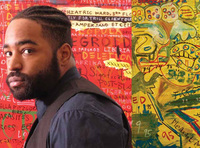
In April 2012, Langston Wesley came to Hopewell. Valedictorian of his high school class in Chicago, he had been awarded a scholarship to Stanford University. Episodes of manic behavior escalated during his junior year, and he had to drop out. When he could not stop running through the subways of Chicago wearing a Batman mask, “fighting crime,” he was hospitalized for 31 days. It was then his mother learned about Hopewell.

Langston says, “My mom helped me a lot through traumatic experiences. I’m glad she found Hopewell for me. First thing I remember about coming to Hopewell was the grounds. I thought that space could help me free my mind and my spirit.”

First admitted to Hopewell in April 2012 with a diagnosis of schizophrenia, Langston did well and remained at Hopewell until September 2013. He was readmitted in June 2015, this time with a diagnosis of schizoaffective disorder, bipolar type. He transitioned to independent living in September 2015.

Since then, Langston has lived independently in Cleveland, Ohio. He is working hard, preparing for the first major exhibition of his works as a professional artist. James Corcoran, owner of Corcoran Fine Arts, one of the region’s most prestigious galleries, says, “Langston is the first living Cleveland artist I have shown in 20 years. His work is particularly interesting and meritorious. I wanted to be the one to give him his break.”

By age four, Langston already was working in acrylics. By 4th grade, he was winning art contests. By high school, though, his interests were elsewhere. It was not until he came to Hopewell that his love of creating art was rekindled. When he walked into the Art Room, he felt “at home again.”

“At Hopewell, painting was a means for catharsis for me,” he remembers. He could devote as much time as he wanted to reconnect with and exploring his talent. After his time at Hopewell, he continued to paint, developing his technique and devoting himself ever more strongly to his work.

Like his favorite artist, Jean-Michel Basquiat, Langston Wesley’s pieces often contain autobiographical information along with text and images, codes, numbers, symbols, abstraction, historical references and reflections on current social, political, religious or cultural trends. Also like Basquiat’s works, they often resemble graffiti, fused with evocative images in beautiful colors. They depart from Basquiat in their compelling juxtapositions and personal expressions that are unique to Langston’s “catharsis.”

Langston was born in 1988. (That number appears in his paintings.) It was also in 1988 that Jean-Michel Basquiat died, at age 27. A Basquiat exhibition was on view at the Cleveland Museum of Art January through April 2017. By coincidence, an exhibition entitled “New Directions: Langston Wesley” opened a short distance away, from March through May at Corcoran Fine Arts. One of the pieces for sale in the exhibition was a multi-media collage that was created by Langston while at Hopewell.

When asked to comment on his stay at Hopewell, Langston responded:

“When I got to Hopewell, my life was in shambles. Almost five years later, I’m making headway, doing things I never thought I could do.

Mental illness is a very difficult circumstance. It is often misdiagnosed and almost always misunderstood. I have been hospitalized about a million times and given about a million prescribed medications. It makes you feel like a lab rat. Now I take only one medication, and I live on my own.

I want to tell people out there who are going through things with their mental health, and their loved ones, that there really is a way out. I had to advocate for myself and communicate about my problems. Ultimately, I became the greatest factor in eliminating my symptoms.”

Hopewell helped Langston re-find the tools he needed to take control of his life and to pursue a fulfilling career. He shares his name with Langston Hughes (1902-1967), the great American poet, activist, novelist and playwright from Cleveland, who wrote, “An artist must be free to choose what he does, certainly, but he must also never be afraid to do what he might choose.” At Hopewell, everyone is encouraged to believe in and work toward their highest potential.

(Of special note: James Corcoran has been a friend of Hopewell for many years. In fact, he has staged the silent auction for Summer Solstice! Corcoran Fine Arts is located at 12610 Larchmere Boulevard, Cleveland, OH 44120, just off Shaker Square. Visit www.corcoranfinearts.com. A portion of the gallery’s proceeds from Langston’s exhibition benefitted Hopewell.)

Resident Writing Feature – I Told You So!

Residents at Hopewell are encouraged to heal and grow in ways that work best for them. One of the outlets available is a therapeutic writing group. A number of residents gather together, draw prompts, and express themselves through verse. We are excited to showcase some of the talent and creativity that is shown in this group.

Prompt in writing group: The most amazing thing just happened! And you can finally say “I told you so!” It feels good to be right, but even better to experience that magical thing that they said couldn’t be done. Describe this experience…..

It started with getting up for early morning work groups and breakfast. Each and every day I got up for breakfast and went. I would go to breakfast and meet people I have never met before. I would converse openly with them and discuss not only my problems but their problems as well. After breakfast I would then ready myself for work crew.

Work crew is a new experience. Each morning I would head to the barn to clean stables, give hay to the horses, clean up poop and take care of the animals. It was very therapeutic for complete a job. Even though the barn was damp and dark there was a comraderie amongst the four men that were in the work crew. We all worked together today. Cleaning the stalls, prepping food for the horses. Feeding the chickens. Finally we loaded up the truck with recyclable material and took it to where it can be recycled.

Afterwards, although I was sad because I feel that my life has spiraled out of control and all I could think about was my two boys, I did do something productive.

Then each day I was able to make it to lunch and participate. I made it to all afternoon groups that I could and participated as best I could. I tried to learn all I could in the time that was provided.

Every evening I would make it to dinner. I would sit down and enjoy a meal with my colleagues. I never slept through a breakfast, lunch, dinner, or group session.

Pretty soon the place began to grow on me. I was achieving success after success. Outside factors were beginning to take care of themselves one by one. I was able to focus on myself and try to get better. My depression began to life. I felt a lot less like crying. I felt a lot less that the time away from my boys was the end of the world.

I began to see how my own positive approach could life me out of my depression. I began to see that it was just not just one thing that made me so depressed but that it was several.

Little by little I began to feel like my old self again. No one could have believe with my attitude when I got here that I would be able to recover from depression. But with hard work I was finally able to say: “I told you so!”

-Anonymous

From Hopewell with Light and Love

Enriching and adventurous was my four month experience at the farm and cottages of Hopewell, Ohio. Open fields, wooded trails, and quite an active farm. Waking up, you join the others for a community breakfast, which is always enjoyable because there is live morning music and songs to wake the day. From there, you choose your duties and head off for the day. I chose to work at the farm because of the animals, multiple tasks, and how the work would change up day by day. I chose to work at the farm, but there are numerous other assignments within Hopewell that a person can sign up for.

The farm is really neat and special. It’s up to us to take care of these animals, these little lives. When I was there, there were chickens, turkeys, sheep, pigs, cows in the fields, and three very healthy horses. It was up to us to feed, clean, refresh hay, get them their water, sweep out the barn, repair any fences, and sometimes adjust and work on the chickens’ sun shade “huts.” One of the main daily tasks was collecting the chicken eggs from the chickens in the coop. Then to the kitchen where we would wash the eggs and put them in their crates. We had baby chickies while I was there, and we had to keep them warm and protected with an incubator.

Farm work is very satisfying, because of the animals and working together as a team- and you get a daily experience of the fruits of your labor. The daily routine was very beneficial to me and kept me looking forward to each day. The surroundings are particularly beautiful: open fields and pastures, rolling hills, encompassed by woods. After work, we would go into town to a wonderful Amish country store and get something to drink and a snack. On certain days we would take the pickup to the feed store to load up all the feed for the animals. Working the farm is challenging and fulfilling, with new surprises each day. Overall, all the duties at Hopewell are rewarding and purposeful.

After I left Hopewell, I moved back to Florida and began writing. It came slowly at first, but now I have published my first book of poetry. Hopewell helped me so much to harness and focus my energy, and I used these skills to focus on writing. It is poetry for star travelers and vagabonds. If you would like to check it out, I would be most grateful. You can find it on Amazon.com, you can access it here, or search Cosmic Poetry and look for Matt Sauls.

The staff and mentors I found at Hopewell were truly excellent and really left an impression on me. The quality of communication and care exceeded my expectations. They really are a great group of guides, caretakers, and they are truly engaged with the residents. Add to that a great group of college-age volunteers who are top-notch. My experience at Hopewell left me healthy, capable, and enhanced. I owe Hopewell a great honor, for I know they have helped many, many people find their purpose and direction. I am so grateful I found Hopewell, and that there are people like this in this world – those who sacrifice so much to help other people. Hopewell helped me chart my course, and my experience there still inspires me.

Matt Sauls

Diagnosed Bipolar/affective 2001

Former Benedictine monk

Hopewell resident July-October 2013

Resident Artwork Spotlight – Alex

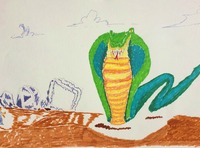
Alex is a delightful member of our Hopewell community. He is an accomplished pianist and has a variety of artistic skills. Alex enjoys attending morning work crews in the art room, making wares for our Farm Market. He also regularly attends our afternoon open studio and weekly art therapy group. Alex says that he likes working most in pencil. Alex also enjoys occasionally utilizing paint brushes. His main palette consists of greens, beiges, teals, and some yellows. Art has had a significant impact in Alex’s life. It helps clear his mind and think clearly. “Art helps me rest in the knowledge that things have a beginning and an end,” he shares. It also provides an illumination of “in the moment” for Alex, a space free of outside noise and distraction. Alex also enjoys incorporating other interests into his art work. “There’s music, and then there’s animals. Technology stuff, buildings, cars and planes, they all fit in.” Alex demonstrates how art brings together different facets of his life to create harmony.

Alex shares that he’s learned a lot of new skills in the art studio at Hopewell. He’s thoroughly enjoyed learning how to make jewelry. He also spends time creating clay chess pieces. Alex believes that making art has helped him to breathe and relax in the present. He looks forward to contributing more to art at Hopewell.

Today we are highlighting just a few of Alex’s favorite pieces that feature a snake, alligator, turtle, farm life, clay chess pieces, and a contemporary piece name harmony. Thank you for taking the time to allow us to highlight some of the great artwork that is created everyday as part of the therapeutic process.

Resident Writing Feature – Bill Sears

Residents at Hopewell are encouraged to heal and grow in ways that work best for them. One of the outlets available is a therapeutic writing group. A number of residents gather together, draw prompts, and express themselves through verse. We are excited to showcase some of the talent and creativity that is shown in this group.

Today’s resident writing feature is by Bill Sears. His prompt was “Your inner parent is about to ground your inner child.”

I relapsed in behavior when I came to Hopewell. I had already fallen to relapse in my addiction but old behaviors began to crop up. Before my break in Memphis, I lived in relative peace but was hardly functional. I was no longer attention seeking, no longer driven by my fears, but was still grandiose in my image of myself.

The inner parent in me tells me to find peace with everything and do only good. Find peace with attention, have no fear of what I can’t control. Find peace with the fact that I’m not a savior to the world.

My child self is restless. He calls for action and resolve for every living being and equal treatment of all things.

One side calls for action towards this in my life, the other calls for the resolve of internal struggle. Peace with pain outside my control. A choice. Why is one set of values and rhetoric superior to another? Equality. Peace. Peace is the only thing outside of rhetoric.

To be a peaceful warrior. A warrior for peace. To fight against mental illness and all that is wrong. To resolve and let go. To give up and find peace.

A choice.

“Takin’ Care of Business”

No one wants to think of traumatic brain injury, especially when it impacts a brilliant young man in his early 20s.

In a heartbeat, a tragic automobile accident forever changed the life of Bill G. After many years and treatment at other facilities, Bill came to Hopewell ten years ago. He is part of our Extended Stay Program. Last month he celebrated his 64th birthday. And he celebrated his third month as an employee at the Wal-Mart store in Middlefield.

Bill often uses song lyrics to frame his comments and observations. Today, one of his theme songs is the Bachman-Turner Overdrive hit, “Takin’ Care of Business.” But in Bill’s version the chorus is, “Takin’ care of business every day, takin’ care of business any way.” Whether working at Wal-Mart or as part of the farm crew at Hopewell, Bill rises to every occasion. He takes his work seriously and enjoys the personal, emotional rewards of being part of a work place and part of a community.

Since his arrival at Hopewell, Bill has enjoyed working on the farm crew. He says he has learned a great deal from our Farm Manager, Norman Wengerd, and Farm Crew Leader, Bruce McAllester. But recently it became important to Bill to in his words “pay my own way” (although he is not personally responsible for any of his Hopewell fees). To gain the readiness he would need to work outside the farm, Bill took part in a training program last summer. He held a temporary job at a grocery store in Champion, Ohio. Each day he worked, he was observed by a job coach who assessed his skills and capacity to assume a permanent job.

In November, he was hired by Wal-Mart as a seasonal helper. It didn’t take long for Wal-Mart management to appreciate Bill’s bright smile, outgoing personality and conscientious work ethic. He now works 20 to 25 hours per week, primarily gathering the shopping carts. Hopewell staff provide his transportation, but Bill is “takin’ care of business” independently while he is at his job.

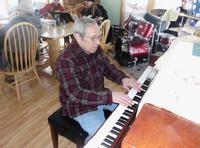
Music means more to Bill than song titles. He began learning to play the piano while in kindergarten. His family donated the funds that allowed Hopewell to purchase the piano Bill plays as a member of the Hopewell Band. (He is proud that his skills may be heard on the band’s recent recordings.)

Bill is also a member of the Resident Council. Council members gather information from their peers in order to decide what field trips to take, provide input about program changes, and assist with conflict resolution. The Resident Council empowers Hopewell residents and ensures they know they have a voice in their community. In order to be eligible to sit on the Council, a resident must have at least a 90 percent participation level in all program activities. Bill is usually at 100 percent participation.

Robert Weirich, Hopewell’s Education Program Coordinator, has been assisting Bill with an online self-publishing application. Bill’s goal is to complete and publish a book of his own acrostic-style poetry. Bob reports, Bill is a very talented and compassionate man. He is always seeking to do the best at whatever he does. It has been a pleasure playing in the Hopewell Band with him. Very often, he will “blow us away” with a blistering hot solo on the piano.

Lastly, Bill is a wonderful role model for others. It has been an honor and a pleasure to work with such a fine gentleman. So if you happen to stop at the Middlefield Wal-Mart, drop by the farm when eggs are being gathered, or catch a rehearsal of the Hopewell Band, be sure to say hello to Bill G. He’ll be there, “takin’ care of business” – his special way.

DONATE