Close

Who We Are

Strategic Plan

Board of Directors

Staff

Annual Reports

Overview

Transition Services

Sample Daily Schedule

Facilities Tour

Overview

Measuring Success

Success Stories

For Caregivers

For Professionals

Fees for Service

Apply

Corporate Partners

Planned Giving

Donate

Wishing Well

Exploring Mental Health

Summer Solstice 2026

What is Sandplay Therapy?

By Candace Carlton, LISW-S, RSP, Quality Improvement & Compliance Director, Clinician

Sandplay is rooted in Jungian psychology that emphasizes the importance of the unconscious mind. C. J. Jung said, “Often the hands will solve a mystery that the intellect has struggled with in vain.”

I was introduced to Sandplay by Dr. Sana Loue when she was engaged in research projects at Hopewell. I was drawn to it after attending a weeklong workshop/seminar where case presentations showed how children and adults healed their trauma through work in the sand over a series of therapy sessions. I was also drawn to the creative process with the miniatures, objects and sand trays.

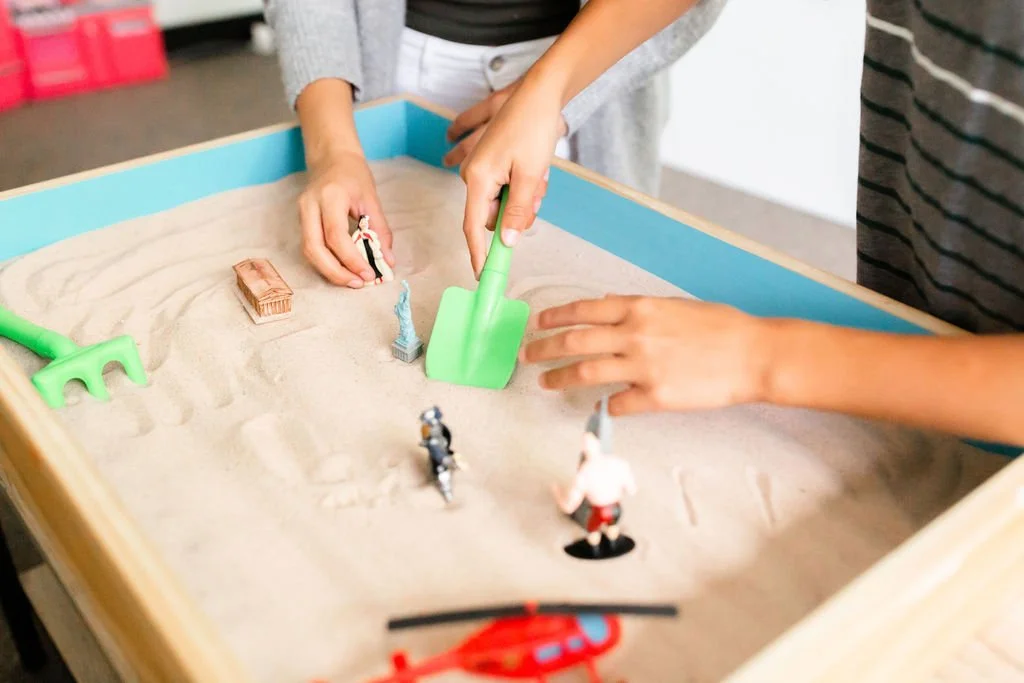
Sandplay Therapy is a non-verbal, non-directed, form of expressive art and creative process using a sand tray to create a picture or story in the sand. The client may pick from either a wet tray to add water to mold or shape the sand if they would like or they may use a dry tray. The client may use a variety of miniatures that include everything from animals, mythical creatures, houses, transportation vehicles, airplanes, cars, and trucks. They may also add items in the collections including trees, flowers, stones, crystals, plants and much more. See the photo for a sample sand tray in which the blue bottom represents water and the unconscious. This sand tray shows going into the blue (unconscious) and hopefully bringing healing to consciousness.

While the client is creating in the sand tray, the clinician holds the “free and protected space” for the client, a term used by Dora Kalff, who developed Sandplay Therapy. After the client has finished, the clinician will ask what they want to share and if they want to give the tray a title. The client shares what they want to about their creation.

Benefits of Sandplay Therapy are many. Clients have shared that the process of creating in the sand tray helps them to feel grounded and calm, sort out thoughts and feelings, let go, vent anger, grieve a variety of losses and integrate and heal trauma.

I have seen Hopewell residents heal in the process of sandplay including integrating and healing from trauma, feeling empowered about important decisions and meeting goals, feeling grounded after feeling anxiety and grieving loss of family members and friends. Sandplay Therapy is an important tool because a client may not be able to put into words their trauma or issues, but a picture may tell a story and help them heal.

A Letter from a Behavioral Health Professional who Found their Working Family

Dear Reader,

Like any family dynamic, you have your ups and you have your downs. What distinguishes functionality is how the members react to those situations. When you are at 10%, you hope your family can supplement the other 90%; just as if you are at 100%, the hope is you support others through those situations. This concept can be applied to any organization and working team. Organizations may experience things like not meeting quarterly goals, unexpected turnover, and may have disagreements over policy changes, but how the team handles these hurdles defines a good organization.

When you work in a supportive working environment there is no hesitation to maintain transparency or ask for help. It just comes naturally. When there is a problem, you feel comfortable approaching your leadership for guidance or leaning on coworkers to problem-solve.

According to the Pew Research Center, as of March 2023, 49% of Americans stated they were satisfied with their jobs*, which means that more than half of the country is not content with their current occupation. So it begs the question, why? For some, it’s financial reasons, for others it’s workplace toxicity or work-life balance, and for some it’s not finding meaning in their work.

A good program will do its best to implement systems that address these issues, starting with leadership. Dr. Christian Peonsgen shared a diagram of a concept called Servant Leadership where it takes the traditional leadership hierarchy and flips it upside down

[image:1]

Good programs will incentivize loyalty with appreciation of employees’ dedication and hard work through things like bonuses, raises, and solid benefit packages, and they will do their best to meet market value regarding their salary. Your morals and ethics will never feel compromised from organizational decisions. A good program will actively listen to employees’ concerns and prioritize their needs to ensure they are met. When these needs are not met, an individual may be engrossed in a toxic workplace environment. Moreover, when they are not appreciated or respected by their team it can leave lasting trauma and lead to turnover.

When applying these concepts to the behavioral health field specifically, it is even more crucial for organizations to excel at caring for their staff. The behavioral health field is physically and emotionally demanding where the demand of services greatly outweighs the supply of treatment professionals. Often employment requires long hours, unsustainable caseloads, high pressure work environments, and a wage that does not fairly reflect the amount of work needed. Employees will work with individuals struggling with their mental and physical wellbeing while also struggling with their own. This begs the next question: why do folks do it? The simple answer is humanity. As Albert Einstein said, “Only a life lived in service to others is worth living.”

For some, the need and drive to help others overrides all else and is intrinsic. This is the case especially if those individuals are a part of vulnerable populations who have not been given the same chances and opportunities, whether in poverty, the young, the mature adult, the cognitively impaired, the mentally ill, the physically disabled, or the neurodivergent. They often make for the most complex and difficult cases. If it is natural for behavioral health professionals to provide this genuine care given some of these barriers, it should be natural for organizations, whether a facility, hospital, residential treatment center, outpatient counseling center, or other, to ensure they do their best in fostering quality care to those same employees. It is reflective of the care the organization provides their patients and clients.

Upon reflecting on my own work environment, I am certain I have found my working family, and I work for the best program and most incredible team. Everyone involved, staff and residents alike, receives the same genuine care and respect, and it can be seen day to day. Hopewell is not just a treatment program for residents, it’s a transformative holistic healing experience for staff included. You believe in the mission, you see the vision, and you resonate with the core values. The support of our team outweighs any hurdles, and that instilled intrinsic feeling of meaning drives you to do all you can to get individuals struggling with mental health the care they need and deserve. Meaningful work and community are fundamental to Hopewell’s therapeutic treatment. They are also fundamental to a good program.

Hopewell puts these values into practice by ensuring our basic needs are met from good benefits so we can maintain our own health and wellbeing, they encourage you to take your hard earned PTO, they offer options of flex time for working longer hours, they do their best to balance caseloads so clinicians can maintain individualized client centered care, they create committees for our ideas to not only be heard but put into changeable actions, they provide training and opportunities for professional growth to give us the tools for success, and they show appreciation in fair wages and celebrations. They invest in you, so you invest in them. That is what a good program can do for you, and I hope above all else you find your working family because when you do, you’ll know it.

Sincerest regards from Hopewell Farm,

Rachel McDonald

Sources:

*Pew Research Center: How Americans View Their Jobs | Pew Research Center

** Servant Leadership Diagram: https://www.linkedin.com/posts/christianpoensgen_great-leaders-dont-command-but-serve-activity-7288541128520257536-ctzu?utm_source=share&utm_medium=member_desktop&rcm=ACoAACBK3K8BahP7hY7KGbEA7SDP_-JzMFgr-7g
Artist in Residence

Dana Langenbrunner, a former Hopewell resident, returned to Hopewell as a Visiting Artist to lead a 3-day workshop for staff and residents. Her workshop centered around the theme of empowerment – participants engaged in meaningful discussions about empowerment and learned how to create books. Dana joined morning art crews and spent time getting to know new residents and catching up with staff members during her visit.

Dana is a Cincinnati artist, mental health advocate, and peer recovery coach. Her passion for art came at a young age to cope with her own mental health issues, including depression, anxiety, bipolar disorder and trauma. She has a Bachelor’s Degree in Fine Arts with a concentration in Art Therapy through Mount Saint Joseph University.

Dana uses art day-to-day to help others struggling with mental illness and addiction through various organizations in Cincinnati. She volunteers weekly with Women of Alabaster, a home for women working to free themselves from sex trafficking, and Art for All People, a ministry aimed at providing art classes and materials to those trying to reach recovery from addiction and mental illness. Additionally, Dana is the founding Director of Programming at Madi’s House, a non-residential relapse prevention and mental health community center in Cincinnati.

On the Fourth, A Renewed Commitment

On the Fourth of July we celebrate the concept that all people are created equal. This is an insight that would have emerged much more slowly had its earlier, more narrow formulation not first occurred in our Declaration of Independence.

Thus it is fitting that today, as Hopewell’s new leader, I publish one of my leadership priorities, about equality.

Statement of Renewed Commitment

Hopewell is a therapeutic community. Our model has always rejected oppressive mental health practices, and striven to administer holistic, person-centered care and support. Since our inception almost 25 years ago, the foundation of our work has centered on the healing and transformative power of community. We know healing does not occur in a vacuum. It does not occur in isolation. When we heal, we heal together. We can attest to the power of community in the lives of our residents, families, staff, and partners over these last two decades.

But we also acknowledge we are part of a larger community where Black people continue to be oppressed and brutalized, and where racism, health disparities, and direct violence are not rare. As an organization that serves the needs of others, we pledge to do more to address and rectify these injustices, and to uplift and serve others in need of healing and recovery.

To that end, today and moving forward, Hopewell pledges to:

  • Hold ourselves accountable to our values as an organization, particularly as they pertain to issues of racial justice and equality
  • Seek out, partner with, and support Black mental health organizations
  • Seek out, partner with, and support Black leaders and professionals in the mental health community
  • Review our practices and root out any elements of care that could be deemed racist or racially insensitive.
  • Provide resources, training, and education to our residents, staff, and wider network of professional support on diversity, equality, and racial justice

Amid this crisis, we are collectively learning that we are interconnected. If one of us is unwell, all of us are unwell. Building a healthy community depends on the whole of us being safe and healthy. We are committed to making Hopewell a community where Black lives matter.

Telehealth Communication

Last month a majority of mental health providers were suddenly thrust into the world of telehealth. If you were one of these practitioners, you have likely developed an opinion of working over video. My very unscientific polling of colleagues indicates people tend to be polarized into one camp or the other (love/hate). Telehealth is new for many, and one thing I know about new experiences is they tend to be uncomfortable. Having done my first telehealth session in 2013, I was somewhat prepared to jump into the environment, and yet not. I have never done telehealth within a residential facility, and never without new equipment in spaces set up specifically for this purpose. All new situations come with a learning curve and telehealth is an ever changing opportunity to learn.

Therapy can be somewhat uncomfortable for providers right now as we navigate a new world of helping people live through and manage the stress of a current traumatic situation that we ourselves are not sure how to navigate. We do not know how to do a pandemic. We are learning as we go, hopefully changing our process in a positive way.

Our friends at ideastream reported on a new study https://www.annfammed.org/content/18/3/272) identifying ways that practitioners can build stronger relationships over telehealth. (https://www.ideastream.org/news/new-study-suggests-ways-doctors-can-foster-relationships-through-telehealth)

Practitioners can work on developing their telehealth skills to improve their outcomes and experience with this modality. There are a ton of trainings right now related to this, but the best I’ve seen is here. (https://www.nicabm.com/improving-telehealth-sessions/ )

Telehealth provides new and exciting possibilities for reaching clients. We can create a new normal that allows us to remain connected while physically apart.

Another beautiful ideastream post about Hopewell

Come with us on a road trip, about an hour east of Cleveland, to a farm in the most rural section of Trumbull County. It sits amid Amish communities and land that has been tended by hand for generations. Watch now.

Summer Solstice 2019

Summer Solstice 2019 was held Friday, June 14, at a beautiful estate in Hunting Valley. Under a gorgeous sky, more than 500 guests sipped cocktails and enjoyed hor d’oeuvres and an elegant dinner prepared by Nosh Creative Catering.

Check out the photos at https://www.hopewellcommunity.org/events/summer-solstice-2019/photo-gallery

Our Friends at Active Minds Need YOUR Vote!

Active Minds, is a non-profit dedicated to creating a world where no person dies by suicide, and every person who struggles with their mental health gets the support he or she needs. As a leading voice in the mental health movement, Active Minds has been selected as one of 25 charities in the race to win $1,000,000 through the American Giving Awards presented by Chase.

We had the pleasure of meeting with the Active Minds leadership team in March at their home office in Washington D.C., and I have never met such an energetic, passionate and dedicated team of young people. Through their work, and with the help of over 350 chapters on college campuses across the country, Active Minds members have become the voice of young adult mental health advocacy nationwide.

Mental health issues are real, they impact all of us, and Active Minds is transforming the way society talks about these issues. Please join the Hopewell community in helping Active Minds win these much needed funds by liking the American Giving Awards presented by Chase Facebook page, voting for Active Minds, and then asking your friends and family to do the same! If you are a Chase customer you can also vote at www.chasegiving.com.

Active Minds needs votes. Voting is the week of Tuesday, November 27 – Tuesday, December 4. The grant will be awarded at a star-studded awards ceremony which will air on December 8th on NBC.

Find out more about Active Minds at www.activeminds.org VOTE at: bit.ly/voteAM

Voting has conculded. Thank you to all who particpated.

DONATE