Close

Who We Are

Strategic Plan

Board of Directors

Staff

Annual Reports

Overview

Transition Services

Sample Daily Schedule

Facilities Tour

Overview

Measuring Success

Success Stories

For Caregivers

For Professionals

Fees for Service

Apply

Corporate Partners

Planned Giving

Donate

Wishing Well

Exploring Mental Health

Summer Solstice 2026

Meet Savannah Schindelar, Admissions Coordinator

Hired in fall 2023, Savannah Schindelar began her career at Hopewell as a new member of the admissions team. She joined Tim Bitting (National Outreach Manager), Rachel MacDonald (Regional Outreach Manager), Daniel Horne (Clinical Director), Sarah Turner (Clinical Services Coordinator), and Acting Executive Director Colleen Welder.

The admissions team fields all incoming inquiries from families, prospective residents, and professional referrals. Tim and Rachel build relationships with mental health facilities, other mental health programs and counseling practices and handle most of the professional referrals. Savannah is often the first stop to help families and prospective residents determine whether they are a good fit to begin the application process.

Many families contact Hopewell when they are stressed and confused about next steps for their loved ones’ mental health journey. Savannah said, “Callers need some validation and reassurance and to feel like they have been heard. I can’t give clinical advice, but empathy is a huge part of initial relationship building.”

What motivates you to work with people with mental illness?

“Working at Hopewell provides the opportunity to do a little good in the world. I don’t believe that ultimate good can be achieved in one fell swoop – it takes a lot of tiny efforts,” Savannah observed. “I can help by suiting up and showing up for those with mental illness.”

Savannah’s Journey Begins

Savannah’s background in behavioral health began in 2019 when she was employed at Glenbeigh Hospital in Rock Creek, Ohio, an inpatient facility that treats adults with substance use disorder. “At Glenbeigh, I learned the boundaries of empathy and professionalism, keeping composure when clients are experiencing difficulties. When working with people in crisis, you need to navigate many strong emotions. That is much easier now,” she said.

A Chicago Detour

Life brought Savannah to Chicago in 2021. She found an Administrative Assistant and Intake Specialist position at Primary Care Psychology Associates (PCPA), which provides short-term Cognitive Behavioral Therapy (CBT) for adults and children. She did intake and billing, fielded inquiries, coordinated with the clinicians and ran the front of the ship.

Savannah also held a second job as a bouncer. “Security work made me more aware of potentially volatile situations and how to handle them, and I became more attentive to my surroundings. These experiences translated into my current role in behavioral health. I am more able to handle crises with a level of tact and poise,” she stated.

The most important thing Savannah found in Chicago was her partner, Louis, who hails from the North Island of New Zealand. She has since visited him in his home country for a month of travel and Louis has joined her in Ohio to meet her family. A spring trip to New Zealand is planned.

Back to Ohio and a New Start at Hopewell

Savannah returned to Ohio in 2023 and landed the brand-new position of Admissions Assistant at Hopewell and has since been upgraded to the Admissions Coordinator title. Interestingly, she is completely self-taught. “My experience, job opportunities, and teams I have worked with molded me to the professional I am,” she said. One of her dreams is to pursue professional development opportunities in hopes of becoming a licensed clinical psychologist with her own clients.

Because Hopewell is a working farm, Savannah has had opportunities to bring other life skills to work. While growing up on her family’s farm, she worked with lots of animals – goats, sheep, chickens, turkeys, and horses – and participated in 4H. “This past summer I helped staff wrangle a newborn calf off the field who had not eaten because her mom rejected her. I helped set up a feeding regimen and the calf made a full recovery.”

What does working at Hopewell mean to you?

Savannah related a poignant story about what working at Hopewell means to her. “A resident came to us from another facility where he had lived for several years. He looked beaten down. I did his intake, and I saw even upon admission how relieved he was to be joining a community. It’s immensely gratifying and fantastic to watch the progress he has made on his journey while at Hopewell. That impresses me a lot. We do something right here.”

She continued, “I am proud to be one small part in a greater machine that helps people get better. It takes a village, and I am happy to be part of this village.”

Ecotherapy: The Environmental Benefits of a Therapeutic Farm

By Cecelia Futch, LPCC-S, retired Hopewell clinician

What is Ecotherapy?

Ecotherapy, also known as Nature Therapy or Green Therapy, is the applied practice of the emerging field of ecopsychology, a concept first coined by Theodore Roszak in the 1990s. This therapeutic modality proves to be an effective approach of treatment for physical, mental and emotional health. At its core, Ecotherapy recognizes that humans have become increasingly isolated from nature, a contributing factor to the increase of various disorders and illnesses. Evidenced-based research has thus far supported the belief that as we renew our connection and involvement with natural environments, symptoms of mental illness are often reduced or sometimes eliminated, and a general sense of well-being is increased.

This fall Cecelia Futch will lead an exciting journey into “Ecotherapy in Clinical Practice,” a four-part virtual seminar with clinicians from Hopewell and Pasadena Villa.

Ecotherapy at Hopewell

Hopewell was established in 1993 as a therapeutic farm community for adults with serious mental illness. The guiding belief of its founder, Clara T. Rankin, is that nature, along with clinical engagement, a supportive community, and meaningful work combine to provide a holistic approach to help individuals live and function well in their communities once they are ready to leave Hopewell.

With its 325 acres of forest, meadows, streams, ponds, farmland and animals, Hopewell is especially suited to provide an intentional, focused Ecotherapy program for residents and staff alike. Research strongly indicates that some of the benefits of Ecotherapy include reduced stress, improved mood, increased ability to regulate one’s emotions, enhanced cognitive functioning, creative thinking and problem-solving skills, and more.

To give you an inkling of the positive benefits of providing Ecotherapy at Hopewell, consider the following: greenery and open spaces are known to lower cortisol levels thus reducing stress and anxiety; nature exposure increases our body’s natural production of serotonin thus improving mood and overall emotional well-being; nature sounds such as birds chirping, leaves rustling, and grasses blowing in the breeze have a calming effect; breathing the forest aerosol filled with organic compounds (such as tree phytoncides) reduces the symptoms of asthma and other pulmonary disorders, slows rapid heart rate, reduces blood pressure, and strengthens the immune system.

Interventions and Practical Applications

These are just some of the compelling reasons to incorporate Ecotherapy as a therapeutic modality at Hopewell. So, how does it work? Following are some of the Ecotherapy interventions that have been utilized with successful outcomes at Hopewell:

  • Walk & Talk Therapy: This is the most widely used intervention in the clinical practice of Ecotherapy everywhere. Clinicians at Hopewell are trained in a variety of modalities, all of which involve talk therapy to one degree or another. Taking talk therapy out of doors often helps clients clear their thoughts and explore issues that they are reluctant to bring up when sitting in the confines of the clinician’s office.

“Jon” presented with symptoms that were quite serious and interfered with his ability to function in his home community. Once established in the Hopewell community, Jon met with his clinician regularly for weeks but made little progress. One day his clinician invited him to join her on a nature walk, which he readily accepted. To the clinician’s surprise, Jon spontaneously began talking, first about his home life, but as they continued down the trail, he began to open up about his troubles. After that experience, the clinician and Jon met regularly for Walk & Talk sessions. As a result, Jon was able to creatively explore ways to achieve his goals of independent living, getting a job to support himself, and identifying support services he would need once he returned home.

  • Sit-Spot: Another cornerstone of Ecotherapy which is universally practiced is identifying and utilizing a sit-spot. Just as the name implies, a sit-spot is a place where the ecopractitioner regularly returns to sit, reflect, daydream, journal, or simply notice what is going on around them. The sit-spot becomes a place of refuge when one needs alone time. Early in a client’s Ecotherapy journey at Hopewell, the ecotherapist will help the client find one or two sit-spots which the client can make use of throughout their stay at Hopewell.

“Sandy” suffered with extreme anxiety and chronic depression, which led her to Hopewell. She had previously enjoyed sports and being outdoors, but in the grip of her illness she found it impossible to do things she once enjoyed. After assessing Sandy’s situation and reviewing her history, her clinician invited her to meet for outdoor counseling sessions. During their first Walk & Talk session, the clinician helped her find a sit-spot that provided a comforting, safe place. Over time the clinician noticed that Sandy would regularly retreat to her sit-spot to journal, reflect, or simply watch her surroundings. As Sandy neared the end of her stay at Hopewell, she exhibited increasing emotional stability and positive outlook for her future. When asked, she replied that the entire Hopewell experience helped her regain control of her life, and that having a sit-spot was a practice she would take with her when she was ready to discharge.

  • Horticulture: Horticulture therapy has been a well-established mental health intervention since the 1940s, and is perfect for the Hopewell farm community. Hopewell residents and staff participate in planting and growing food crops, which will be enjoyed by the community. Digging in dirt, growing plants in the greenhouses, vegetables and herbs outdoors, and engaging in the meaningful work of providing for the Hopewell community is shown to support mental health.

“Mike” was a self-described “city boy” who had never grown anything in his life. When he came to Hopewell, Mike recalled that he felt like a “fish out of water.” He balked when invited to help weed the vegetable garden, but he eventually, reluctantly gave in. Once in the garden, working alongside other residents and staff, however, Mike discovered the joy of “playing in the dirt.” The garden crew became his regular work assignment. Mike made remarkable progress during his time at Hopewell, and upon his return home, chose to continue horticulture therapy. Months later in an he sent to his clinician, Mike included pictures of the garden he planted and cared for in his back yard.

These Ecotherapy practices are just a few of the many ways residents and staff can connect with nature and reap innumerable health benefits, many of which are listed above. Sylvotherapy (Tree Therapy), Animal Assisted Therapy (Equine Therapy), EcoArt Therapy, and more, are used in the service of residents at the farm. Integrating nature, farm activities, clinical and community support provides a strong therapeutic and holistic approach to healing and wellness for the entire Hopewell farm community.

Meet Cecelia Futch, LPCC-S

Living in a tipi for four months at age 15 was a foundational experience that eventually led to Cecelia Futch, LPCC-S, becoming a credentialed ecotherapist. This fall she will lead an exciting journey into “Ecotherapy in Clinical Practice,” a four-part virtual seminar with clinicians from Hopewell and Pasadena Villa. Cecelia explained, “Ecotherapy refers to various methods of cultivating the health benefits of being in nature. My hope for the upcoming training is to instill in clinicians the confidence – based on empirical evidence, ongoing research, and personal experience – to incorporate Ecotherapy into their clinical practice as well as their daily lives.”

A Broad Counseling Background

During her lengthy career, Cecelia has counseled people with mental illness in a number of populations, including women with addiction disorders, low-income seniors, women in a prison release program, and adults and youth with HIV/AIDS. “I believe in a holistic approach that addresses the body, mind, and spirit, and I have traveled along that authentic pathway without regret,” she said.

One of Cecelia’s competencies, Cognitive Behavioral Therapy (CBT), addresses the belief that cognitive, behavioral, and emotional factors together influence actions, thoughts, and mood. She stated, “CBT teaches clients skills to change their thoughts such as affirmations, challenging thoughts, and emotional regulation, which helps them modify how they respond to difficult situations.”

Cecelia trained in Dialectical Behavior Therapy (DBT), which was developed to treat Borderline Personality Disorder. DBT helps people who engage in black-and-white thinking and who experience extreme emotional highs and lows. In this case, emotional regulation means accepting mood swings, that opposing emotions and thoughts are valid, and clients can learn to tolerate the discomfort.

Using Acceptance Commitment Therapy (ACT), Cecelia helped clients accept their history and stop trying to relive it wishing things would turn out differently. “Clients going through ACT come to accept that life includes painful times, joyful times, and struggling times. We discover a path that can help make meaning of life, explore values, and define goals.”

She continued, “CBT, DBT, and ACT are all structured therapies, so different from classic psychoanalytic models. Using these modalities, we find what will help clients live better, what tools they can learn, and how to move towards a positive outcome in a shorter period of time.”

A Lifelong Journey to Ecotherapy

Cecelia’s path towards Ecotherapy started with a love of camping and outdoor activities while on adventuresome family vacations all over the United States. “I grew up in Louisiana and when I was 15, our parents took us to a homestead high in the Rockies for four months. We built a Lakota tipi and lived without running water, foraged and fished, cooked in the tipi, hiked, and panned for gold. I remember it as a real grand adventure,” she enthused with a soft drawl.

“Camping all my life as well as living in the tipi really resulted in my interest in Ecotherapy. I have always believed that nature innately supports us psychologically, emotionally, and physically. Even in my earlier counseling experience – before Ecotherapy’s recognition as a treatment modality – we did a lot of things outside, kind of by instinct. For example, we would go to a park and walk on the trails. People would talk about things differently when walking side by side outdoors as opposed to face to face in a clinical setting. It can feel safer to explore the inner landscape.”

In 2017, Cecelia took an extensive online 6-month course with the Earthbody Institute, followed by an immersion experience in the Blue Ridge Mountains with ecotherapists from around the country. She feels that Ecotherapy doesn’t take the place of other modalities; rather, it enhances them. “Research shows breathing forest air enhances our immune system and triggers our bodies to produce natural serotonin. A walk in the woods with a client is a simple way to start exploring the benefits.”

Hopewell: A Therapeutic Community

Ecotherapy fits right into the types of collaboration at Hopewell, Cecelia maintained. “The beauty of Hopewell derives from the cooperative team approach where staff and residents create a community of support together,” she recalled. In addition to weekly clinical meetings, non-clinical staff also contribute. “A kitchen worker might report that a resident was anxious about eating in the communal dining area. Or someone from the buildings and grounds staff might notice a resident yelling at a tree and bring it to a clinician’s attention. The entire staff observes, informs, and supports each other for the benefit of our residents.”

Cecelia confirmed, “Hopewell is not just a mental health facility as much as a therapeutic community, where we can reduce isolation in people who are experiencing distress or mental illness. I saw miracles there,” she exclaimed. “A new resident might present a real challenge and we would see how well they were functioning in 3-4 months. I wouldn’t have believed it if I hadn’t seen it with my own eyes. Also, we didn’t just celebrate positive outcomes – we also suffered disappointments and losses together with support and supervision. It was sheer joy working with people who were concerned about each other’s well-being.”

In addition to counseling residents on the farm, Cecelia worked with Hopewell’s University Circle Transition (UCT) program, an apartment-based program for residents who wanted to experience more independent living but still access Hopewell therapists and services. While there, she developed an Ecotherapy module for an urban setting. “With a short walk to a nearby lagoon and nature trails, residents at UCT could find water, trees, grass, and beautiful landscaping. We incorporated nature into their apartments, such as taking care of houseplants. Pictures on a wall, the sound of birds or streams can measurably lower stress levels.”

During their walks, Cecelia would help a client find a “sit spot” where they feel comfortable. “We’d do some mindfulness and breath work, which helps people become calmer, reduces blood pressure, and feel more grounded. We did guided imagery in the natural setting and I encouraged them to return to the spot whenever they felt anxious or needed a break.”

Retirement: The Journey Continues

After over six years as a clinical counselor at Hopewell, Cecelia retired in 2023. She has traveled, camped, or hiked in 48 states, which leaves Alaska and California on her retirement bucket list. She wants to visit her children and grandchildren and do some more camping. In addition, Cecelia enjoys her lifelong photography hobby and teaches Qi Gong. Another goal is to increase her proficiency in banjo, ukelele, and other folk instruments.

Cecelia holds an MS in mental health counseling from Capella University (2013), an MDiv in Bible, Theology, and Pastoral Care from The Divinity School (1994), and a Bachelor of Arts from Morehead State University (1984).

Summer 2024: Summer Solstice Highlights

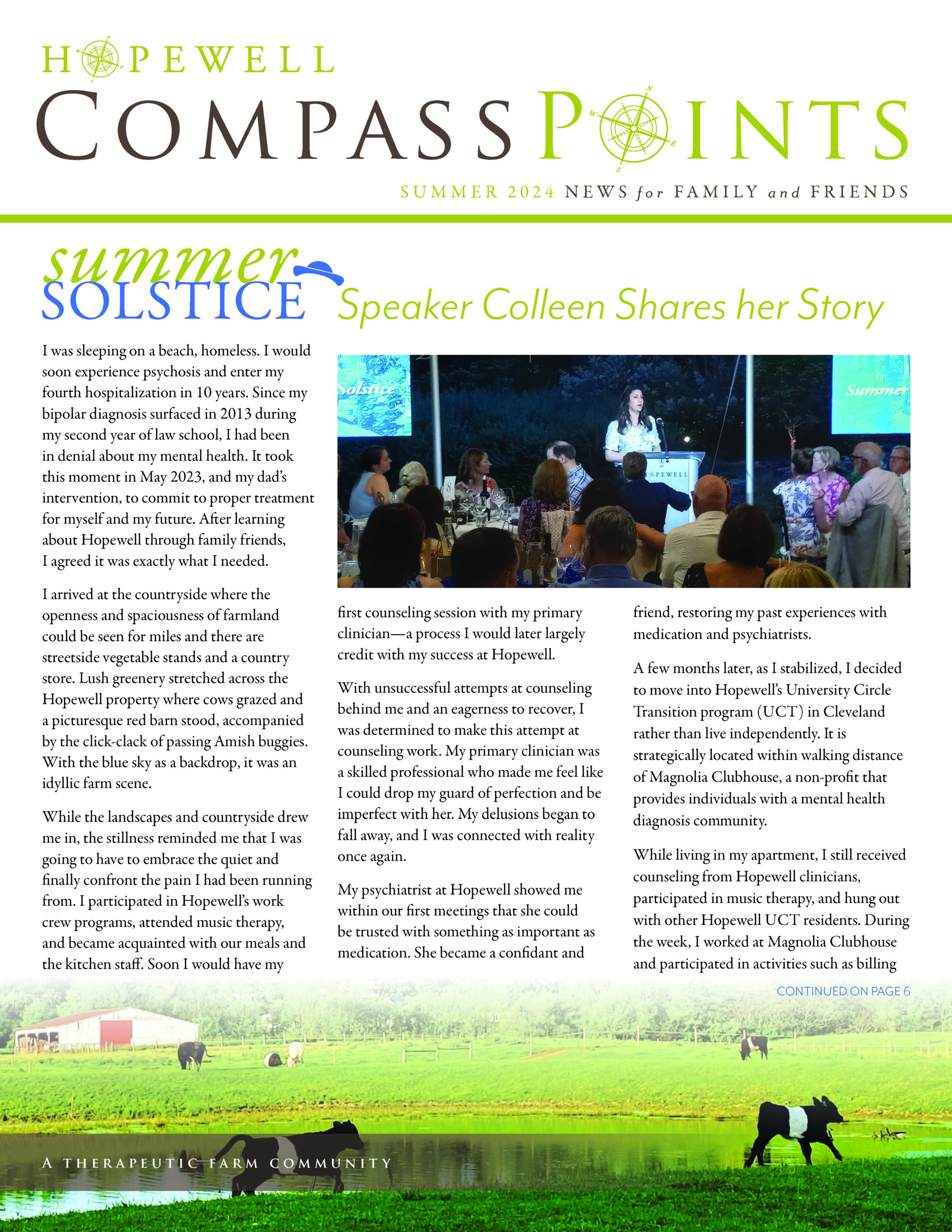
Meet Hopewell’s new board members, view Summer Solstice photographs, and register to earn CEUs for “Ecotherapy in Clinical Practice” series.

Outcomes Report 2023

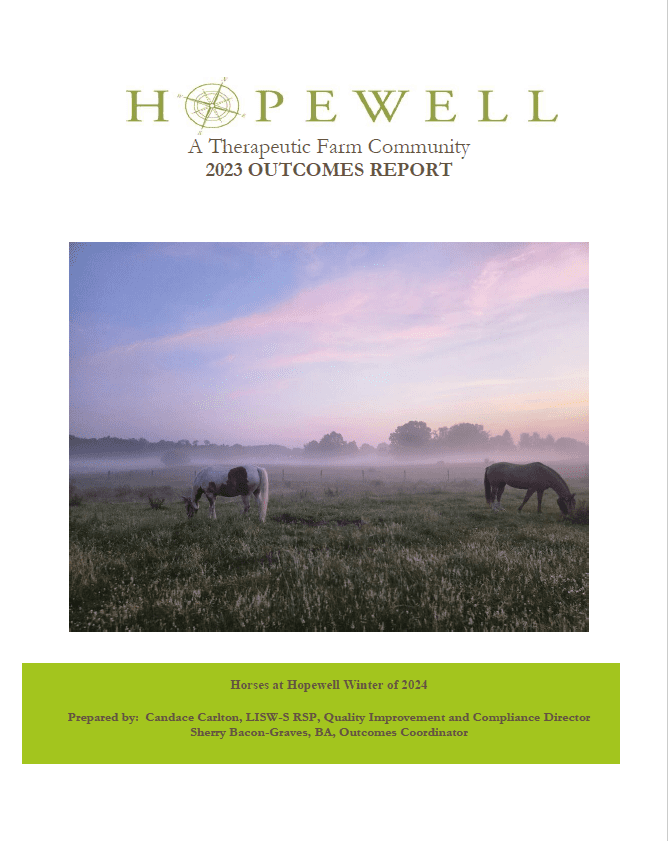
Hopewell’s 2023 Outcomes Report

Spring 2024: Spring has Sprung!

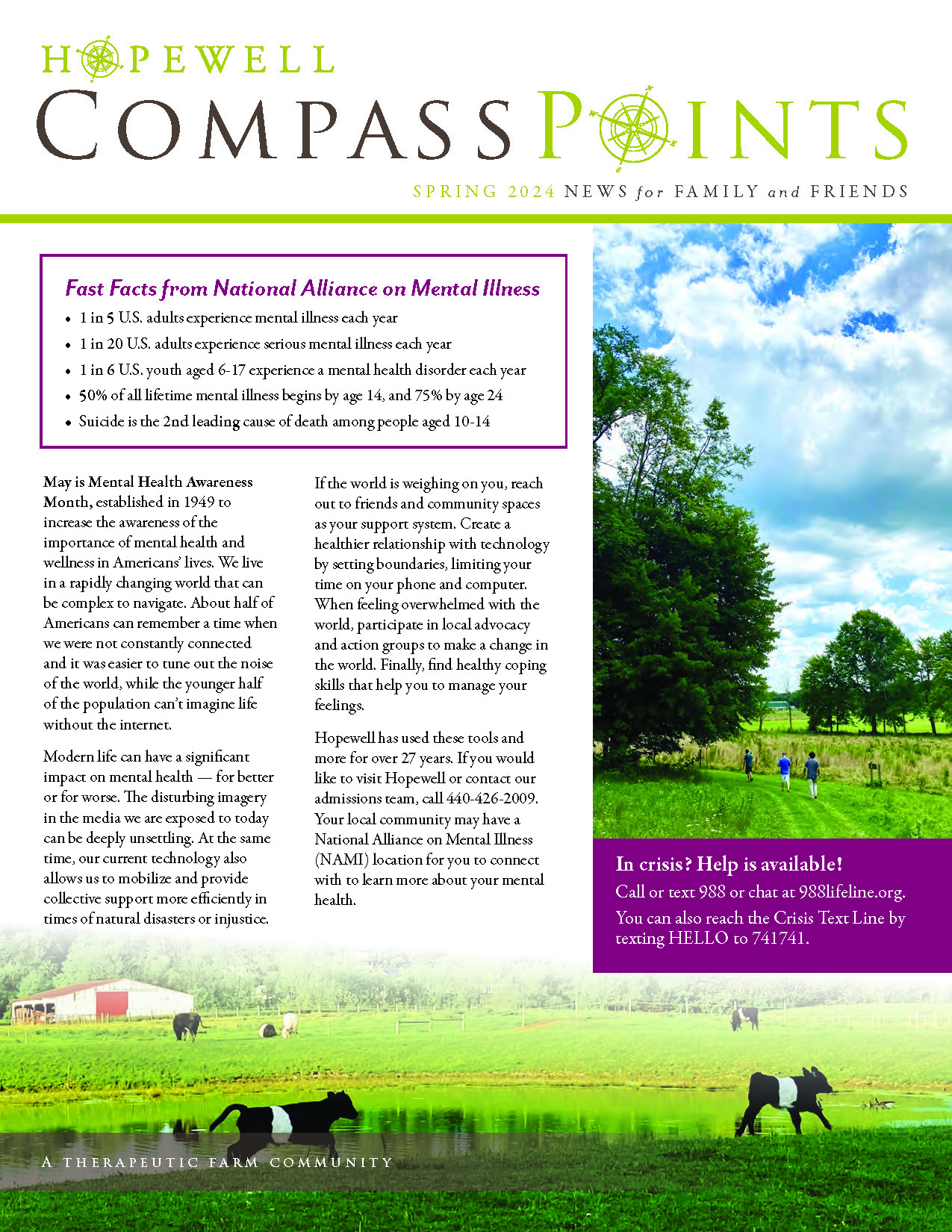
Hopewell’s spring newsletter is filled with our new clinicians, turtles and flowers, and many other updates. Don’t miss it!

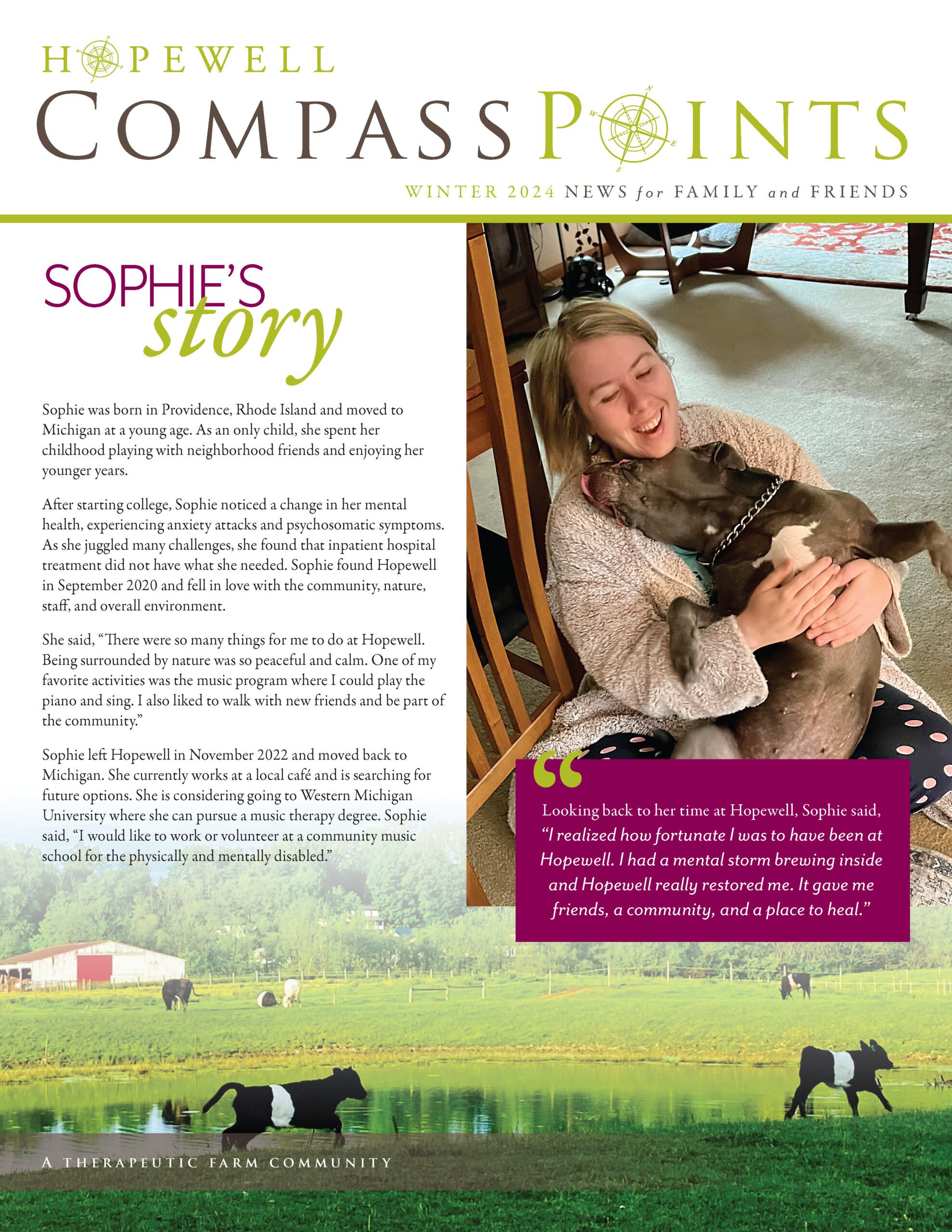
Winter 2024: Sophie’s Story

Looking back to her time at Hopewell, Sophie said, “I realized how fortunate I was to have been at Hopewell. I had a mental storm brewing inside and being at Hopewell really restored me. It gave me friends, a community, and a place to heal.”

Meet Martha

“Working at a place like Hopewell has been a goal ever since I was a medical resident in Boston,” says Martha Schinagle, MD, Hopewell’s psychiatrist. “I heard about Gould Farm (one of the four other residential farms for adults with mental illness in the United States) and it sounded like a wonderful place to recover and a great place to work.”

An experience as a medical student cemented Martha’s decision to specialize in psychiatry. She worked on a mental health inpatient unit studying the effectiveness of a drug that treats schizophrenia. “One of my patients had a very difficult time with her illness,” she recalled. “When she reached a therapeutic dose of the medication, she said, ‘Thank you for giving me my life back!’ Where else in medicine can you hear that? Bringing her back from far away was so satisfying.”

Martha pursued a career in community mental health before returning to Cleveland to be closer to family. In 2013, she joined the staff at Hopewell, and that long ago dream that had stayed in the back of her mind was realized. Her duties include assessing residents’ needs, consulting with clinicians about treatment plans and medication, and counseling residents.

“One of the important aspects of Hopewell is the opportunity to be in nature. It’s so healing,” Martha said. She loves to garden and spend time outside with family and her dogs. During the summer, she visits Lake Chautauqua and enjoys boating.

When asked what makes working at Hopewell meaningful, Martha stated, “I like making a difference in people’s lives and seeing people get better. It is a privilege to work with our remarkably dedicated clinicians. Also, it’s inspiring to see the healing community in action!” She continued, “Recently, as a resident came out of a depression, she started motivating people to get more involved, asking them to sit with her at dinner or join her at a group. She helped a lot of her peers.”

Thank you, Martha, for fulfilling your dream at Hopewell!

2023 Annual Report

We are extremely grateful for your Hopewell support as we continue to help so many who suffer from mental illness. We could not have done it without you. Thank you.

Visiting Artist Program — Apply today!

Hopewell is currently seeking applicants for our 2024 Visiting Artist Program. Our visiting artist program is designed to foster an alliance between creative arts and wellness. We are seeking artists who value the connection between mental health and artistic expression, and who are interested in exploring this intersection through instruction, collaboration, and community engagement. Through this program, it is our vision to connect individuals experiencing mental illness with creative and innovative approaches to healing and recovery.

As a visiting artist, you will be invited to stay on the farm in a private apartment for the duration of your artist workshop. Meals with the community will be provided, and artists will have access to studio space as well as the rest of our 325-acre working farm, including hiking trails, ponds, and natural sanctuaries. Artists will be expected to run a minimum 2-day workshop that will provide instruction of their craft to our residents. Projects may be tailored to individual or group work. Artists will also be asked to donate a creative piece of their own making that will reflect the visiting artist’s experience. Cost of supplies, up to $500, for running the workshop will be covered by Hopewell and artists will receive an additional $500 stipend at the completion of their stay.

To apply for our visiting artist program, please submit to Clare Conway at cconway@hopewell.cc: • Resume or CV • Letter of intent stating your specific interest in working with Hopewell and how involvement will influence your work • Three professional references • Portfolio work that clearly demonstrates what you will provide for the workshop.

DONATE