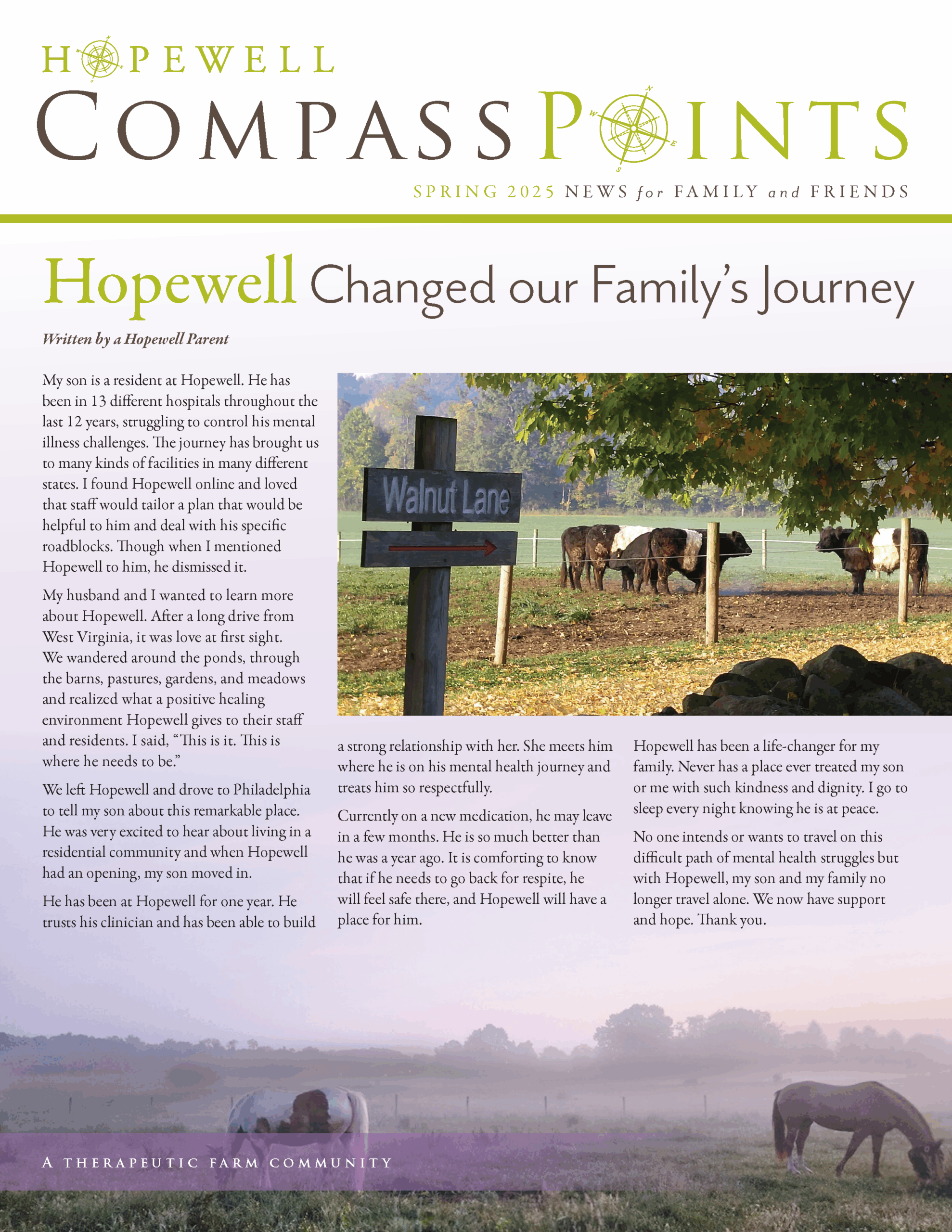
Learn more about Hopewell’s programs, staff and residents, and purchase your Summer Solstice tickets!
Author: Ann Thompson
Meet Jenn Miller

Food Service Manager and Wellness Educator Jenn Miller’s favorite Hopewell moments have to do with food. . . and no wonder! She started her Hopewell career in the kitchen as head cook in 2011 and in 2016 she moved into her present position. She also is a certified personal trainer. She said, “Nutrition and fitness are personal passions of mine – especially how they impact the mind and body.”
“Two of my favorite experiences with staff and residents are making apple cider with Hopewell apples and making maple syrup from our sugarbush,” Jenn said. “After they’ve been working a while, everyone loves to have hot maple syrup on cold vanilla ice cream as a treat.”
Before Hopewell, Jenn was in the workforce as a nursing assistant in a nursing home setting, which she found very stressful. When she found Hopewell through a friend of a friend, she knew she was home.
“My heart goes out to people with mental illness. I see their struggles to overcome their illnesses and I know that this is not what they want for themselves. It is personally meaningful to be a part of anything I can to help them heal, see things differently, and to help them have some sort of normalcy.”
Jenn plans three full meals a day seven days a week, cooking everything from scratch with the best and freshest foods. Some of the vegetables are sourced in our gardens, and chicken, ham, and beef comes from our livestock program. She works with Kelly Flynn, Garden and Landscape Manager, to select foods grown in the garden. She also schedules the animals to be processed, orders chicks, and works with other farm staff to bring pigs and cows to the farm.
Working Towards Residents’ Independence
When residents are getting ready to transition to more independence, Jenn works with them one on one or holds small class cooking instruction. “I put together transition packets with kitchen safety tips, shopping lists for pantry basics and healthy groceries, menu planning instructions, and more. As a group, we pick 5-6 things that are easy to prepare and nutritious. The goal is to learn to make something you can prepare for yourself even on a bad day.”
The class focuses on eggs, a breakfast menu, and pasta dishes, then cooks together once a week. “It’s rewarding when residents see that cooking was not as overwhelming as they thought. So many times when we eat what the residents make someone says, ‘Oh my gosh this is so good!’ They are proud of themselves for making it.”.
Part of the transition to independence is becoming familiar with and confident about new situations, so Jenn teaches residents how to go grocery shopping by visiting ALDI and Walmart. “We go over the lay of the grocery store, where to find basics, how to avoid junk food, and how to find the nutritious staples they need. I also teach them to compare prices.”
Jenn continued, “When you are having a bad day, your tendency is to grab the most convenient thing, but I teach residents how to find food that will help your brain. You can nourish your body and it does not have to be complicated or fast food.”
A Great Day at Hopewell
A great day at Hopewell for Jenn is “Just seeing the healing process. Residents come to Hopewell lost and confused, not joining the community much. Then I can watch their progress as they grow, see them laugh with a group of friends and come out of their shell. Food brings them together and is a shared experience. We recently changed our seating and many residents sit at a big table in the middle of the dining room, where they laugh and chat. This has made a tremendous difference.”
Some of her favorite memories are summertime Field Days that are organized with various team games, relay games, pool noodle polo, water balloon sling shots, and the like. “It’s great to see residents all of a sudden running, they lit up, they were competitive and laughing. They let down their hair and are kids again. Even some of the hardest ones to draw out came out to join the fun,” Jenn remembered.
Among Jenn’s goals are to continue to grow the nutrition program, keep things fresh and incorporate new recipes. She wants to get more hands on with people, get involved in gardening and preparing the food.
At home, Jenn loves to work in her garden in new raised beds that her husband built. They are empty nesters and she loves to spend time with her children and grandchildren. Hiking is another favorite activity, as is travel out west. Montana, Wyoming and Yellowstone are on their list for future trips.
Thank you, Jenn, for everything you do for Hopewell!
What is Sandplay Therapy?

By Candace Carlton, LISW-S, RSP, Quality Improvement & Compliance Director, Clinician
Sandplay is rooted in Jungian psychology that emphasizes the importance of the unconscious mind. C. J. Jung said, “Often the hands will solve a mystery that the intellect has struggled with in vain.”
I was introduced to Sandplay by Dr. Sana Loue when she was engaged in research projects at Hopewell. I was drawn to it after attending a weeklong workshop/seminar where case presentations showed how children and adults healed their trauma through work in the sand over a series of therapy sessions. I was also drawn to the creative process with the miniatures, objects and sand trays.
Sandplay Therapy is a non-verbal, non-directed, form of expressive art and creative process using a sand tray to create a picture or story in the sand. The client may pick from either a wet tray to add water to mold or shape the sand if they would like or they may use a dry tray. The client may use a variety of miniatures that include everything from animals, mythical creatures, houses, transportation vehicles, airplanes, cars, and trucks. They may also add items in the collections including trees, flowers, stones, crystals, plants and much more. See the photo for a sample sand tray in which the blue bottom represents water and the unconscious. This sand tray shows going into the blue (unconscious) and hopefully bringing healing to consciousness.
While the client is creating in the sand tray, the clinician holds the “free and protected space” for the client, a term used by Dora Kalff, who developed Sandplay Therapy. After the client has finished, the clinician will ask what they want to share and if they want to give the tray a title. The client shares what they want to about their creation.
Benefits of Sandplay Therapy are many. Clients have shared that the process of creating in the sand tray helps them to feel grounded and calm, sort out thoughts and feelings, let go, vent anger, grieve a variety of losses and integrate and heal trauma.
I have seen Hopewell residents heal in the process of sandplay including integrating and healing from trauma, feeling empowered about important decisions and meeting goals, feeling grounded after feeling anxiety and grieving loss of family members and friends. Sandplay Therapy is an important tool because a client may not be able to put into words their trauma or issues, but a picture may tell a story and help them heal.
Meet Candace Carlton
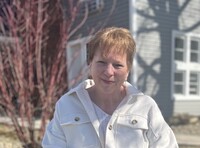
“It is immensely important to me to be part of a healing community where we are invested in each other’s growth. Residents and staff all work together. There’s nowhere else like Hopewell.” – Candace Carlton
Meet Candance Carlton, LISW-SP, RSP, clinician and Quality Improvement and Compliance Director – a true veteran who has been on staff since 2000. If you wanted to store all the hats she wears, you wouldn’t need a shelf – more like a closet! As a member of the Leadership Team, her many roles and far-reaching involvement exemplify her passion for the community and for personal growth.
Throughout her life you can see the influence of her grandmother, Pearl, who has encouraged her to pursue education and opportunities. “My grandmother taught school in Alaska, but she did not pursue her degree until she was 45. She always urged me to follow my dreams and continue to learn, even when others said I was ‘too old’ or ‘too busy’ to make time for education,” Candace said. She completed a bachelor’s degree in criminal justice at Kent State University at age 28 while working a full-time job and raising a daughter as a single mother.
When asked what drew her to working with people with mental illness, she said, “I had a loved one who was suffering, and I went to a support group fun by NAMI (National Alliance for the Mentally Ill). This experience deepened my understanding of mental illness, and I wanted to know more. It opened my eyes to mental health.”
“After I got my degree, I wanted to work here so I called the hiring manager every week for two months,” Candace laughs. When she began her tenure at Hopewell, the staff we currently call program facilitators were case managers. Her part-time evening position encompassed working directly with residents, taking people shopping and on outings. “We did not have as robust a clinical staff as we do now,” she remembered. “As I transitioned to full time, I was certified to pass medications and take blood pressure. I concentrated on supporting residents with their personal care goals, we went for walks in the woods, went fishing, played volleyball, and participated in work crews.”
With the encouragement of the Leadership Team, Candace went back to school to acquire her master’s in social work from Youngstown State University. Grandmother Pearl was there in spirit with words of support and encouragement.
Let’s Start Counting Hats
A major portion of Candace’s work at Hopewell is administration. Many years ago, she helped get Hopewell ready for accreditation from CARF (Commission on Accreditation of Rehabilitation Facilities), which stepped up our professionalism as an institution. She also eventually became the compliance director, which led to working on administrative pieces with CARF and ODMHAS (Ohio Department of Mental Health and Addiction Services) as well as overseeing research and outcomes. She has worked on implementing ODMHAS (Ohio Department of Mental Health and Addiction Services) and ODODD (Ohio Department of Developmental Disabilities) standards for our certification. Three times a year as a CARF surveyor, she travels to other residential treatment facilities to consult on meeting certification standards and improving services. On top of all of this, she prepares outcome studies and performance improvement projects and functions as the client rights officer.
Wearing her “clinician” hat, Candace carries a small caseload, develops treatment plans, provides individual therapy, and facilitates weekly Resident Council meetings. Over the years, Candace has been certified as a practitioner of several therapeutic modalities, including Sandplay therapy, which helps residents process inner emotions in a nonverbal way and EMDR (Eye Movement Desensitization and Reprocessing), an individual therapy which helps people process trauma, and Acceptance and Commitment Therapy. Two of her favorite resident activity groups are Spirituality, in which residents explore universal spiritual themes and become comfortable sharing their religion, and Mindfulness and Meditation. When wearing her “employee” hat, Candace leads the Diversity, Equity, Inclusion, and Accessibility group.
“A great day at Hopewell means residents helping one another and having a sense of belonging to the community,” Candace remarked. “Two recent special memories are when the residents, staff, and families gathered together for the eclipse and when our Musical Journey group held a concert. Everyone is so talented.”
Candace loves to go to concerts (blues rock and Joe Bonamassa are her current favorite), reads a great deal, crochets, sews, and loves being in nature. She enjoys painting, drawing and sketching, especially trees. She is a Lucille Ball fan and she has DVDs of all of the “I Love Lucy” episodes. Candace enjoys travel and has been to 35 states. She would love to see the states she has not visited yet and has considered Ireland, Wales, and England for future trips.
Thank you, Candace, for everything you do for Hopewell!
Meet Sarah Turner
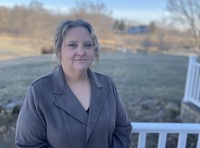
“I really like having a front row seat to people’s healing,” says Clinical Services Coordinator Sarah Turner.
A Hopewell Journey
Sarah always knew she wanted to work with and help people, not just hold a 9-5 desk job. Her Hopewell journey began in 2014 when she came onboard as a PRN program facilitator; she then worked her way into her current role.
Families first encounter Sarah when they consider Hopewell as an option for their loved one’s residential mental health care. “Talking to families in crisis makes this a tough job on some days,” Sarah said. “These conversations are crucial to determine whether the potential residents would be a good fit for Hopewell, and to be sure we can meet their needs.
“Hopewell is never the first go-to for residents,” she continued. “Listening to families, I hear about numerous hospitalizations, suicide attempts, and more. People call to talk about very heavy things. I listen empathetically, take notes, and talk them through the admissions process.”
Talking to families can make it a tough day and it’s necessary to process those emotions. “The stories that I hear are often difficult. It can really play on my emotions. There are times that I feel the need to decompress. We are lucky to have a gym here at Hopewell as well as a track to walk. Getting away from my desk and going for a quick walk is helpful. Talking with coworkers is also very helpful.”
By the time someone is admitted to Hopewell, Sarah and the admissions team know their whole story. Sarah shared, “I love it when I get to meet someone face to face and admit them, and they are so grateful for what we have done to get them here. Then over time it’s very satisfying so see their success.”
Some aspects of Sarah’s job are administrative in nature. She helps residents qualify for Medicaid to cover the cost of prescriptions and other medical services. She also assesses residents for disability benefits, which assures that they will have some funds coming in. As residents begin to look for options after Hopewell, she works on discharge planning with the clinical team and helps to ensure that residents are set up for success when they leave. “All of these parts of my job are self-taught. I did a lot of research, took some classes and found that I really enjoy it!”
Family Time and a Passion Project
Sarah finds a lot of joy in family time with her grown children and her youngest, a four-year-old. “She keeps me busy! Being with her brings a lot of kid-like wonder and joy that you lose when your kids get older. I have regained that through her.” She also enjoys metalworking with her dad, who is teaching her how to weld in his metal shop.
But Sarah’s real passion project is somewhat surprising. She devotes spare time to being a resource for families of children who have cleft lip or cleft palate. “I belong to a lot of online forums for parents of these children, where I try to answer questions from the standpoint of someone with experience.”
Sarah was born in 1981 when there was no ultrasound technology to show that she had a cleft. This shocked her young parents, barely out of their teens – here was a baby with a facial deformity. The only person available to talk to her mother was the surgeon, as there were no other support resources. “My parents had an unusual approach to my surgeries,” Sarah remembered. “They always planned them around the holidays so there was something to look forward to while I was recuperating.”
Sadly, Sarah was bullied at school and things were difficult. “This affected my mental health – I just did not feel good about myself and I became depressed. A turning point came after I graduated high school and I felt empowered to say I was done after roughly 25 surgeries. I chose to accept how I looked and start moving forward with life rather than focusing on what surgery would happen next.”
Talk about turning pain into promise!
Sarah pursued a double major in sociology and psychology at Youngstown State University. Eventually she accepted a position with Comprehensive Children & Family Services in Pennsylvania, where she did wraparound work with children who had autism and other mental health and behavioral issues. She worked with kids in school, at home, and in community settings, and developed treatment plans for them. This was very rewarding.
When her middle daughter started kindergarten, Sarah became a substitute teacher. She loved teaching and found working with kids with different abilities enjoyable.
Motivation and Meaning
When asked about what motivates her to work with people with mental illness, she mentioned, “I have a desire to help make a positive impact on the lives of those with mental health issues and find fulfillment in witnessing their progress and healing.”
The family environment at Hopewell means a lot to Sarah. “My favorite memory is when we had a Family Fun Day on campus. Residents, staff, and their families came together, made apple cider and s’mores. It was a neat feeling to watch my little girl interact with everyone. Hopewell is home for many residents, and they aren’t around children often. Seeing how they interested they were was heartwarming. That day wasn’t about their illnesses – it was about having fun. I was so happy to see joy on their faces as they all ran around to different activities together with their families.”
Some of Sarah’s future plans include traveling out west. She would love to do a family RV trip where they can stop whenever they want to look around. Given her energy and drive, we have no doubt that will happen someday soon.
Thank you, Sarah for everything you do!
Winter 2025: Clara T. Rankin
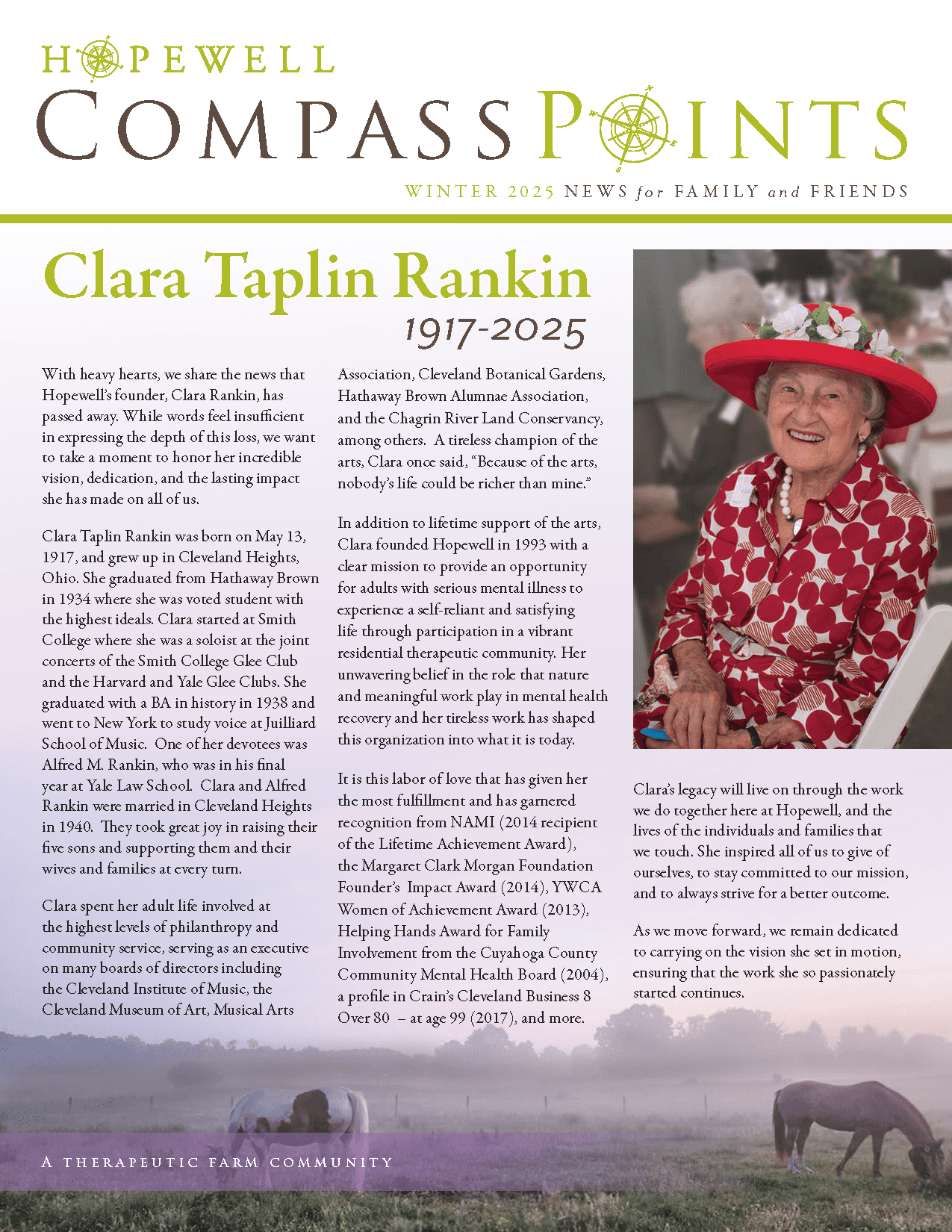
With heavy hearts, we share the news that Hopewell’s founder, Clara Rankin, has passed away. While words feel insufficient in expressing the depth of this loss, we want to take a moment to honor her incredible vision, dedication, and the lasting impact she has made on all of us.
Clara T. Rankin, 1917-2025

Dear Hopewell Friends,
With heavy hearts, we share the news that our founder, Clara T. Rankin, has passed away. While words feel insufficient in expressing the depth of this loss, we want to take a moment to honor her incredible vision, dedication, and the lasting impact she has made on all of us.
Mrs. Rankin founded Hopewell in 1993 with a clear mission to provide an opportunity for adults with serious mental illness to experience a self-reliant and satisfying life through participation in a vibrant residential therapeutic community. Her unwavering belief in the role that nature and meaningful work play in mental health recovery and her tireless effort has shaped this organization into what it is today. She did not just create a non-profit—she built a strong community that will continue to thrive in her memory.
Her legacy will live on through the work we do together and the lives of the individuals and families that we touch. She inspired all of us to give of ourselves, to stay committed to our mission, and to always strive for better outcomes. As we move forward, we remain dedicated to carrying on the vision she set in motion, ensuring that the work she so passionately started continues.
While we mourn her loss, we also celebrate her remarkable life. Our thoughts are with her family, friends, and all who were blessed to know her.
Together, we will keep her vision alive, honoring her by continuing the mission she so deeply believed in.
Warm regards,
Colleen Welder, Executive Director
A Letter from a Behavioral Health Professional who Found their Working Family

Dear Reader,
Like any family dynamic, you have your ups and you have your downs. What distinguishes functionality is how the members react to those situations. When you are at 10%, you hope your family can supplement the other 90%; just as if you are at 100%, the hope is you support others through those situations. This concept can be applied to any organization and working team. Organizations may experience things like not meeting quarterly goals, unexpected turnover, and may have disagreements over policy changes, but how the team handles these hurdles defines a good organization.
When you work in a supportive working environment there is no hesitation to maintain transparency or ask for help. It just comes naturally. When there is a problem, you feel comfortable approaching your leadership for guidance or leaning on coworkers to problem-solve.
According to the Pew Research Center, as of March 2023, 49% of Americans stated they were satisfied with their jobs*, which means that more than half of the country is not content with their current occupation. So it begs the question, why? For some, it’s financial reasons, for others it’s workplace toxicity or work-life balance, and for some it’s not finding meaning in their work.
A good program will do its best to implement systems that address these issues, starting with leadership. Dr. Christian Peonsgen shared a diagram of a concept called Servant Leadership where it takes the traditional leadership hierarchy and flips it upside down
[image:1]
Good programs will incentivize loyalty with appreciation of employees’ dedication and hard work through things like bonuses, raises, and solid benefit packages, and they will do their best to meet market value regarding their salary. Your morals and ethics will never feel compromised from organizational decisions. A good program will actively listen to employees’ concerns and prioritize their needs to ensure they are met. When these needs are not met, an individual may be engrossed in a toxic workplace environment. Moreover, when they are not appreciated or respected by their team it can leave lasting trauma and lead to turnover.
When applying these concepts to the behavioral health field specifically, it is even more crucial for organizations to excel at caring for their staff. The behavioral health field is physically and emotionally demanding where the demand of services greatly outweighs the supply of treatment professionals. Often employment requires long hours, unsustainable caseloads, high pressure work environments, and a wage that does not fairly reflect the amount of work needed. Employees will work with individuals struggling with their mental and physical wellbeing while also struggling with their own. This begs the next question: why do folks do it? The simple answer is humanity. As Albert Einstein said, “Only a life lived in service to others is worth living.”
For some, the need and drive to help others overrides all else and is intrinsic. This is the case especially if those individuals are a part of vulnerable populations who have not been given the same chances and opportunities, whether in poverty, the young, the mature adult, the cognitively impaired, the mentally ill, the physically disabled, or the neurodivergent. They often make for the most complex and difficult cases. If it is natural for behavioral health professionals to provide this genuine care given some of these barriers, it should be natural for organizations, whether a facility, hospital, residential treatment center, outpatient counseling center, or other, to ensure they do their best in fostering quality care to those same employees. It is reflective of the care the organization provides their patients and clients.
Upon reflecting on my own work environment, I am certain I have found my working family, and I work for the best program and most incredible team. Everyone involved, staff and residents alike, receives the same genuine care and respect, and it can be seen day to day. Hopewell is not just a treatment program for residents, it’s a transformative holistic healing experience for staff included. You believe in the mission, you see the vision, and you resonate with the core values. The support of our team outweighs any hurdles, and that instilled intrinsic feeling of meaning drives you to do all you can to get individuals struggling with mental health the care they need and deserve. Meaningful work and community are fundamental to Hopewell’s therapeutic treatment. They are also fundamental to a good program.
Hopewell puts these values into practice by ensuring our basic needs are met from good benefits so we can maintain our own health and wellbeing, they encourage you to take your hard earned PTO, they offer options of flex time for working longer hours, they do their best to balance caseloads so clinicians can maintain individualized client centered care, they create committees for our ideas to not only be heard but put into changeable actions, they provide training and opportunities for professional growth to give us the tools for success, and they show appreciation in fair wages and celebrations. They invest in you, so you invest in them. That is what a good program can do for you, and I hope above all else you find your working family because when you do, you’ll know it.
Sincerest regards from Hopewell Farm,
Rachel McDonald
Sources:
*Pew Research Center: How Americans View Their Jobs | Pew Research Center
** Servant Leadership Diagram: https://www.linkedin.com/posts/christianpoensgen_great-leaders-dont-command-but-serve-activity-7288541128520257536-ctzu?utm_source=share&utm_medium=member_desktop&rcm=ACoAACBK3K8BahP7hY7KGbEA7SDP_-JzMFgr-7g
Meet Rachel McDonald, Regional Marketing Manager

“As an advocate for mental health, I work every day as a voice for those disadvantaged and under serviced. The mental health crisis motivates me to strive for a more informed and de-stigmatized world.”
Rachel McDonald, Hopewell’s Regional Marketing Manager, has always felt herself drawn to working with vulnerable populations. She joined the Hopewell staff after two years working with autistic youth in Cleveland. But we’re getting ahead of ourselves.
Ever since she was younger, she learned the power of community. Growing up in a large family with six older brothers, she was always surrounded by support (not without its difficulties) and was graced with learning how impactful those values are today as an adult. “My family owns a local small business that sells, services, and distributes engines upon which instilled in me an entrepreneurial spirit that further heightened that value of true community. Rachel stated, “I owe everything to and have so much appreciation for my parents.”
During high school, Rachel volunteered in a special needs classroom, on a committee to raise funds to build a facility for adults with mental illness, and at Hamlet Manor, a geriatric nursing facility. Warm, compassionate, and high energy, her positive spirit helps motivate the people she works with to achieve their best and try new things. But her long-term goal was law school. Merging her two interests was a challenge to be explored.
First, she pursued a bachelor’s degree in business for a great basic education. An MBA followed and she expected to find work to raise funds to pursue her law degree dream. During her studies, she was exposed to health care law and health care management, both of which piqued her interest.
Working with Autistic Youth
Rachel said, “Typically, hospitals look for management candidates who have had direct experience in health care. I felt comfortable working with a geriatric population or with special needs youth.” This led her to Bellefaire JCB where she accepted a position as a Youth Autism Specialist.
“This was a hard job at a great organization,” Rachel continued. “There were a lot of clients with co-occurring autism, behavioral issues, and mental health disorders. We worked on everything from activities of daily living, getting kids ready for school, helping prepare meals, and teaching coping skills. The number one job was to keep kids safe from themselves and others, and to keep staff safe, too.”
Rachel then trained to become a Therapeutic Behavior Specialist and over time she made her way up to a supervisor role with a caseload, where she worked with clients and their families. “It made it real to see an individual and how they fit into the family system. I gained a ‘therapeutic brain’ through working with families on a deeper level.”
As a direct care professional, Rachel was often the first one in a crisis. She remembered, “It was physically and mentally challenging to protect yourself and others, keep your composure, stay calm, and keep your ‘therapeutic brain’ on at all times to help clients process their emotional deregulation. On the flip side, we did a lot of fun activities, went on trips, danced, played, and tried to make sure that they had a childhood even though they were in a residential facility. I will be eternally grateful to have been a part of an organization helping to change the lives of individuals who would not have been given a chance otherwise. I witnessed a few kids move on, and how they grew was humbling.”
Outreach at Hopewell
Rachel found herself ready to explore new career opportunities and again asked herself how she could couple her business background and health care experience. “Then the outreach role showed up at Hopewell and it emphasized community, building relationships, spreading the word about the services we provide and helping those in need of treatment know that there is a more holistic option out there. It just felt right. Hopewell is more than just a therapeutic farm, it is a way of life that encompasses everything intrinsic about being human. Community, support, nature, meaningful work, and joy are just some of the things that make Hopewell so great.”
As an outreach manager, Rachel works on building, maintaining, and sustaining relationships in the immediate community around Hopewell and the region encompassing Ohio, Pennsylvania, Indiana, and Michigan. “It is fulfilling to tell people about Hopewell and the services we provide. Before Hopewell, I did not know about therapeutic communities. My role encompasses educating clinicians and counseling programs to let them know we are an option. We want to be sure that we are the right fit for prospective residents.”
Another aspect of Rachel’s position is being a member of Hopewell’s admissions team. She takes incoming calls from families in crisis and shares our options for their loved one’s mental health care. “Hearing the heartaching situations that families are going through motivate me and reminds me why what we do is so significant”
Part of outreach also includes connecting Hopewell staff with programs, hospitals, and clinicians who offer services in mental and behavioral health. When residents are ready to move on, clinicians have more options to offer for aftercare services. “A big part of my job is being a good referral partner to other programs. We provide discharge options for Hopewell’s clinical team and help them find a therapist, medical providers, and future care based on the individual resident’s needs, wishes and goals.”
Hopewell is part of GCR (Give Connect Receive) Networking, which coordinates lunches for mental health professionals to connect and share resources. Rachel explained, “Lunches, dinners and facility tours happen all over the regions. We therefore have more resources to share client-centered resources with families. This includes lunch and learns where I speak to clinicians and explain our services and how we can mutually benefit our clients.
Yet another part of Rachel’s job is developing social media content and marketing materials. She’s the person behind weekly “Meet a Team Member” Monday about our fabulous staff, and she has a camera at the ready for Hopewell Happenings posts about interesting things happening on the farm.
Some of her marketing is representing Hopewell at events such the NAMI walk, when residents, staff, and families did the walk as a group. She also represents Hopewell at regional conferences of the NASW (National Association of Social Workers), the AOCC (All Ohio Counselors Conference), and the Ohio Mental Health and Addiction Services Conference. She is also part of the Employee Appreciation Committee, where she helps plan events to celebrate and appreciate our internal community and is part of our CIA Committee (Collaboration, Innovation, and Action). ‘I love being involved in these committees! We must take care of our own,” she said.
The Hopewell Effect
“I always say that everyone at Hopewell – board members, staff, residents, animals, even delivery people – everyone gets level of respect that you don’t get outside of Hopewell. We are a therapeutic community and it’s transformative when you come to campus. First time visitors even feel the effect that Hopewell has on anyone. We don’t define anyone by their diagnosis which is extremely important for someone who has only been defined that way. Everyone wants to feel normal, and everyone is met where they are at and accepted.”
When asked about a Hopewell memory, Rachel recalled, “Before the holidays, residents wanted to have a karaoke day. I like to keep the energy high and fun, so I found some random karaoke on YouTube. Residents brought cookies and hot cocoa and we took turns singing karaoke with battery powered microphones. The acuity of the residents did not matter. It was a very neutral, safe space and we had a blast. A resident who does not like to talk sang because that was easier. We all sang ‘Sweet Caroline,’ and then learned Elton John’s ‘Daniel,’ which we recorded and sent to our Clinical Director, Daniel Horne. It took 20 minutes, and it brought so much joy. It was awesome.”
Finding Joy
When it comes to her spare time, Rachel described herself as “an old soul. I enjoy the Cleveland Browns, sports, laughter (as it is the best medicine), music from the 40’s til current, and fishing. I can find a pond anywhere for the sport of it and for being outside. Another thing that brings me joy is helping my family in any way I can. A future goal is raising a family. . . someday!”
Thank you, Rachel, for bringing your positive energy to everything you do!
The Therapeutic Benefits of Working with Plants

By Kelly Flynn, MS, Garden and Landscape Manager at Hopewell
In the heart of every therapeutic community lies a shared goal: fostering healing, growth, resilience, and connection. For individuals navigating the complexities of mental illness, the path to recovery might extend beyond traditional therapies. As we learn more about the many forms of mental illness, these non-traditional therapies are justifiably, becoming a popular option. One innovative and humanistic approach is therapeutic horticulture.
What is Therapeutic Horticulture?
According to the American Horticultural Therapy Association, therapeutic horticulture is “the process through which participants enhance their well-being through active or passive involvement in plant and plant-related activities.” (1)
Historical Precedents
People’s positive relationship to plants goes all the way back to the beginning of our first major civilizations. There are records from as far back as 2000 BCE from Mesopotamia and Egypt that document the benefits of a simple walk through the garden. The first documentation of the therapeutic use of horticulture, however, was in 1100 BCE at a monastery in Clairvaux, France. At that monastery, they kept a garden specifically for hospice patients. In 1812, a professor at the University of Pennsylvania published research stating that compared to those who didn’t participate in gardening, patients who worked in the gardens there had better recovery rates from mania (as defined at that time) (2).
Therapeutic gardening and later, horticulture therapy hit its stride in the 20th century. In the 1940s and 50s, Veterans Administration hospitals used on-site gardens to help with rehabilitation efforts. In the process, therapeutic horticulture started to become more widely known and used (1). In the 1970s, the American Horticulture Therapy Association was founded, validating therapeutic horticulture as a professional field of work with guidelines and certifications to become a Horticultural Therapist.
The Benefits of Therapeutic Horticulture
The National Institute of Mental Health reports that more than one in five or 23.1% of adults live with mental illness in the United States. Of that number 6% are classified as having serious mental illness (4). With this increasingly high number of adults affected, research is continuously being done to discover and validate different modalities for treatment.
There has been increased interest in researching how horticulture can help individuals living with mental illness. More recently published studies continue to show statistical significance of the positive benefits of therapeutic horticulture. One study published in the International Journal of Environmental Research and Public Health found that participants reported a decrease in stress and anxiety and an increased feeling of well-being, engagement and sense of meaningfulness and/or accomplishment (5). Another study, using participants with mental illness, specifically studied the effect of Horticultural Therapy on self-esteem. This study included participants with schizophrenia and Major Depression Disorder among others. They found that regardless of the participants’ diagnoses, self-esteem scores increased (6).
Along with the mental health benefits, there are physical and social benefits as well. Gardening itself can encourage increased physical activity. Moving mulch, weeding, and seeding for example, help refine both gross and fine motor skills respectively. Depending on the time of year, individuals can benefit from being out in the sun; lowering blood pressure and increasing vitamin D levels (7). At Hopewell we farm produce on a ¼ of an acre. This might seem small but once the weeds start sprouting, it’s “all hands-on deck.” Gardening naturally fosters social interaction and communication. Gardening at Hopewell is a team effort. This teamwork helps build a sense of community and can increase an individual’s communication skills.
There is a wonderful acronym from Sally Haskett, HTR at NC State Extension that summarizes how therapeutic horticulture can affect one’s mental health and social connections by using the word P.L.A.N.T.S:
P: Purposeful – taking part in meaningful experiences with useful results
L: Life Focus – Being mindful of life in the present and forward thinking
A: Acceptance – Being accepted by others and accepting ourselves
N: Nurturance – Giving back, caring for another living being
T: Together – Making connections to people and the world around us
S: Safety – Feeling comfort, familiarity and security (3)
Therapeutic horticulture is incredibly versatile making it an inclusive therapy modality. Through research, therapeutic horticulture is repeatedly being shown to help individuals in many positive ways. With every paper published we learn more about how working with plants helps individuals. This in turn helps fund future research into the subject and helps fund new horticulture programs. The impact of gardening and working with plants cannot be understated.
- AHTA (n.d.). Ahta definitions and positions. American Horticultural Therapy Association. https://www.ahta.org/ahta-definitions-and-positions
- Dinardo, M. F., DePrado, L., Polanin, N., & Flagler, J. (n.d.). Enabling gardens: The practical side of horticultural therapy. FS1208: Enabling Gardens: The Practical Side of Horticultural Therapy (Rutgers NJAES). https://njaes.rutgers.edu/fs1208/
- Hendrick, R. (2021, January 27). Therapeutic Horticulture- Master Gardeners Filling a Gap. https://mastergardener.osu.edu/sites/mgv/files/imce/OSU EMG TH Presentation_Hendrick.pdf
- n/a. (n.d.). Mental illness. National Institute of Mental Health. https://www.nimh.nih.gov/health/statistics/mental-illness
- Siu, A.M., Kam, M.C., & Mok, I. (2020). Horticultural Therapy Program for People with Mental Illness: A Mixed-Method Evaluation. International Journal of Environmental Research and Public Health, 17.
- Subagyo, W., & Wahyuningsih, D. (2024). The Effect of Horticultural Therapy on Increased Self-Esteem for Mental Disorders in the Community. IIUM Medical Journal Malaysia.
- Thompson R. Gardening for health: a regular dose of gardening. Clin Med (Lond). 2018 Jun;18(3):201-205. doi: 10.7861/clinmedicine.18-3-201. PMID: 29858428; PMCID: PMC6334070.