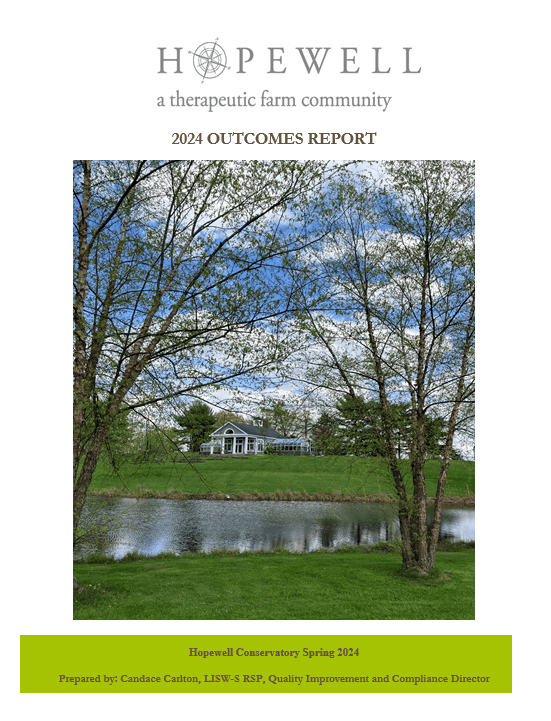
In 2006, Hopewell began a systematic data collection program of outcomes research to guide its efforts to help the seriously mentally ill. As part of this program, Hopewell tracks the attendance and participation of each Resident on a daily basis and collects periodic systematic measurements of each Resident’s progress. The data recorded includes participation in work crews, therapeutic clinical groups, social activities, exercise, and community meetings.
Month: June 2025
State of the Organization Report, 2024-2025
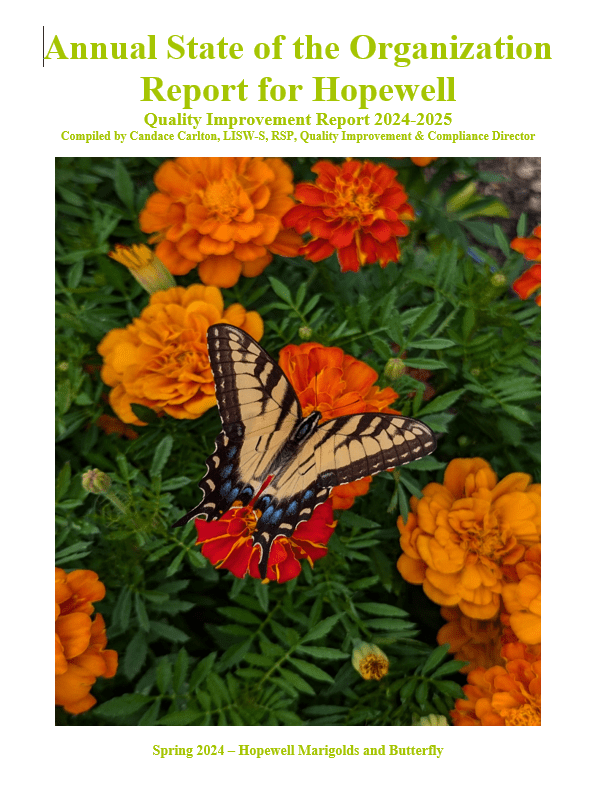
Hopewell is committed to continually improving our organization and service delivery. The goal of this report is to show the steps Hopewell took throughout 2024 to (1) be more effective and efficient; (2) review access to services; (3) look at satisfaction and feedback; and (4) make future improvement plans. Included here is information such as accomplishments and future plans for quality and performance improvements from each of Hopewell’s staff committees. This information is shared with stakeholders and residents as well as the staff and volunteers who are essential in the process of supporting continual improvements to Hopewell’s Therapeutic Community.
Meet Kala Mansfield

Meet Kala Mansfield, LPC, ATR-P, who joined the Hopewell staff in 2023 as an intern.She was hired as a clinician in May 2024 when she graduated from Ursuline College with her Master’s in Counseling and Art Therapy.
Kala runs the ceramics room, meets with residents for individual therapy sessions and runs the Acceptance and Commitment Therapy (ACT) Art Therapy group. She is also a program facilitator two days per week, runs a weekly Dungeons & Dragons game for residents, and holds a lot of open studio hours.
Art Therapy at Hopewell
For her Master’s thesis, Kala applied Acceptance and Commitment therapy principles (cognitive diffusion, acceptance, values, committed actions, the self as context) and created art activities. It was so successful that she is still running the group today. Some of the activities are physically engaging and some are more a reminder of what you are learning. She explained, “For example, this week we are working on separating from our struggles and gaining new perspectives. Residents were asked to draw something that bothers them, then ripped it up and glued it back together in a collage.”
“Art therapy can be structured many different ways depending on the needs of the residents,” she said. “It really is personalized. Sometimes we have a therapy session and make art together at the same time. The art is grounding and distracting – something to focus on instead of just an emotionally difficult discussion. Sometimes art sessions are educational and I teach life skills such as sewing. You feel more independent when you can sew something functional, and it gives a sense of accomplishment. Other times art is for emotional expression: you don’t have to think, just pour your emotions into the art, then we discuss the art that was created.”
Open studio time is very popular – residents come to the studio for free expressive time. “Working on a project in a group helps with social interaction. People work together and ask for advice and suggestions. It’s a good day when I feel like the art therapy groups were impactful and successful.”
Time for Travel. . . Time for Art
Other than making art and jewelry, Kala’s main hobby is travel. While an undergraduate at Miami University, she lived with a host family and studied in Luxemburg, which afforded her the opportunity to travel throughout France, Italy, and Germany. Graduate school included trips to South Africa and Nepal where she volunteered with United Planet. In South Africa, Kala worked in township schools in disadvantaged community making art with kids who didn’t speak English. In Nepal, she worked with foster kids whose parents were incarcerated.
Kala remembered, “Nepal has a significant part of my heart! I was told by multiple people that they expect to see me again. People are wonderful. They have a karmic culture which inspires them to do good things in this lifetime while looking towards the next. They believe that actions have consequences beyond the immediate future. I took what they call a ‘nice hike’ up Champa Devi, the third tallest hill in the Katmandu Valley in the foothills of the Himalayas. It was an exhausting and exhilarating afternoon.”
Art has always been part of Kala’s life and she expresses herself in many different media. In high school, she painted with watercolors and did graphite drawings. College led her into jewelry making and metalwork. More recently she has gotten into textile art and embroidery.
As far as the future is concerned, Kala said, “I am only a year outside of graduate school and I’m still adjusting to life without homework and with evenings free. Traveling is on my list, specifically to Ireland and to go hiking in Utah. I make a lot of art and wire jewelry. A big goal would be to build a garage workshop. I also just bought my first house and I’m slowly transitioning.”
Thank you, Kala, for everything you do for Hopewell!
Resilience and Physical Activity
By Sami Petty, MSN, APRN, PMHNP-BC, Consulting Nurse Practitioner
At Hopewell, we witness daily how the simple rhythm of physical activity, walking the trails, tending the garden, and mucking stalls, can bring about powerful shifts in mood, mindset, and mental resilience. Science is catching up to what farmers and healers have long known: moving our bodies helps us feel stronger, not just physically, but emotionally, mentally, and spiritually.
In a world that often feels overwhelming, building resilience – the ability to recover from stress, adapt to challenges, and stay grounded through life’s ups and downs – is more important than ever. For individuals living with serious mental illness, resilience is not just a nice idea, it’s a vital part of healing and recovery. Physical activity is one of the most accessible and effective tools for strengthening one’s own resilience.
When we engage in physical movement, several powerful things occur in the brain: feel-good chemicals are released, stress hormones are reduced, and cognitive function improves.
Feel-good chemicals are released: Exercise boosts endorphins, dopamine, and serotonin neurotransmitters that improve mood and reduce anxiety.
Stress hormones are reduced: Physical activity helps regulate cortisol, the body’s primary stress hormone, keeping us from getting stuck in fight-or-flight mode.
Cognitive function improves: Regular movement increases blood flow to the brain, improving focus, memory, and executive functioning. This is especially important for people with serious mental illness who may experience cognitive challenges as part of their condition.
Beyond the science, physical activity helps people reconnect with their bodies, build self-esteem, and feel a sense of accomplishment. At Hopewell, these benefits are multiplied when movement is meaningful, exemplified by caring for animals, harvesting vegetables, or simply walking on the trails. Whether it’s feeding chickens, vacuuming the main house or collecting maple syrup, every act of movement has a purpose. This physical engagement is about being present and connected to our surroundings. This heightened body awareness and connection to the environment enhance resilience and support stronger mental health.
Call to action: How can you support movement and resilience?
- Start small: A short walk, sweeping the porch, or stretching in the morning can make a difference.
- Choose purposeful activities: Tasks that feel meaningful, like gardening, cooking, or caring for a pet, engage the body and mind.
- Make it social: Movement is more enjoyable when shared. Invite others to join in a walk or help with a project.
- Connect it to nature: Whenever possible, move outdoors. Fresh air and natural surroundings amplify the mental health benefits.
At Hopewell, we’re not just growing food, we’re growing resilience. Through daily, grounded movement in nature, our residents are rediscovering their own strength, one step at a time. Wherever you are, remember movement matters. Not just for the body, but for the mind and spirit, too.
Move to Thrive: How Physical Activity Fuels Emotional Resilence
By Sami Petty, MSN, APRN, PMHNP-BC, Consulting Nurse Practitioner
Learn how movement and exercise help boost emotional resilience, improve mood, and support mental health.
At Hopewell, we witness daily how the simple rhythm of physical activity, walking the trails, tending the garden, and mucking stalls, can bring about powerful shifts in mood, mindset, and mental resilience. Science is catching up to what farmers and healers have long known: moving our bodies helps us feel stronger, not just physically, but emotionally, mentally, and spiritually.
In a world that often feels overwhelming, building resilience – the ability to recover from stress, adapt to challenges, and stay grounded through life’s ups and downs – is more important than ever. For individuals living with serious mental illness, resilience is not just a nice idea, it’s a vital part of healing and recovery. Physical activity is one of the most accessible and effective tools for strengthening one’s own resilience.
When we engage in physical movement, several powerful things occur in the brain: feel-good chemicals are released, stress hormones are reduced, and cognitive function improves.
Feel-good chemicals are released: Exercise boosts endorphins, dopamine, and serotonin neurotransmitters that improve mood and reduce anxiety.
Stress hormones are reduced: Physical activity helps regulate cortisol, the body’s primary stress hormone, keeping us from getting stuck in fight-or-flight mode.
Cognitive function improves: Regular movement increases blood flow to the brain, improving focus, memory, and executive functioning. This is especially important for people with serious mental illness who may experience cognitive challenges as part of their condition.
Beyond the science, physical activity helps people reconnect with their bodies, build self-esteem, and feel a sense of accomplishment. At Hopewell, these benefits are multiplied when movement is meaningful, exemplified by caring for animals, harvesting vegetables, or simply walking on the trails. Whether it’s feeding chickens, vacuuming the main house or collecting maple syrup, every act of movement has a purpose. This physical engagement is about being present and connected to our surroundings. This heightened body awareness and connection to the environment enhance resilience and support stronger mental health.
Call to action: How can you support movement and resilience?
- Start small: A short walk, sweeping the porch, or stretching in the morning can make a difference.
- Choose purposeful activities: Tasks that feel meaningful, like gardening, cooking, or caring for a pet, engage the body and mind.
- Make it social: Movement is more enjoyable when shared. Invite others to join in a walk or help with a project.
- Connect it to nature: Whenever possible, move outdoors. Fresh air and natural surroundings amplify the mental health benefits.
At Hopewell, we’re not just growing food, we’re growing resilience. Through daily, grounded movement in nature, our residents are rediscovering their own strength, one step at a time. Wherever you are, remember movement matters. Not just for the body, but for the mind and spirit, too.