Close

Who We Are

Strategic Plan

Board of Directors

Staff

Annual Reports

Overview

Transition Services

Sample Daily Schedule

Facilities Tour

Overview

Measuring Success

Success Stories

For Caregivers

For Professionals

Fees for Service

Apply

Corporate Partners

Planned Giving

Donate

Wishing Well

Exploring Mental Health

Summer Solstice 2026

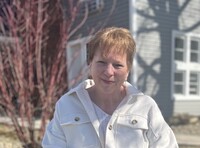
Meet Jenn Miller

Food Service Manager and Wellness Educator Jenn Miller’s favorite Hopewell moments have to do with food. . . and no wonder! She started her Hopewell career in the kitchen as head cook in 2011 and in 2016 she moved into her present position. She also is a certified personal trainer. She said, “Nutrition and fitness are personal passions of mine – especially how they impact the mind and body.”

“Two of my favorite experiences with staff and residents are making apple cider with Hopewell apples and making maple syrup from our sugarbush,” Jenn said. “After they’ve been working a while, everyone loves to have hot maple syrup on cold vanilla ice cream as a treat.”

Before Hopewell, Jenn was in the workforce as a nursing assistant in a nursing home setting, which she found very stressful. When she found Hopewell through a friend of a friend, she knew she was home.

“My heart goes out to people with mental illness. I see their struggles to overcome their illnesses and I know that this is not what they want for themselves. It is personally meaningful to be a part of anything I can to help them heal, see things differently, and to help them have some sort of normalcy.”

Jenn plans three full meals a day seven days a week, cooking everything from scratch with the best and freshest foods. Some of the vegetables are sourced in our gardens, and chicken, ham, and beef comes from our livestock program. She works with Kelly Flynn, Garden and Landscape Manager, to select foods grown in the garden. She also schedules the animals to be processed, orders chicks, and works with other farm staff to bring pigs and cows to the farm.

Working Towards Residents’ Independence

When residents are getting ready to transition to more independence, Jenn works with them one on one or holds small class cooking instruction. “I put together transition packets with kitchen safety tips, shopping lists for pantry basics and healthy groceries, menu planning instructions, and more. As a group, we pick 5-6 things that are easy to prepare and nutritious. The goal is to learn to make something you can prepare for yourself even on a bad day.”

The class focuses on eggs, a breakfast menu, and pasta dishes, then cooks together once a week. “It’s rewarding when residents see that cooking was not as overwhelming as they thought. So many times when we eat what the residents make someone says, ‘Oh my gosh this is so good!’ They are proud of themselves for making it.”.

Part of the transition to independence is becoming familiar with and confident about new situations, so Jenn teaches residents how to go grocery shopping by visiting ALDI and Walmart. “We go over the lay of the grocery store, where to find basics, how to avoid junk food, and how to find the nutritious staples they need. I also teach them to compare prices.”

Jenn continued, “When you are having a bad day, your tendency is to grab the most convenient thing, but I teach residents how to find food that will help your brain. You can nourish your body and it does not have to be complicated or fast food.”

A Great Day at Hopewell

A great day at Hopewell for Jenn is “Just seeing the healing process. Residents come to Hopewell lost and confused, not joining the community much. Then I can watch their progress as they grow, see them laugh with a group of friends and come out of their shell. Food brings them together and is a shared experience. We recently changed our seating and many residents sit at a big table in the middle of the dining room, where they laugh and chat. This has made a tremendous difference.”

Some of her favorite memories are summertime Field Days that are organized with various team games, relay games, pool noodle polo, water balloon sling shots, and the like. “It’s great to see residents all of a sudden running, they lit up, they were competitive and laughing. They let down their hair and are kids again. Even some of the hardest ones to draw out came out to join the fun,” Jenn remembered.

Among Jenn’s goals are to continue to grow the nutrition program, keep things fresh and incorporate new recipes. She wants to get more hands on with people, get involved in gardening and preparing the food.

At home, Jenn loves to work in her garden in new raised beds that her husband built. They are empty nesters and she loves to spend time with her children and grandchildren. Hiking is another favorite activity, as is travel out west. Montana, Wyoming and Yellowstone are on their list for future trips.

Thank you, Jenn, for everything you do for Hopewell!
What is Sandplay Therapy?

By Candace Carlton, LISW-S, RSP, Quality Improvement & Compliance Director, Clinician

Sandplay is rooted in Jungian psychology that emphasizes the importance of the unconscious mind. C. J. Jung said, “Often the hands will solve a mystery that the intellect has struggled with in vain.”

I was introduced to Sandplay by Dr. Sana Loue when she was engaged in research projects at Hopewell. I was drawn to it after attending a weeklong workshop/seminar where case presentations showed how children and adults healed their trauma through work in the sand over a series of therapy sessions. I was also drawn to the creative process with the miniatures, objects and sand trays.

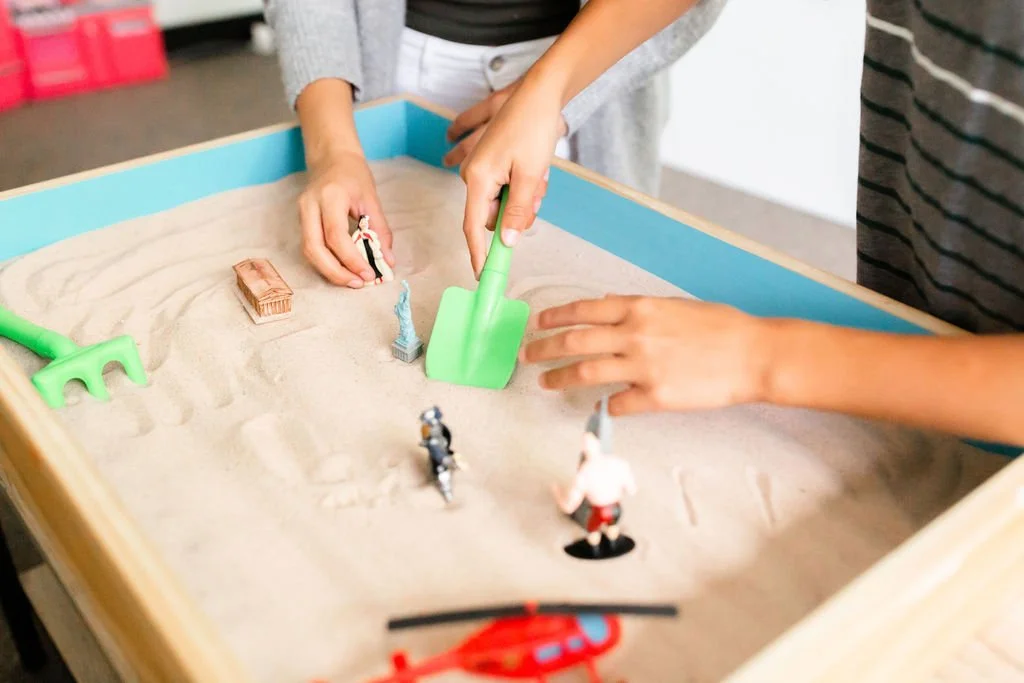
Sandplay Therapy is a non-verbal, non-directed, form of expressive art and creative process using a sand tray to create a picture or story in the sand. The client may pick from either a wet tray to add water to mold or shape the sand if they would like or they may use a dry tray. The client may use a variety of miniatures that include everything from animals, mythical creatures, houses, transportation vehicles, airplanes, cars, and trucks. They may also add items in the collections including trees, flowers, stones, crystals, plants and much more. See the photo for a sample sand tray in which the blue bottom represents water and the unconscious. This sand tray shows going into the blue (unconscious) and hopefully bringing healing to consciousness.

While the client is creating in the sand tray, the clinician holds the “free and protected space” for the client, a term used by Dora Kalff, who developed Sandplay Therapy. After the client has finished, the clinician will ask what they want to share and if they want to give the tray a title. The client shares what they want to about their creation.

Benefits of Sandplay Therapy are many. Clients have shared that the process of creating in the sand tray helps them to feel grounded and calm, sort out thoughts and feelings, let go, vent anger, grieve a variety of losses and integrate and heal trauma.

I have seen Hopewell residents heal in the process of sandplay including integrating and healing from trauma, feeling empowered about important decisions and meeting goals, feeling grounded after feeling anxiety and grieving loss of family members and friends. Sandplay Therapy is an important tool because a client may not be able to put into words their trauma or issues, but a picture may tell a story and help them heal.

Meet Candace Carlton

“It is immensely important to me to be part of a healing community where we are invested in each other’s growth. Residents and staff all work together. There’s nowhere else like Hopewell.” – Candace Carlton

Meet Candance Carlton, LISW-SP, RSP, clinician and Quality Improvement and Compliance Director – a true veteran who has been on staff since 2000. If you wanted to store all the hats she wears, you wouldn’t need a shelf – more like a closet! As a member of the Leadership Team, her many roles and far-reaching involvement exemplify her passion for the community and for personal growth.

Throughout her life you can see the influence of her grandmother, Pearl, who has encouraged her to pursue education and opportunities. “My grandmother taught school in Alaska, but she did not pursue her degree until she was 45. She always urged me to follow my dreams and continue to learn, even when others said I was ‘too old’ or ‘too busy’ to make time for education,” Candace said. She completed a bachelor’s degree in criminal justice at Kent State University at age 28 while working a full-time job and raising a daughter as a single mother.

When asked what drew her to working with people with mental illness, she said, “I had a loved one who was suffering, and I went to a support group fun by NAMI (National Alliance for the Mentally Ill). This experience deepened my understanding of mental illness, and I wanted to know more. It opened my eyes to mental health.”

“After I got my degree, I wanted to work here so I called the hiring manager every week for two months,” Candace laughs. When she began her tenure at Hopewell, the staff we currently call program facilitators were case managers. Her part-time evening position encompassed working directly with residents, taking people shopping and on outings. “We did not have as robust a clinical staff as we do now,” she remembered. “As I transitioned to full time, I was certified to pass medications and take blood pressure. I concentrated on supporting residents with their personal care goals, we went for walks in the woods, went fishing, played volleyball, and participated in work crews.”

With the encouragement of the Leadership Team, Candace went back to school to acquire her master’s in social work from Youngstown State University. Grandmother Pearl was there in spirit with words of support and encouragement.

Let’s Start Counting Hats

A major portion of Candace’s work at Hopewell is administration. Many years ago, she helped get Hopewell ready for accreditation from CARF (Commission on Accreditation of Rehabilitation Facilities), which stepped up our professionalism as an institution. She also eventually became the compliance director, which led to working on administrative pieces with CARF and ODMHAS (Ohio Department of Mental Health and Addiction Services) as well as overseeing research and outcomes. She has worked on implementing ODMHAS (Ohio Department of Mental Health and Addiction Services) and ODODD (Ohio Department of Developmental Disabilities) standards for our certification. Three times a year as a CARF surveyor, she travels to other residential treatment facilities to consult on meeting certification standards and improving services. On top of all of this, she prepares outcome studies and performance improvement projects and functions as the client rights officer.

Wearing her “clinician” hat, Candace carries a small caseload, develops treatment plans, provides individual therapy, and facilitates weekly Resident Council meetings. Over the years, Candace has been certified as a practitioner of several therapeutic modalities, including Sandplay therapy, which helps residents process inner emotions in a nonverbal way and EMDR (Eye Movement Desensitization and Reprocessing), an individual therapy which helps people process trauma, and Acceptance and Commitment Therapy. Two of her favorite resident activity groups are Spirituality, in which residents explore universal spiritual themes and become comfortable sharing their religion, and Mindfulness and Meditation. When wearing her “employee” hat, Candace leads the Diversity, Equity, Inclusion, and Accessibility group.

“A great day at Hopewell means residents helping one another and having a sense of belonging to the community,” Candace remarked. “Two recent special memories are when the residents, staff, and families gathered together for the eclipse and when our Musical Journey group held a concert. Everyone is so talented.”

Candace loves to go to concerts (blues rock and Joe Bonamassa are her current favorite), reads a great deal, crochets, sews, and loves being in nature. She enjoys painting, drawing and sketching, especially trees. She is a Lucille Ball fan and she has DVDs of all of the “I Love Lucy” episodes. Candace enjoys travel and has been to 35 states. She would love to see the states she has not visited yet and has considered Ireland, Wales, and England for future trips.

Thank you, Candace, for everything you do for Hopewell!

DONATE