Close

Who We Are

Strategic Plan

Board of Directors

Staff

Annual Reports

Overview

Transition Services

Sample Daily Schedule

Facilities Tour

Overview

Measuring Success

Success Stories

For Caregivers

For Professionals

Fees for Service

Apply

Corporate Partners

Planned Giving

Donate

Wishing Well

Exploring Mental Health

Summer Solstice 2026

Meet Sarah Turner

“I really like having a front row seat to people’s healing,” says Clinical Services Coordinator Sarah Turner.

A Hopewell Journey

Sarah always knew she wanted to work with and help people, not just hold a 9-5 desk job. Her Hopewell journey began in 2014 when she came onboard as a PRN program facilitator; she then worked her way into her current role.

Families first encounter Sarah when they consider Hopewell as an option for their loved one’s residential mental health care. “Talking to families in crisis makes this a tough job on some days,” Sarah said. “These conversations are crucial to determine whether the potential residents would be a good fit for Hopewell, and to be sure we can meet their needs.

“Hopewell is never the first go-to for residents,” she continued. “Listening to families, I hear about numerous hospitalizations, suicide attempts, and more. People call to talk about very heavy things. I listen empathetically, take notes, and talk them through the admissions process.”

Talking to families can make it a tough day and it’s necessary to process those emotions. “The stories that I hear are often difficult. It can really play on my emotions. There are times that I feel the need to decompress. We are lucky to have a gym here at Hopewell as well as a track to walk. Getting away from my desk and going for a quick walk is helpful. Talking with coworkers is also very helpful.”

By the time someone is admitted to Hopewell, Sarah and the admissions team know their whole story. Sarah shared, “I love it when I get to meet someone face to face and admit them, and they are so grateful for what we have done to get them here. Then over time it’s very satisfying so see their success.”

Some aspects of Sarah’s job are administrative in nature. She helps residents qualify for Medicaid to cover the cost of prescriptions and other medical services. She also assesses residents for disability benefits, which assures that they will have some funds coming in. As residents begin to look for options after Hopewell, she works on discharge planning with the clinical team and helps to ensure that residents are set up for success when they leave. “All of these parts of my job are self-taught. I did a lot of research, took some classes and found that I really enjoy it!”

Family Time and a Passion Project

Sarah finds a lot of joy in family time with her grown children and her youngest, a four-year-old. “She keeps me busy! Being with her brings a lot of kid-like wonder and joy that you lose when your kids get older. I have regained that through her.” She also enjoys metalworking with her dad, who is teaching her how to weld in his metal shop.

But Sarah’s real passion project is somewhat surprising. She devotes spare time to being a resource for families of children who have cleft lip or cleft palate. “I belong to a lot of online forums for parents of these children, where I try to answer questions from the standpoint of someone with experience.”

Sarah was born in 1981 when there was no ultrasound technology to show that she had a cleft. This shocked her young parents, barely out of their teens – here was a baby with a facial deformity. The only person available to talk to her mother was the surgeon, as there were no other support resources. “My parents had an unusual approach to my surgeries,” Sarah remembered. “They always planned them around the holidays so there was something to look forward to while I was recuperating.”

Sadly, Sarah was bullied at school and things were difficult. “This affected my mental health – I just did not feel good about myself and I became depressed. A turning point came after I graduated high school and I felt empowered to say I was done after roughly 25 surgeries. I chose to accept how I looked and start moving forward with life rather than focusing on what surgery would happen next.”

Talk about turning pain into promise!

Sarah pursued a double major in sociology and psychology at Youngstown State University. Eventually she accepted a position with Comprehensive Children & Family Services in Pennsylvania, where she did wraparound work with children who had autism and other mental health and behavioral issues. She worked with kids in school, at home, and in community settings, and developed treatment plans for them. This was very rewarding.

When her middle daughter started kindergarten, Sarah became a substitute teacher. She loved teaching and found working with kids with different abilities enjoyable.

Motivation and Meaning

When asked about what motivates her to work with people with mental illness, she mentioned, “I have a desire to help make a positive impact on the lives of those with mental health issues and find fulfillment in witnessing their progress and healing.”

The family environment at Hopewell means a lot to Sarah. “My favorite memory is when we had a Family Fun Day on campus. Residents, staff, and their families came together, made apple cider and s’mores. It was a neat feeling to watch my little girl interact with everyone. Hopewell is home for many residents, and they aren’t around children often. Seeing how they interested they were was heartwarming. That day wasn’t about their illnesses – it was about having fun. I was so happy to see joy on their faces as they all ran around to different activities together with their families.”

Some of Sarah’s future plans include traveling out west. She would love to do a family RV trip where they can stop whenever they want to look around. Given her energy and drive, we have no doubt that will happen someday soon.

Thank you, Sarah for everything you do!
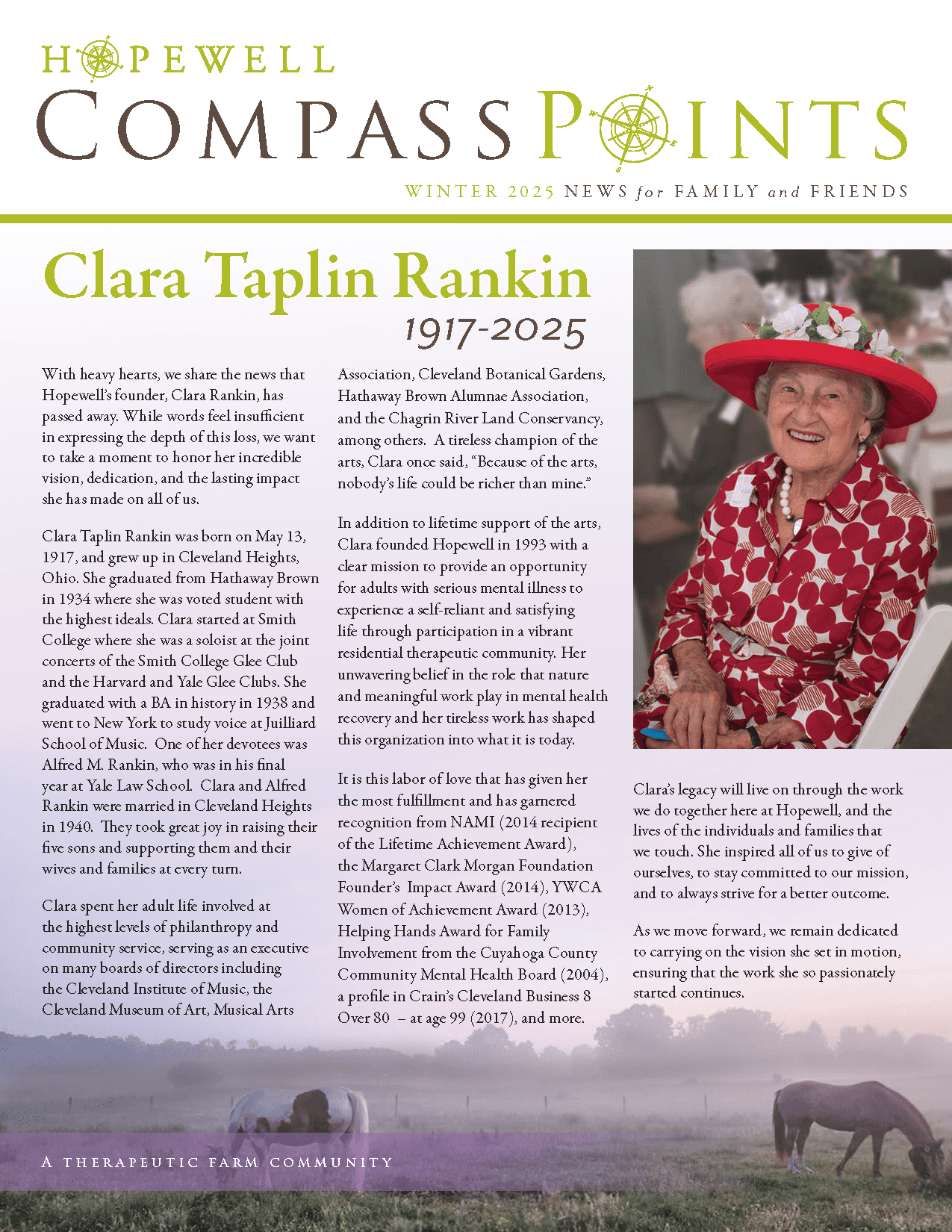
Winter 2025: Clara T. Rankin

With heavy hearts, we share the news that Hopewell’s founder, Clara Rankin, has passed away. While words feel insufficient in expressing the depth of this loss, we want to take a moment to honor her incredible vision, dedication, and the lasting impact she has made on all of us.

Clara T. Rankin, 1917-2025

Dear Hopewell Friends,

With heavy hearts, we share the news that our founder, Clara T. Rankin, has passed away. While words feel insufficient in expressing the depth of this loss, we want to take a moment to honor her incredible vision, dedication, and the lasting impact she has made on all of us.

Mrs. Rankin founded Hopewell in 1993 with a clear mission to provide an opportunity for adults with serious mental illness to experience a self-reliant and satisfying life through participation in a vibrant residential therapeutic community. Her unwavering belief in the role that nature and meaningful work play in mental health recovery and her tireless effort has shaped this organization into what it is today. She did not just create a non-profit—she built a strong community that will continue to thrive in her memory.

Her legacy will live on through the work we do together and the lives of the individuals and families that we touch. She inspired all of us to give of ourselves, to stay committed to our mission, and to always strive for better outcomes. As we move forward, we remain dedicated to carrying on the vision she set in motion, ensuring that the work she so passionately started continues.

While we mourn her loss, we also celebrate her remarkable life. Our thoughts are with her family, friends, and all who were blessed to know her.

Together, we will keep her vision alive, honoring her by continuing the mission she so deeply believed in.

Warm regards,

Colleen Welder, Executive Director

A Letter from a Behavioral Health Professional who Found their Working Family

Dear Reader,

Like any family dynamic, you have your ups and you have your downs. What distinguishes functionality is how the members react to those situations. When you are at 10%, you hope your family can supplement the other 90%; just as if you are at 100%, the hope is you support others through those situations. This concept can be applied to any organization and working team. Organizations may experience things like not meeting quarterly goals, unexpected turnover, and may have disagreements over policy changes, but how the team handles these hurdles defines a good organization.

When you work in a supportive working environment there is no hesitation to maintain transparency or ask for help. It just comes naturally. When there is a problem, you feel comfortable approaching your leadership for guidance or leaning on coworkers to problem-solve.

According to the Pew Research Center, as of March 2023, 49% of Americans stated they were satisfied with their jobs*, which means that more than half of the country is not content with their current occupation. So it begs the question, why? For some, it’s financial reasons, for others it’s workplace toxicity or work-life balance, and for some it’s not finding meaning in their work.

A good program will do its best to implement systems that address these issues, starting with leadership. Dr. Christian Peonsgen shared a diagram of a concept called Servant Leadership where it takes the traditional leadership hierarchy and flips it upside down

[image:1]

Good programs will incentivize loyalty with appreciation of employees’ dedication and hard work through things like bonuses, raises, and solid benefit packages, and they will do their best to meet market value regarding their salary. Your morals and ethics will never feel compromised from organizational decisions. A good program will actively listen to employees’ concerns and prioritize their needs to ensure they are met. When these needs are not met, an individual may be engrossed in a toxic workplace environment. Moreover, when they are not appreciated or respected by their team it can leave lasting trauma and lead to turnover.

When applying these concepts to the behavioral health field specifically, it is even more crucial for organizations to excel at caring for their staff. The behavioral health field is physically and emotionally demanding where the demand of services greatly outweighs the supply of treatment professionals. Often employment requires long hours, unsustainable caseloads, high pressure work environments, and a wage that does not fairly reflect the amount of work needed. Employees will work with individuals struggling with their mental and physical wellbeing while also struggling with their own. This begs the next question: why do folks do it? The simple answer is humanity. As Albert Einstein said, “Only a life lived in service to others is worth living.”

For some, the need and drive to help others overrides all else and is intrinsic. This is the case especially if those individuals are a part of vulnerable populations who have not been given the same chances and opportunities, whether in poverty, the young, the mature adult, the cognitively impaired, the mentally ill, the physically disabled, or the neurodivergent. They often make for the most complex and difficult cases. If it is natural for behavioral health professionals to provide this genuine care given some of these barriers, it should be natural for organizations, whether a facility, hospital, residential treatment center, outpatient counseling center, or other, to ensure they do their best in fostering quality care to those same employees. It is reflective of the care the organization provides their patients and clients.

Upon reflecting on my own work environment, I am certain I have found my working family, and I work for the best program and most incredible team. Everyone involved, staff and residents alike, receives the same genuine care and respect, and it can be seen day to day. Hopewell is not just a treatment program for residents, it’s a transformative holistic healing experience for staff included. You believe in the mission, you see the vision, and you resonate with the core values. The support of our team outweighs any hurdles, and that instilled intrinsic feeling of meaning drives you to do all you can to get individuals struggling with mental health the care they need and deserve. Meaningful work and community are fundamental to Hopewell’s therapeutic treatment. They are also fundamental to a good program.

Hopewell puts these values into practice by ensuring our basic needs are met from good benefits so we can maintain our own health and wellbeing, they encourage you to take your hard earned PTO, they offer options of flex time for working longer hours, they do their best to balance caseloads so clinicians can maintain individualized client centered care, they create committees for our ideas to not only be heard but put into changeable actions, they provide training and opportunities for professional growth to give us the tools for success, and they show appreciation in fair wages and celebrations. They invest in you, so you invest in them. That is what a good program can do for you, and I hope above all else you find your working family because when you do, you’ll know it.

Sincerest regards from Hopewell Farm,

Rachel McDonald

Sources:

*Pew Research Center: How Americans View Their Jobs | Pew Research Center

** Servant Leadership Diagram: https://www.linkedin.com/posts/christianpoensgen_great-leaders-dont-command-but-serve-activity-7288541128520257536-ctzu?utm_source=share&utm_medium=member_desktop&rcm=ACoAACBK3K8BahP7hY7KGbEA7SDP_-JzMFgr-7g

DONATE