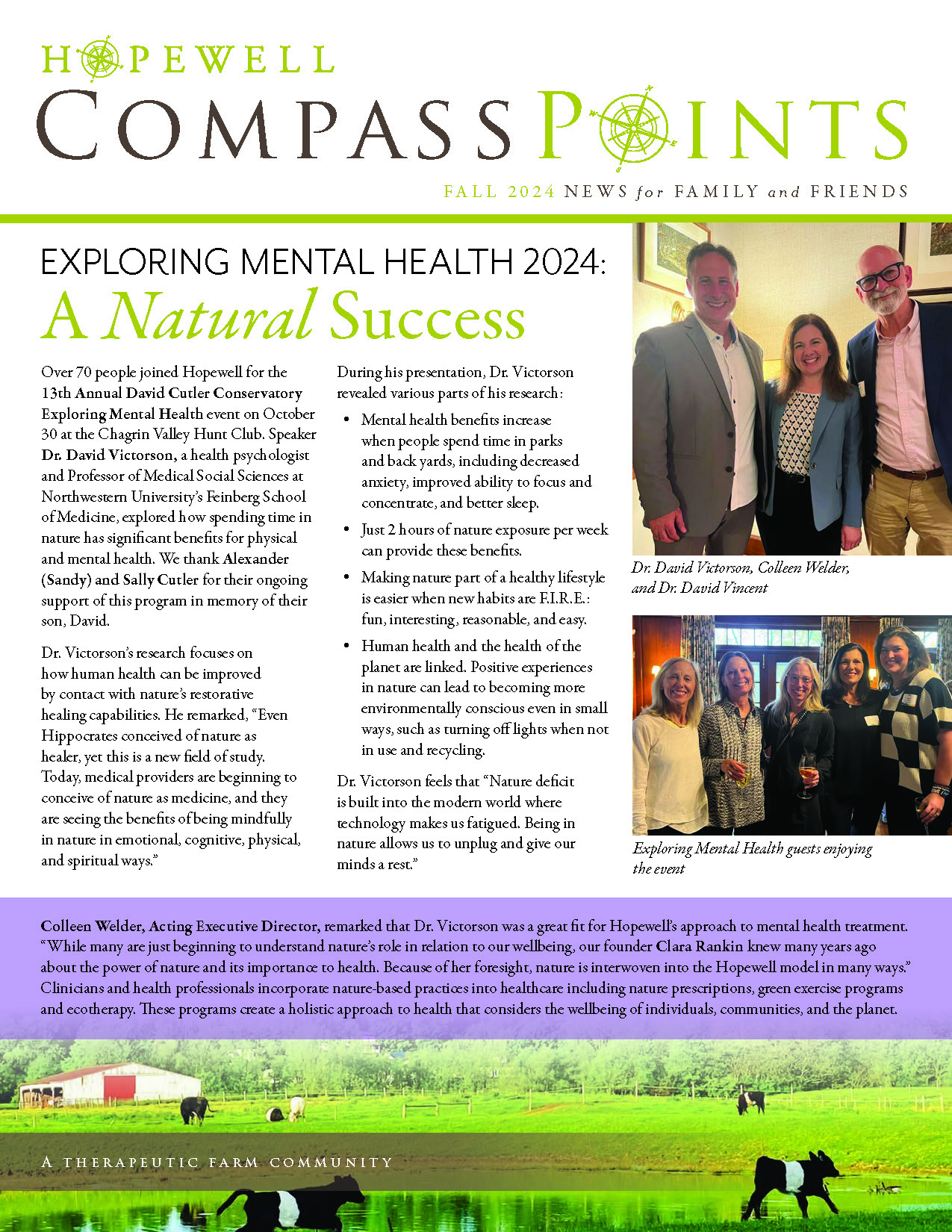
Fall is a beautiful time of year at Hopewell. Learn more about our Exploring Mental Health event, Save-the-Date for 2025 Summer Solstice, and experience our fall activities.
Month: November 2024
The “Dogter” Is In: An Exploration of Animal-Assisted Therapy and the Role of Animals in Improving Mental Health

By Heidi Moser, LPC, Hopewell Clinician
Relationships between human beings and animals have existed since the dawn of time (picture a big wooden boat floating around the flooded earth with two of every creature). Throughout history animals have provided food and transportation, helped tend fields, herded and protected livestock, served as police officers, guided the blind, and moved into our homes and hearts. More recently animals have even taken on the job of therapist as part of a treatment modality, Animal-Assisted Therapy (AAT), that is gaining increased recognition and research attention.
So what is AAT? What does it take to be a therapy animal? How is that different from a service animal? And what are emotional support animals? Read on as we explore these questions and more together.
Animal-Assisted Therapy (AAT) Definition
The American Veterinary Medical Association (AVMA) defines AAT as “a goal directed intervention in which an animal meeting specific criteria is an integral part of the treatment process. Animal-assisted therapy is delivered and/or directed by health or human service providers working within the scope of their profession. Animal-assisted therapy is designed to promote improvement in human physical, social, emotional, or cognitive function” (https://www.avma.org/resources-tools/avma-policies/animal-assisted-interventions-definitions). While the AVMA provides definitions and general guidelines for AAT, the AVMA is not a governing body of therapies involving animals. In fact, there is no one individual regulatory agency for the field.
What classifies an animal as a therapy animal can vary and depends upon the accrediting organization. Numerous organizations register or certify therapy animals and handlers. Some, like the Alliance of Therapy Dogs, certify canines only, while other organizations like Pet Partners (formerly the Delta Society) register multiple species of animals including guinea pigs, birds, and alpacas to name a few. Published information can be found in the Handbook on Animal-Assisted Therapy (now in its sixth edition) and the Standards of Practice in Animal-Assisted Interventions (https://therapyanimalstandards.org/), both of which provide best practices for individuals and organizations engaged in AAT.
Therapy animals must have proper training along with steady temperaments, and owners/handlers must be knowledgeable and able to work effectively with their pets. In addition to remaining under their handlers’ control, therapy animals must be able to remain calm and responsive in the presence of loud or unexpected stimuli, such as one might find in a public setting. A reputable certifying organization abides by published standards and will not grant status of therapy animal to just any pet (or owner). For instance, while my completely adorable Corgi, Ducky, is super friendly most of the time, she barks at kids in strollers and lunges at people on bikes when we are out walking. Such behavior effectively rules her out as a therapy dog (unless her lackadaisical owner works on habituating Ducky to these things, and even then, there are no guarantees).
Therapy Animals, Service Animals and Emotional Support Animals – Oh My!
Therapy animals and service animals have similarities, but service animals are often more specific in their function and go through more rigorous training and screening. Like therapy animals, service animals must meet certain criteria and be recognized by a certifying body. However, unlike them, federal laws allow for service animal provisions. According to the Americans with Disabilities Act (ADA) a service animal is defined as “any dog that is individually trained to do work or perform tasks for the benefit of an individual with a disability” (https://www.ada.gov/law-and-regs/regulations/title-iii-regulations).
Along with dogs, the ADA specifically recognizes miniature horses as service animals. According to the law, businesses and government agencies must make reasonable accommodations to allow a disabled person’s use of their service animal. It is important to note that the ADA is intended to provide legal protection for people with disabilities, not service animals apart from their owners. The law also requires service animals to be housebroken and under the control of their handlers at all times.
Hours and hours of work and expertise go into training a service animal, yet even then, not every animal that undergoes the training makes the cut. A steady temperament that is appropriate to the served person/population proves to be a major factor in whether that animal goes on to work as a service animal. For an interesting and in-depth look at what it takes to train (and become) a service dog, check out the Netflix documentary, “Inside the Mind of a Dog.”
Emotional support or assistance animal is a term used to describe an animal that provides emotional and/or physical benefit to their owner but does not necessarily have any formal training or certification like service and therapy animals do. While the ADA only allows provisions for service animals, the federal Fair Housing Act extends protection for disabled individuals and their emotional support or assistance animals. Once again, this law concerns individuals with disabilities, so if a person wants to move into apartment that does not allow pets, they need to have a documented disability in order to claim their pet is an emotional support or assistance animal.
Doctors and therapists are increasingly being asked to write emotional support animal (ESA) letters for clients. Whether or not an individual could be provided with an ESA letter depends on their diagnosis as well as the policy of their provider’s practice/agency on issuing such letters.
Animal-Assisted Interventions at Hopewell
So, how does all of this apply at Hopewell? Although Hopewell is first and foremost a working farm and does not offer Animal-Assisted Therapy per se, we do incorporate Animal-Assisted Interventions (AAI) into treatment, depending on a resident’s preferences and individualized service plan. The AVMA describes AAI as “a broad term that is now commonly used to describe the utilization of various species of animals in diverse manners beneficial to humans” (https://www.avma.org/resources-tools/avma-policies/animal-assisted-interventions-definitions).
At Hopewell residents can participate in Equine Assisted Learning, facilitated by Hopewell clinician, Annie Melinz, under the guidance of our Acting Executive Director, Colleen Welder, both of whom are avid horse enthusiasts and trained in this therapeutic modality. During this activity residents interact with the horses by walking with them, grooming them, and learning to read their body language and vocalizations. Residents also learn etiquette and manners around the horses and can gradually gain confidence through guiding the horses. Annie checks in with residents before and after the group and noted that residents report feeling more calm and “free” after working with the horses. The horses can also help residents process emotions through what they observe in the horses. Annie shared, “Horses can feel someone’s heartbeat from six feet away. Horses can pick up on and reflect how we are feeling.”
In addition, many residents and staff enjoy taking care of our resident horses (two minis and two full-sized), goats, pigs, turkeys, and numerous chickens. Residents feed the animals, clean their stalls, brush the horses, escort the horses and goats to the pasture, and feed and collect eggs from the chickens. Hopewell also has a herd of Belted Galloway cattle (picture giant roaming Oreo cookies that chew their cud and moo). Four calves were born this year! What a joy it was to see the little ones in the field among the herd. One of the calves, named Macy, was sadly rejected by her mother and had to be bottle fed. Needless to say there was competition among the Hopewell community when it came time to feed her.
A resident who recently completed her treatment program and returned home to her family was asked how interacting with the animals at Hopewell impacted her treatment. She replied, “It gave me relief during the day, helping them. They helped with anxiety and calmed my nerves.” Noted among the experiences that stand out most for her was feeding the baby calf which she described as “special.”
Another opportunity to interact with living creatures at Hopewell includes weekday fish feeding at one of the two ponds on campus. Strange as it might sound, residents and staff particularly enjoy the appearance of four large catfish that seem to be able to tell time (or perhaps more accurately detect the presence of footsteps on the dock). One resident who regularly attends the fish feeding stated, “I think the time I started feeding the fish is when I began to participate more in other activities as well.” This resident was instrumental in naming all four of the catfish and knows them so well that he can easily pick out each one!
Animals appear to help facilitate residents’ engagement in the Hopewell therapeutic farm community through sharing in enjoyable activities involving the other living creatures who reside here. Connection with others is an important part of achieving and maintaining wellness, but for those struggling with mental health conditions, sometimes interacting with other people proves challenging. Connecting with and through animals can be more accessible for some, especially those who may struggle with social anxiety.
The Human-Animal Bond
All the above examples speak to the healing effect animals can have in our lives and demonstrate the power of the human-animal bond. It is well known that interacting with an animal can improve human physical health. Research has shown that spending time with animals can reduce stress and even decrease blood pressure. When one considers the mind-body connection, it makes sense that animals improve our mental wellness, too. People report less depression and anxiety after spending time with animals. Animals offer us companionship and can be a good cure for loneliness.
But one does not need to be a Hopewell resident or in an animal-assisted therapy program to reap the benefits of animal assisted interactions. While animals are certainly not for everyone, those of us who have ever loved a pet are well aware of the meaningful and unique nature of the human-animal bond. Taking care of an animal involves getting up off the couch to walk the dog, play with the cat, exercise the horse, etc. Pet owners experience a sense of responsibility and satisfaction in caring for something other than themselves.
Animals can make us smile and laugh, enriching our lives in countless ways. Aside from providing food and shelter, one might start to wonder whether we do as much for them as they do for us. Although they regularly communicate with us in other ways, if animals could speak our language what might they say about the human-animal bond?
Meet Heidi Moser, LPC

Heidi Moser’s favorite place on the farm is on the stone wall, pictured above. A resident recently added cairns to the wall, short piles of stones that guide hikers on otherwise unmarked treks in the wilderness. To a hiker, those cairns say, “This is the way.” It’s hard to believe but until recently, Heidi did not know what those cairns signified; however, it seems that they’ve been guiding her way forward all along.
The Journey Begins
Heidi’s pathway to Hopewell began after college when she lived in Manhattan. Her first introduction to the world of counseling was as an administrative assistant in the department of counseling and clinical psychology at Columbia University’s Teachers College. Eventually she realized she wasn’t really a city girl (as she puts it) and returned to Ohio to live near her parents. Imagine an invisible cairn showing the way – a first left turn in her journey.
“I looked back at my life and animals were very important to me. I didn’t want to become a veterinarian, so I pursued an Associates of Applied Science in Veterinary Technology,” Heidi said. “Most people think of vet techs as the nurses of the veterinary field, but I found a position at a diagnostic vet laboratory. I loved being a scientist and I stayed for 18 years.”
Heidi bought a home on the Mahoning River and discovered a new love of kayaking. “I love being in nature but I had never set foot in a kayak until I bought the house. I made my maiden voyage in my backyard,” she quipped. “Being on the water brings me a real sense of peace, tranquility, and connectedness to the natural world.”
Back to Psychology
In 2015 Heidi picked up a remote position at the A.K. Rice Institute, a nonprofit organization that studies how unconscious thoughts and feelings impact our lives when we are in groups. This brought her back to the world of psychology, and a realization that she needed to find more satisfying work. Cue another turn on the pathway.
Heidi returned to school, earning a Master of Science in Education in Clinical Mental Health Counseling in 2021. She worked in an outpatient substance abuse and counseling facility as well as a private practice, and earned her credential as a Licensed Professional Counselor (LPC).
Finding Hopewell
“At one point I found a Hopewell brochure and I started following Hopewell on Facebook. I remember saying to myself, ‘That’s my dream job!’” Heidi said. When she learned about a job opening, she applied and joined the team in February 2024. Those invisible cairns were leading her to a new resting place.
At Hopewell, Heidi provides individual psychotherapy and cognitive behavioral group therapy to residents. She co-facilitates a 12-step informed recovery group and a group using Exposure and Response Prevention (ERP) for Obsessive Compulsive Disorder, and she is training for certification in Eye Movement Desensitization and Reprocessing (EMDR).
“Every day at Hopewell has something to offer. I enjoy interacting with residents and participating in community activities. Taking residents on a nature walk is one of my favorite activities,” Heidi said. “It’s so cool to see people improving, making changes, and watching their lives improve. That’s an encouraging thing to see and it’s what keeps me going.”
The Traveling Life
Heidi has always carved out time to travel, looking for beautiful landscapes and nature both at home and abroad. A big believer in independent journeys, she often adventures solo. “I do a lot of homework in advance so I can be spontaneous and do my own thing. Even as a woman alone, that’s more appealing to me,” she said. To keep track of her travels, you’ll need a global map and some pins.
She has visited Italy a couple of times and has made a few trips to Great Britain. Her last big trip abroad was just before the pandemic in March 2020, when she went to Iceland, rented a car, and drove the Ring Road around the entire perimeter of the country by herself. Heidi recalled, “It was quite the experience. Over ten days I saw incredibly beautiful fjords, glaciers, waterfalls, and even some reindeer on the winter tundra landscape.”
Heidi really lights up when she describes one of her travel bucket list items: walking the longest Pembrokeshire coastal pathway in Wales. “This is the most mind-blowing coastline in Britain. I’ve hiked part of it before but I’d love to hike the whole thing, which is 186 miles long. One website has broken down the hikes into chunks you can do in a day, then a bus takes you to overnight accommodations.” She’ll likely find plenty of cairns marking the pathway.
Care to Cycle?
Heidi’s love of professional cycling led to some stateside wandering experiences. She traveled in California and Colorado working as a marshal for week-long staged races. “It was really fun, riding around from spot to spot with a team of people in a van, seeing beautiful areas, then jumping out to direct the racers. Unfortunately, the pandemic put a fork in that as racing lost sponsorship,” she said. “Now I’d attend races as a fan: just walk up a mountain and watch a race go by.”
The Tour de France captures Heidi’s interest every year. “Another travel goal is to watch the first stage of the race, the Grand Depart, when cyclists often begin the race in other countries. Then I’d go to France, have a picnic in a field and enjoy a good French cheese as the riders go by.” Quite the relaxing visual!
Free time at home means hanging out and hiking in the woods with her two corgis, Patch and Ducky. Heidi used to go mountain biking but now finds it more enjoyable to travel with her bike. Recently she rode the trails with a friend in a beautiful area known as the Grand Canyon of Pennsylvania. If she gets lost or wanders away from a trail, you know she’ll be looking for cairns to guide her way home.
Hopewell and the Financial Dynamic

By Savannah Schindelar, Admissions Coordinator
Families considering Hopewell for their loved one’s residential mental health treatment may raise concerns about financial arrangements. We are a nonprofit private pay facility with some limited access to insurance coverage and we understand that long-term treatment may strain the pocketbook. However, we pride ourselves in doing everything that we can to reduce the financial burden.
Insurance Coverage
One of the first questions families ask is whether Hopewell accepts insurance. Due to our average length of stay (6-9 months) and our niche type of care, we rarely see full coverage from any insurance provider. Here is a brief summary of the current options.
- Commercial and Private Insurance: We are in network with Anthem Blue Cross/Blue Shield plans that are not Medicaid. We work to get authorization but coverage is never guaranteed.
- Medicare and Medicaid policies unfortunately do not cover our room, board, and treatment costs. Those policies generally cover individual costs such as doctors’ appointments and medications.
Financial Assistance
Many generous donors and foundations support Hopewell’s programs, and fortunately we are able to offer significant financial assistance to those who are eligible. We ask all families who request financial assistance to fill out an application. We can then determine a percentage reduction to our daily rate, reducing the fees as much as 75%. At present, up to 85% of our residents receive some level of fee assistance in this way.
The Utilization Review Process
As a courtesy, for any individuals who have a commercial insurance provider, we will run a Verification of Benefits. This verification lets us know if a policy offers in- or out-of-network benefits. This is important for those residents who come from outside the state of Ohio, as out of state policies can differ in what coverage they offer for services outside of the providing state.
Families can learn about policy details ahead of time by calling the member services number located on the back of their insurance card. Member services is a great resource for inquiring about facilities that are in network with the insurance plan.
An important takeaway: Due to ever-changing provider/program relationships, we advise families to always check with their insurance provider AND the treatment program they are interested in to make sure this information is the same.
What does authorization entail?
Authorization for insurance coverage is not a guarantee of payment but rather a green light for services that could be covered by the insurance provider. Authorization is pursued within 24 hours of a resident’s admission to Hopewell. A call is placed to the insurance provider’s authorization line. Clinical information is given to the clinical case manager assigned. A determination is made by the clinical case manager on the basis of diagnosis, severity of symptoms, and need for residential level of care.
Upon approval, the insurance provider offers a number of days of treatment. At the end of the authorized days given, another call is made to either pursue further authorization or provide discharge updates to close the case.
Why does insurance provide such limited coverage at Hopewell?
Hopewell provides a residential level of care for mental health, a categorization that is common knowledge to insurance providers. However, most insurance companies are used to levels of care such as 7-10 day stays for inpatient care in crisis scenarios and involuntary admissions, or up to 30 days for stabilization and medication management. Hopewell does not provide these types of care; therefore, discussions with insurance providers often require educating them about our treatment model.
Hopewell offers a very niche, longer-term level of care (up to an average of 9 months) that does not have 24/7 observation, crisis admissions or a related medical component to the program outside of medication management services. Due to this, insurance often finds it hard to justify coverage as we are unique in our treatment for mental health.
Since Hopewell is a unique environment offering independence for our residents, an unsecured campus and freedom to make choices in their treatment plan, insurance will often ask why residents couldn’t simply participate in a Partial Hospitalization Program or Intensive Outpatient services. (Note: These treatment models are non-residential full and half-day programs, which Hopewell does not offer.)
Our clinicians do their best to thoroughly document clinical recommendations for residents. They are careful to explain the need for longer-term participation in our program to help give residents time to improve their living skills in a safe and stable environment.
A Final Word
I am dedicated to pursuing help for individuals who need the kind of residential care the Hopewell offers. The conversations that I have with most clinical case managers on the insurance end revolve mostly around educating about our type of our type of program. Every day I see Hopewell residents benefitting from the care that Hopewell provides. It takes a village, and I am happy to have this role in the community.
821 words