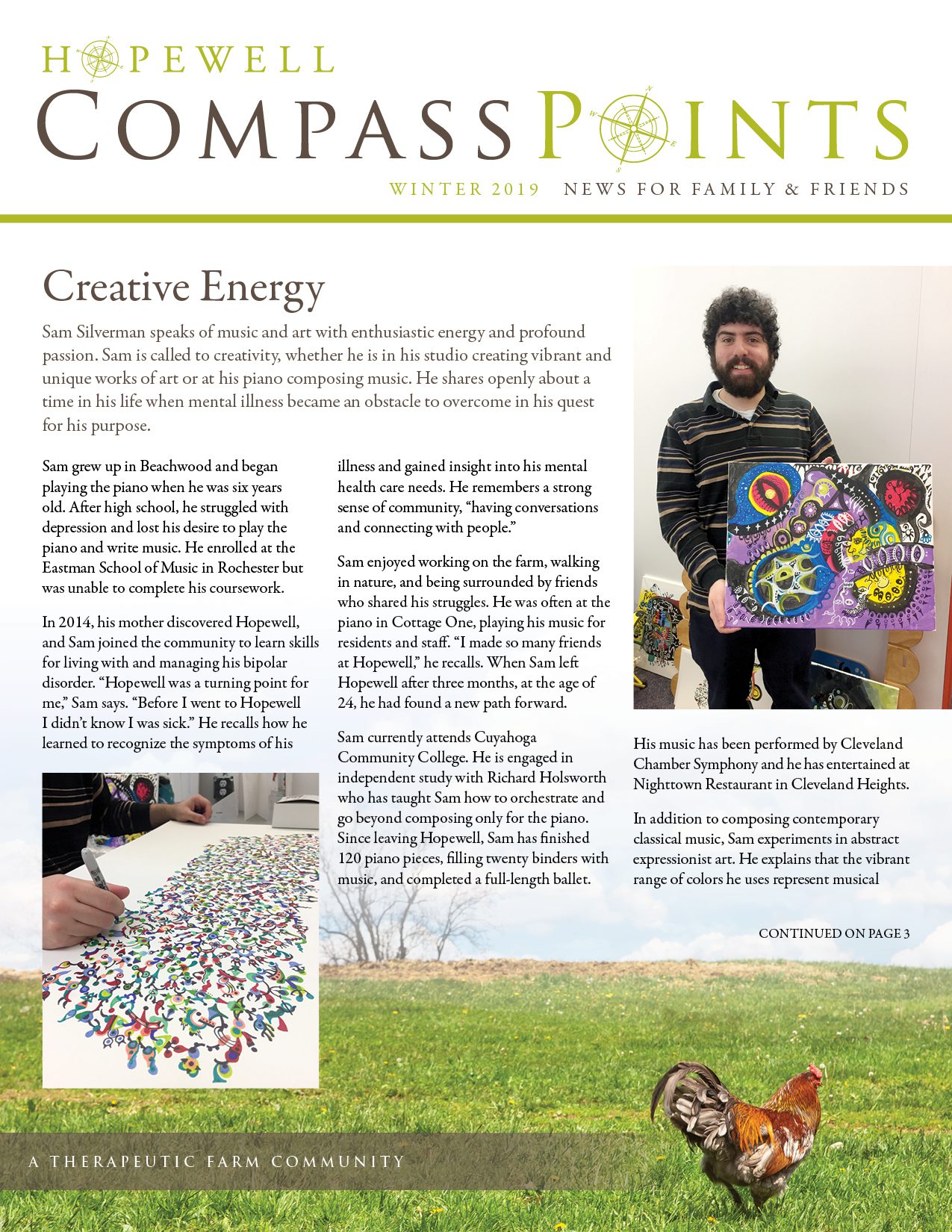
Sam Silverman speaks of music and art with enthusiastic energy and profound passion. Sam is called to creativity, whether he is in his studio creating vibrant and unique works of art or at his piano composing music. He shares openly about a time in his life when mental illness became an obstacle to overcome in his quest for his purpose.
Month: February 2019
Art Studio Gets a Makeover
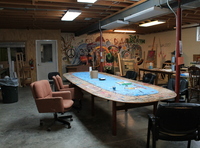
With generous grants from the Veale Foundation and the Eric and Jane Nord Family Fund, Hopewell recently completed a significant renovation of the farm’s Art Studio, located in the basement of Cottage Two. The renovation’s first phase included the installation of sheetrock, new drop ceilings, electrical work and improved lighting, and plumbing. A second phase saw the installation of new storage cabinetry, a paint booth, sink, painting, and the acquisition of equipment and supplies.
One aim of the renovation was to create discrete spaces within the existing art studio for specific art media work. The space now contains much-improved and separate stations for painting, sculpture, pottery, fiber arts, jewelry-making, and other creative arts. Funding was also used to acquire several pottery wheels to complement the program’s existing kiln equipment, making it possible to conduct pottery classes involving several residents at a time.
According to Hopewell’s art therapist, Mary Cassidy, “The objective of our art therapy program is to provide our residents with purposeful work that instructs, challenges, and provides a safe place for our residents to practice real world skills, including showing up on time, following instructions, working with others, problem solving, and risk-taking.”
“Over the past several years, the types of projects selected for our art crew wares have been intentionally chosen based on their therapeutic value – projects that are group oriented, environmentally friendly, skill-focused, and have a practical purpose,” Mary said. “Further, the projects for work crews are selected based on alignment with our holistic approach to treatment. It is important that our residents are given the opportunity to connect with the ‘why’ of creativity, and how it pertains to their personal healing journey, the benefit of our community, and the wider world,” Mary said.
CHANGES AT THE CRAFT MARKET
As a result of this evolving philosophy, and due to limited public traffic, the Hopewell Farm and Craft Market will remain open by appointment only. It will maintain its storefront presence for public access and to serve as an inventory and display space for the farm’s wares, including artwork, candles, pottery, textiles, maple syrup, and wood shop products. Hopewell staff and residents will expand the public presence of our art therapy program by participating in several community art and craft shows each year, and providing Hopewell products for sale at regional consignment shops.
In addition, profits made in sales from Hopewell products will be donated to outside mental health organizations and services, which the community (residents and staff ) will have an opportunity to submit for consideration and select together.
Mary explained, “The purpose of this is to strengthen our commitment to community as a healing force, and by paying it forward the work we do will go directly to help others who need the support. We believe we can extend the therapeutic value of our work by actively fostering such connections with the wider community.”
The community is planning a grand reopening of the Art Studio, and what Mary describes as an “art-activism show” in the fall to give residents a platform to share their personal experiences with mental illness and educate the public on their recovery journeys.
Crisis Intervention Team Training
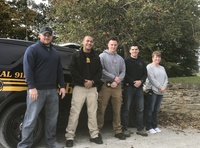
Crisis Intervention Team Training The Trumbull County Mental Health and Recovery Board (TCMHRB) and the Ohio Chapter of the National Alliance on Mental Illness sponsored Crisis Intervention Team (CIT) training for 21 law enforcement officers in early October. Candace Carlton, our Quality Improvement and Compliance Director, and John Myers, CIT Program Coordinator, arranged for four deputies who cover our jurisdiction to visit Hopewell as part of their training.
CIT programs educate law enforcement about local resources, treatment, and supportive services for people experiencing mental health crises. Trainees learn about helping people with mental illness, addiction, and developmental disabilities, and learn and practice skills needed to de-escalate different situations. According to Mr. Myers, “Research has established CIT’s effectiveness in developing better understanding of mental illness, improved crisis response, increased jail diversion, increased continuity with treatment providers in the community, and improved safety for officers as well as the persons they are called upon to deal with, and the larger community.”
Hopewell staff have been thoroughly trained in CIT responses, including verbal de-escalation. Candace explained, “When someone is in crisis, our policy is not to physically restrain residents unless someone’s life is in danger. If a resident is not responding to staff intervention, we follow established protocols and call for law enforcement when necessary. We must keep the other residents and staff safe.”
After an incident, staff members debrief the witnesses and anyone else involved. Candace said, “Some residents have had previous negative experiences with the police and we encourage them to process their feelings. We have observed that when a CIT trained deputy is involved, the aftermath is less traumatic for everyone.”
The site visit was a win-win situation for everyone. Of the four visitors, only one had been to Hopewell in the past. Candace explained our treatment approach and the population we serve, and took the deputies on a tour of the farm to familiarize them with our facilities. “The deputies now know what to expect when they respond to a call from Hopewell,” said Candace. “More importantly, when we ask for a CIT trained deputy, we know that residents will be treated with compassion and respect.