Close

Who We Are

Strategic Plan

Board of Directors

Staff

Annual Reports

Overview

Transition Services

Sample Daily Schedule

Facilities Tour

Overview

Measuring Success

Success Stories

For Caregivers

For Professionals

Fees for Service

Apply

Corporate Partners

Planned Giving

Donate

Wishing Well

Exploring Mental Health

Summer Solstice 2026

Measuring the Effectiveness of the Hopewell Model

An article in the Sunday Review section of the January 17 issue of The New York Times (“How Measurement Fails Doctors and Teachers”) described the current fervor regarding outcomes measurement and accountability as possibly jeopardizing the quality of health care and education in the United States. However, the Times states, “We need more targeted measures, ones that have been vetted to ensure they really matter.”

“At Hopewell, that vetting process is paramount,” said Karges, Executive Director/CEO of Hopewell. “Since 2006, Hopewell has gathered and accessed data regarding the effectiveness of its programs and their impact on the recovery of its residents.”

Hopewell’s Outcomes Measurement Team is led by Candace Carlton, LISW-S, Quality Improvement and Compliance Director, and Sherry Bacon-Graves, BA, Outcomes Coordinator. The team also includes Sana Loue, PhD, MSSA, MA, JD, Hopewell’s Research Consultant from Case Western Reserve University. Dr. Loue meets regularly with Carlton and Bacon-Graves, providing training on research techniques and the most effective methods of data analysis.

This team works with the Research Committee of Hopewell’s board of directors to gather, analyze and report the periodic systematic measurements of each resident’s progress as well as the effectiveness of each of Hopewell’s programs as evidenced by the residents’ progress, according to Karges. Over 70% of Hopewell residents have moved successfully into more self-reliant settings.

“Our outcomes measurement results show clearly that the Hopewell Model of care is effective,” Karges continued. “The results lead us to improvement and may lead to programmatic changes. Often, the results indicate the need to replace older measurement tools with newer ones or to create customized tools as new programs are developed.”

Please read Hopewell’s Outcomes Report for measurements and more information.

About Hopewell

Hopewell is a 300-acre residential working farm located in Mesopotamia, Ohio, where adults with schizophrenia, bipolar disorder and major depression learn to manage their mental illness and return to independent life. Hopewell is the only therapeutic farm community in Ohio. It is ODMHAS-licensed and CARF-accredited. Hopewell is a member of the National Alliance on Mental Illness and the American Residential Treatment Association.

Information and assessments are available by contacting Daniel Horne, director of admissions, at 440.426.2009. Visit www.hopewellcommunity.org.
Resident Writing Feature – Bill Sears

Residents at Hopewell are encouraged to heal and grow in ways that work best for them. One of the outlets available is a therapeutic writing group. A number of residents gather together, draw prompts, and express themselves through verse. We are excited to showcase some of the talent and creativity that is shown in this group.

Today’s resident writing feature is by Bill Sears. His prompt was “Your inner parent is about to ground your inner child.”

I relapsed in behavior when I came to Hopewell. I had already fallen to relapse in my addiction but old behaviors began to crop up. Before my break in Memphis, I lived in relative peace but was hardly functional. I was no longer attention seeking, no longer driven by my fears, but was still grandiose in my image of myself.

The inner parent in me tells me to find peace with everything and do only good. Find peace with attention, have no fear of what I can’t control. Find peace with the fact that I’m not a savior to the world.

My child self is restless. He calls for action and resolve for every living being and equal treatment of all things.

One side calls for action towards this in my life, the other calls for the resolve of internal struggle. Peace with pain outside my control. A choice. Why is one set of values and rhetoric superior to another? Equality. Peace. Peace is the only thing outside of rhetoric.

To be a peaceful warrior. A warrior for peace. To fight against mental illness and all that is wrong. To resolve and let go. To give up and find peace.

A choice.

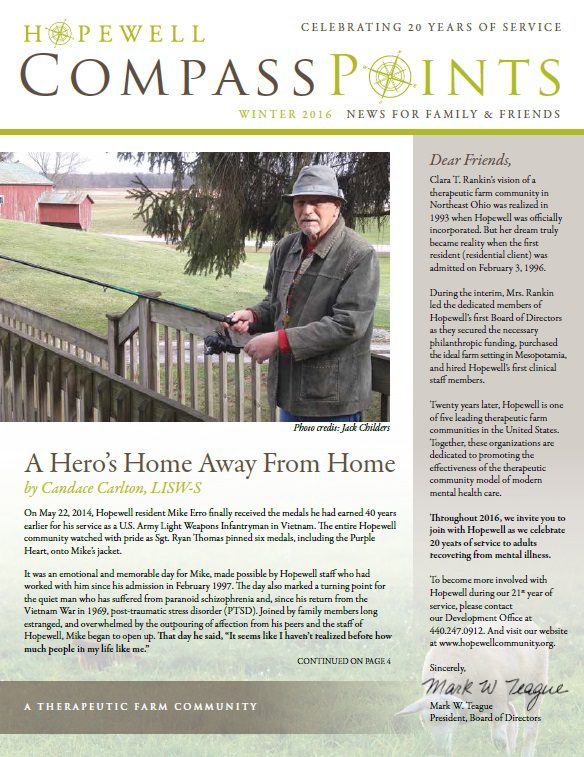
Winter 2016: A Hero’s Home Away From Home

On May 22, 2014, Hopewell resident Mike Erro finally received the medals he had earned 40 years earlier for his service as a U.S. Army Light Weapons Infantryman in Vietnam. The entire Hopewell community watched with pride as Sgt. Ryan Thomas pinned six medals, including the Purple Heart, onto Mike’s jacket.

It was an emotional and memorable day for Mike, made possible by Hopewell staff who had worked with him since his admission in February 1997. The day also marked a turning point for the quiet man who has suffered from paranoid schizophrenia and, since his return from the Vietnam War in 1969, post-traumatic stress disorder (PTSD). Joined by family members long estranged, and overwhelmed by the outpouring of affection from his peers and the staff of Hopewell, Mike began to open up. That day he said, “It seems like I haven’t realized before how much people in my life like me.”

DONATE