Twenty years after the arrival of its first resident, Hopewell is among the leading therapeutic farm communities in the country. The “Hopewell Model” of holistic mental health care is based on a combination of…
Month: December 2015
Work as Therapy
At Hopewell work plays an essential role in our treatment approach and “community as healer” model of care. Our focus is on helping our residents realize a more sustained recovery and improved level of functioning in managing their illness, through engaging in meaningful work-related activities. This experience often leads our resident to achieving a greater sense of self-confidence and self-reliance while learning and developing meaningful work skills that they may choose to draw upon after leaving Hopewell.
While all members of the Hopewell community are working on their own identified goals, they too, are engaged in helping and supporting each other’s progress as well. For both residents and staff, working together, learning together and experiencing together are all essential aspects of our dynamic, healing community.
As Hopewell is a working farm community that focuses on engaging in sustainable practices, our work crews play a vital role in helping to maintain our day-to-day operations. Each resident, upon their admission to Hopewell, has the opportunity to choose to serve on a number of designated work crews. These assignments include experiences with farm, food service, garden, maintenance, housekeeping crews as well as the opportunity to assist in the art room. Woodshop and Farm & Craft Market.
Coupled with a range of other clinical and therapeutic interventions, as well as medication support, Hopewell’s work program plays a critical role in our “whole person” approach to care. It serves to provide greater meaning and reward in helping others, an enhanced sense of self-who, a feeling of contribution ad social inclusion and an opportunity to build on work-oriented interests and skills.
Treating the “Whole Person”
Hopewell is committed to serving the “whole person” (i.e. mind,bodyand spirit) within the context of a safe, nurturing and supportive environment. We also recognize the importance of integrating the power of nature andcurrentstate of the art therapies in helping individuals with serious mental illness recover and experience sustained healing. We value each individual as unique, creative and gifted in their own way.
As such, a key component of Hopewell’s therapeutic milieu will continue to be the incorporation of expressive arts. Utilization of such media as painting, psychodrama, dance, sculpting, music, journaling, sketching and expressive arts are geared to “bridge the gap between the conscious and unconscious.” They can bring insight to areas of therapy that are blocked, inhibited or stuck and bring greater focus to those areas of need and or concern. Expressive arts can spark creative imagination, problem-solving and integrative learning through a variety of sensory experiences. The deepening and enriching experiences that expressive arts therapy offers supports a richer and more vibrant therapeutic environment throughout the Hopewell Community.
Hopewell’s professional commitment to the expressive therapies has been further enhanced through the hiring of Mary Cassidy, a certified art therapist and counselor in September 2015. Mary earned a B.A. in Art History from John Carrol University and a Master’s Degree in Art Therapy and Counseling from Ursuline College. This addition of staff expertise and programming has resulted in our residents having exposure to an even wider range of treatment options and techniques.
What is Moral Treatment?
The concept of “moral treatment” focuses on treating individuals with equality and respect within the context of a healthy living-learning environment. Furthermore it is an approach that values people being able to freely express their feelings and views, as well as, actively participating in decisions affecting their lives. Hopewell’s “therapeutic community” approach is based on many aspects of earlier moral treatment models, including identifying the “community” itself as a modality for change and incorporating a holistic bio-psycho-social orientation to promoting wellness and sustained recovery. Mutual self-help principles, engaging in work, physical exercise, connecting with nature, eating healthy, modeling virtuous behaviors and promoting the value of teamwork and effective medication management are all important components within Hopewell’s therapeutic community.
Fall 2015: Self-Expression – The Art of Healing
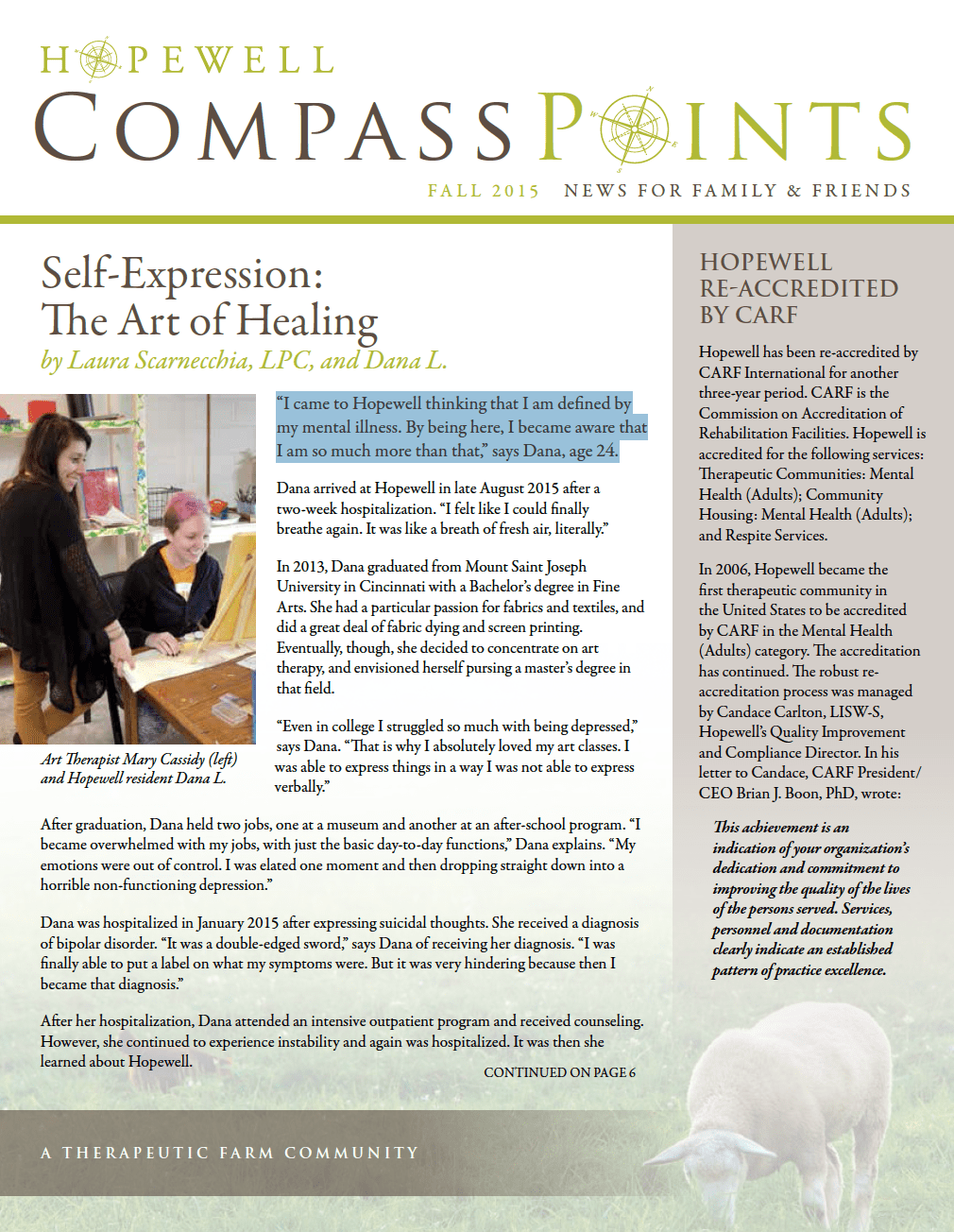
“I came to Hopewell thinking that I am defined by my mental illness. By being here, I became aware that I am so much more than that,” says Dana, age 24.
Dana arrived at Hopewell in late August 2015 after a two-week hospitalization. “I felt like I could finally breathe again. It was like a breath of fresh air, literally.”
In 2013, Dana graduated from Mount Saint Joseph University in Cincinnati with a Bachelor’s degree in Fine Arts. She had a particular passion for fabrics and textiles, and did a great deal of fabric dying and screen printing.