Author: Ann Thompson

What to Bring to Hopewell

Click below for a comprehensive list of what to bring for your stay as a Hopewell resident.
2020 Annual Report
2020 was a year in which Hopewell celebrated twenty-four years of service to adults with serious mental illness. Building on the vision and hard work of our founder, Clara T. Rankin, Hopewell has continued to grow and evolve to meet the needs of our residents and their families.
Telehealth Communication

Last month a majority of mental health providers were suddenly thrust into the world of telehealth. If you were one of these practitioners, you have likely developed an opinion of working over video. My very unscientific polling of colleagues indicates people tend to be polarized into one camp or the other (love/hate). Telehealth is new for many, and one thing I know about new experiences is they tend to be uncomfortable. Having done my first telehealth session in 2013, I was somewhat prepared to jump into the environment, and yet not. I have never done telehealth within a residential facility, and never without new equipment in spaces set up specifically for this purpose. All new situations come with a learning curve and telehealth is an ever changing opportunity to learn.
Therapy can be somewhat uncomfortable for providers right now as we navigate a new world of helping people live through and manage the stress of a current traumatic situation that we ourselves are not sure how to navigate. We do not know how to do a pandemic. We are learning as we go, hopefully changing our process in a positive way.
Our friends at ideastream reported on a new study https://www.annfammed.org/content/18/3/272) identifying ways that practitioners can build stronger relationships over telehealth. (https://www.ideastream.org/news/new-study-suggests-ways-doctors-can-foster-relationships-through-telehealth)
Practitioners can work on developing their telehealth skills to improve their outcomes and experience with this modality. There are a ton of trainings right now related to this, but the best I’ve seen is here. (https://www.nicabm.com/improving-telehealth-sessions/ )
Telehealth provides new and exciting possibilities for reaching clients. We can create a new normal that allows us to remain connected while physically apart.
Forest Bathing
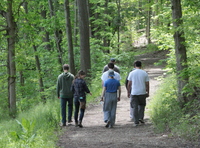
Many people enjoy spending time in nature. But did you know that time among the trees is therapeutic? Forest therapy is a growing practice that promises benefits for your mind and your body.
It can help you relax and refuel — and give you a break from the devices, worries and stress that can dominate your daily life. The Cleveland Clinic said, “Take the time to breathe deeply and turn your focus inward. If you can, get yourself outside among the trees. Leave your screens, your deadlines and your worries behind. It’s worth it — even if you can only spare a few minutes.”
Every Friday, you can experience a forest walk with Christina Goodall, LISW-S, as she wanders the beautiful Hopewell landscape. To register, email Chris at cgoodall@hopewell.cc.
Spring 2020: Hopewell Happenings

VISITING ARTIST OPPORTUNITY
Hopewell is currently seeking applicants for our 2020 Visiting Artist Program. Our visiting artist program is designed to foster an alliance between the creative arts and wellness. We are seeking artists who value the connection between mental health and artistic expression, and who are interested in exploring this intersection through instruction, collaboration, and community engagement. Through this program, it is our vision to connect individuals experiencing mental illness with creative and innovative approaches to healing and recovery. As a visiting artist, you will be invited to stay on the farm in a private apartment for the duration of your artist workshop. Meals with the community will be provided, and artists will have access to studio space as well as the rest of our 306 acre working farm, including hiking trails, ponds, and natural sanctuaries. Artists will be expected to run a minimum 2 day workshop that will provide instruction of their craft to our residents. Projects may be tailored to individual or group work. Artists will also be asked to donate a creative piece of their own making that will reflect the visiting artist experience. Cost of supplies, up to $500, for running the workshop will be covered by Hopewell and artists will receive an additional $500 stipend at the completion of their stay. To learn more about the type of work we do at Hopewell, please visit our website at www.hopewellcommunity.org.
To apply for our visiting artist program, please submit: • Resume or CV • Letter of intent stating your specific interest in working with Hopewell and how involvement will influence your work • Three professional references • Portfolio work that clearly demonstrates what you will provide for the workshop
Submissions and any other inquires may be sent to Mary Cassidy at mcassidy@hopewell.cc.
2019 Annual Report
As Hopewell nears the celebration of our first quarter century of service to adults with serious mental illness and their families, we are profoundly grateful for the hard work and support of many, including Board members, our caring staff, volunteers, donors, and especially the residents themselves. Together we have created a community of healing, where people can learn to manage their illness and develop the skills they need to live successful, productive and happy lives.
Fall 2019: Richard J. Swadey Community Center

A rainy autumn evening didn’t deter more than one hundred members of the Hopewell community from coming to the farm on Wednesday, October 16, for the dedication of our newest facility, the Richard J. Swadey Community Center.
The Value of Helping College Students with Schizophrenia Socialize

Navigating mental health issues while away from home can be difficult for any college student, but especially for those with schizophrenia and schizoaffective disorder. Compared with other students, students with schizophrenia are 70% more likely to become college drop-outs. Schizophrenia disrupts the ability to differentiate between reality and psychotic episodes, potentially leading to paranoia and, consequently, anxiety in social settings such as school. But a schizophrenia diagnosis does not automatically end a college career. And for students who take a leave of absence due to psychotic episodes, returning to college can be beneficial for recovery.
Whether a student with schizophrenia is just starting college or returning, counselors who establish relationships with them, working to set goals and to connect them with campus groups, help to establish a foundation for success in college and in building friendships.
College Offers Structure
Routines keep patients on track with recovery. Schizophrenia is marked by disorganized thinking ― a class schedule can offer stability during an otherwise chaotic day.
Combined with regular counseling appointments, college students with schizophrenia can develop coping skills and re-introduce themselves into social situations. Family can also support students during this time and act as models for successful social interactions. In other words, familial relationships are models for how students will interact with their peers, and if families can showcase stable interactions, this will allow students to develop and foster relationships as their daily routines grow and shift.
Students Develop Their Identities in College
College is an important developmental time in a student’s life. Seventy-five percent of individuals with mental illnesses show symptoms by age 24 ― an age by which many are or are becoming functionally independent. University counseling centers can assist students to incorporate themselves into the college community — supporting development of an identity that integrates, not ignores, their struggles.
Socializing students with schizophrenia allows them to explore different aspects of their personalities that they may not be able to understand on their own. Review anxiety-inducing interaction themes with clients to better understand their social tendencies. Some students might feel most anxious in the classroom when they need to participate in academic conversations or take tests. Others might feel most apprehensive in their dorm rooms communicating with roommates; some might become paranoid as they walk around campus. Counselors might encourage family and childhood friends to help students with schizophrenia understand how they react to different situations, and to identify beneficial characteristics they may want to seek out in friendships and romantic relationships.
Support Systems on Campus Help Students Grow
The stigma traditionally associated with mental illness has been on the decline. As students acclimate to college, they are becoming more open to the idea of seeking help from mental health professionals if they are struggling ― 79.9 percent of college students would consider seeing a mental health professional if their health was declining.
Mental health advocacy groups and clubs on campus such as Students with Schizophrenia can be effective resources for students trying to socialize and adjust to college life with this diagnosis since members already have common interests. Plus, having peers who are encountering some of the same stressors can lead to more effective problem-solving.
Short-term residential community stays can also help socialize patients when treatment begins early. Hopewell’s unique approach to residential treatment encourages socializing with other young adult patients in several different settings. Residents actively improve communication skills that can be applied upon return to college.
Socialization can be more difficult for students with schizophrenia. But with support from counselors, family and friends to uncover primary social stressors and identify healthy coping mechanisms, students can start college, stay in college, and return to college successfully.