
Throughout 2021, Hopewell celebrated our TwentyFifth Anniversary of service to adults with serious mental illness. We celebrated despite the continuation of a global pandemic, and civil, political and economic unrest in our country. Through these challenges, our Board and staff successfully remained focused on keeping our community safe and healthy, and continuing to provide the best mental health care possible for our residents.
Author: Ann Thompson
2020 Outcomes Report

Questions regarding Hopewell’s outcomes research? Please read our 2020 Outcomes Report.
OCD Treatment at the Farm

“I have seen a lot of benefit from the ERP. There are things I am still working on but I have made so much progress. It’s hard work, but it works, I am proof of that.” – Wes H, Hopewell Resident
“At first it seemed it was unnecessarily difficult, and I didn’t like it. But then over time as the habituation process took hold, my anxiety reactions slowly became less intense, and I could see and feel the benefit immensely!” – Jackson B, Hopewell Resident
Hopewell has been exploring the viability of treating Obsessive-Compulsive Disorder (OCD) and related disorders utilizing the treatment modality of Exposure & Response Prevention therapy (ERP). This initiative came out of our discussions with Dr. Paul Keck from the Lindner Center of Hope during his evaluation of our clinical program and capabilities in November of 2018. Subsequently, we contracted with Charles Brady, PhD to consult with us. Dr. Brady was the Clinical Director of Outpatient Services and the Director of the OCD & Anxiety Program at Lindner Center of Hope and is now the Director of Kitsap Peninsula OCD & Anxiety Services in Washington State.
After Dr. Brady visited the farm on a couple of occasions it was determined that including individuals with OCD and related disorders would be an excellent fit for our therapeutic community model of residential treatment.
Dr. Brady has worked with our clinical team to implement a comprehensive ERP program at Hopewell including providing three hours of ERP therapy a day. There are five ERP groups per week, individual ERP sessions, and ERP opportunities during work crews and on their own as homework assignments. We have implemented this new program with four of our current residents who have co-occurring OCD diagnoses or traits.
This pilot program was initiated with our first ERP group on March 2, 2021 and will continue for 90 days. It has been going very well and we anticipate being ready to formally start admitting individuals with a primary diagnosis of OCD and related disorders by early summer.
Hopewell’s Art Crew: Made with Intention

There is often a pleasant aroma that emerges from Hopewell’s art studio each morning – from the scent of freshly poured candles, drying herbs from the garden, or the blending of essential oils. Residents and staff work together on projects for Hopewell’s Farm & Craft Market in art crew, one of several work crews residents may participate in during their stay at Hopewell.
Hopewell is a farm-based residential treatment program for adults with severe mental illnesses and meaningful work is one of its program’s key components. Participation in daily work crews promotes personal responsibility, a structured routine, and an opportunity to contribute to the community. Residents learn to recognize and develop their unique sets of strengths and skills which can foster positive self-esteem and a sense of purpose.
Art crew in particular incorporates the therapeutic benefits of art and craft making. Hopewell’s art therapist Clare Conway, LPC, ATR-P, and art/garden Crew Leader Cindy Wagner developed a line of products that promote mindfulness and creativity. Over the past several years, the types of projects selected for our art crew wares have been intentionally chosen based on their therapeutic value – projects that are group oriented, environmentally friendly, skill-focused, and have a practical purpose.
Candle making, for example, is a group effort, with recipes and precise steps to follow. One resident is tasked with melting wax while others prepare scented oils. Another cleans the jars and sets the wicks in place before the wax is poured. Then comes packaging – residents cooperate to box the candles and label them. Participating in the process from start to finish, while senses and connections to other group members are activated, makes for a positive start to the day.
Residents are given the opportunity to travel with the products to showcase and sell them at community art and craft shows throughout the year. They witness first-hand how their work impacts others and develop social skills and work experience in the process. In this way, residents connect with the ‘why’ of creativity, and how it pertains to their personal healing journey, the benefit of our community, and the wider world.
A portion of the proceeds from the market are donated to outside mental health organizations and services selected by the residents. The purpose of this is to strengthen our commitment to community as a healing force, and by paying it forward the work we do will go directly to help others who need the support. We believe we can extend the therapeutic value of our work by actively fostering such connections with the wider community.
Hopewell’s products can be found at the Hopewell Farm & Craft Market (open by appointment), at upcoming art and craft markets in the area (see below), and at www.hopewellcommunity.org/support-us/store.
WEST WOODS WEDNESDAYS
July 14, August 11, and September 8, 4:00-7:00 pm
The West Woods, 9465 Kinsman Road, Novelty, Ohio
FARM ARTISAN MARKET
August 8, 10:00am-5:00pm
Big Creek Park, 9160 Robinson Road, Chardon, Ohio
HOMESPUN MARKET DAYS
October 2 and 3, 1:00-5:00pm
Swine Creek Reservation, 16004 Hayes Road, Middlefield, Ohio
Spring 2021: Look Beyond for Hope

In 2015, after three stays in mental health facilities in less than a year, a doctor suggested Dana should be in a long-term residential facility. Dana said, “I took a deep breath, summoned every ounce of courage and vulnerability I had and took the plunge. I signed myself up for three months at Hopewell. Those three months turned into six months, which turned into me regaining control of my life in a way I never thought possible.”
Trauma-Informed Care, EMDR
Trauma is often thought of as a “deeply disturbing or distressing experience.” By this definition, it is hard to imagine a human being who has journeyed through life without answering yes to the question “Have you experienced any trauma in your life?” For some people, this may be a single occurrence such as a car accident or natural disaster. For others, there may be a life history that includes multiple, complex factors that have led to psychiatric distress, including adverse childhood experiences, abuse, neglect, or domestic violence.
The prevalence of trauma is profound. Many Hopewell residents have co-occurring diagnoses of PTSD or are experiencing trauma related symptoms that require specific consideration and care during treatment.
For many Hopewell residents, the answer to the question “Have you experienced any trauma in your life?” is often “Yes, my mental illness.”
Trauma-Informed Care is thus a critical component of treatment at Hopewell. Trauma-Informed Care is a means of organizationally structuring mental health care services with the supposition that most individuals receiving services have a trauma history whether or not they meet diagnosis criteria for PTSD.
Trauma-Informed Care requires changing the central question of treatment from “What is wrong with this person?” to “What has happened to this person?” [1] In doing so, communities such as Hopewell can find ways in which to create an environment that is sensitive to resident trauma histories and intentionally creates a community of support and understanding instead of unintentionally causing further harm through re-traumatization.
These are the six guiding principles of Trauma-Informed Care according to SAMHSA [2].
- Safety
- Trustworthiness & Transparency
- Peer support
- Collaboration & Mutuality
- Empowerment & Choice
- Cultural, Historical & Gender Issues
It is essential to provide for the physical and emotional safety of a resident while helping the resident learn to trust staff who are providing care. This trust leads to collaboration and cooperation with service providers and increases the likelihood residents will meaningfully engage in treatment services. A focus on resident strengths creates a culture of empowerment and provides residents with opportunities to learn strategies for coping with their mental health diagnosis as well create goals for the future that include sustaining mental health stability.
The Hopewell therapeutic community model creates opportunities for these six guiding principles in all aspects of programming. At Hopewell, we encourage residents to take an active role in their treatment planning and providers do not direct the course of treatment planning—we collaborate on a plan that is meaningful and sustainable to the resident and includes ongoing informed consent. Helping residents orient to staff and to the therapeutic community while encouraging consistency and healthy boundaries fosters a therapeutic rapport that is central to the healing community. We emphasize resident strengths and support residents in recognizing existing strengths while developing new skills with the goal of increasing independence. Staff receive trainings to increase multicultural competencies.
Our clinical team is passionate about furthering their understanding of Trauma-Informed Care both at the organizational and individual levels. Currently, Hopewell has two clinicians who have trained in Eye Movement Desensitization and Reprocessing Therapy (EMDR) and see residents for individual trauma therapy.
EMDR therapy utilizes the natural healing abilities of both the body and brain and can be an effective, evidence based therapeutic modality for the treatment of a wide range of mental health diagnoses.
First developed in 1987, EMDR emerged as an integrative therapy with proven efficacy in the treatment of individuals with Post Traumatic Stress Disorder (PTSD). As the understanding of trauma has deepened in current clinical practice and as research into the effectiveness of EMDR has grown, this therapy has demonstrated effective application for many mental health concerns, including depression, anxiety, addiction, and eating disorders.
Trauma can be thought of as an intrusion of the past into the present moment. Individuals with trauma histories may find themselves triggered by present day events and respond to them in emotional, cognitive, and physical ways that are maladaptive or painful—responses that are based on what happened in the past, not what is occurring in the present. An example may be an individual who experienced a car accident and is now unable to drive without anxiety, or is perhaps having nightmares about the accident, or has a flashback when hearing the sounds of heavy traffic. Additionally, there may be a blocking cognitive belief such as “I am to blame” or “I am in danger” that is hindering the individual from moving beyond the trauma. This blocking belief may be interfering with their growth in other areas of life as the traumatic event influences how they view their current life experiences.
EMDR therapy supports individuals in learning new coping strategies for traumatic stress and increases their ability to manage distress. Additionally, it provides a means for helping the brain and body “reprocess” the trauma so that it can be experienced less as a present day state of being and more like a past memory. While it may remain in the individual’s consciousness, it becomes less overwhelming and responses to the memory become less maladaptive. EMDR encourages development and strengthening of adaptive skills and beliefs.
EMDR combines elements of Cognitive Behavior Therapy, free association, imaginal exposure, and somatic experience to help individual’s process traumatic memories.
EMDR is unique in that it does not rely on an individual telling the story of the trauma—an act which in itself, for some, can be re-traumatizing. Instead, individuals work with the EMDR therapist to identify difficult memories, emotions, and cognitive beliefs and then utilize a process known as bilateral stimulation (BLS), often in the form of moving one’s eyes back and forth while recalling the traumatic memory, to engage the brain in reprocessing the memory. It is believed that these eye movements, similar to the REM state of sleep, aid the brain in processing the memory in a way not unlike how we process our day to day life during sleep.
The result is less emotional reactivity when the traumatic experience is recalled and a greater emphasis on personal strengths and resources that the individual can use to cope with distress. Ultimately, the individual is better able to ground themselves in the present moment and live more fully in the here and now.
The validity and reliability of EMDR has been demonstrated by ongoing research and it is a recommended by the National Center for PTSD and the US Department of Veteran’s Affairs.
- Harris, M. & Fallot, R. D. (Eds.) (2001). Using Trauma Theory to Design Service Systems. New Directions for Mental Health Services. San Francisco: Jossey-Bass.)
- https://www.cdc.gov/cpr/infographics/6_principles_trauma_info.htm
- (https://www.ptsd.va.gov/index.asp)
Welcome Anthony Coe

Meet Anthony Coe, one of the newest members of the Hopewell community, who has been settling in as the Case Manager at Hopewell’s University Circle Transition Program (UCT). Anthony is a Chemical Dependency Counselor Assistant who has intensive case management experience with people undergoing mental health crises or dealing with substance abuse. He also worked with the Cleveland Treatment Center doing community HIV/ AIDS education, outreach, and testing with high-risk individuals.
At UCT, Anthony will help clients access social, educational, cultural, and employment opportunities, activities, and health care as they transition from life on the farm. “It’s very fulfilling to work with participants as they set goals and meet the challenges of reintegrating into the community,” Anthony said. With a caring, empathetic, and direct manner, he meets people wherever they are in their life’s journey.
It is no surprise that Anthony loves to challenge himself. While at Kent State University, he discovered sky diving. “It’s exhilarating – falling through the sky at a high rate of speed. I was kind of a daredevil,” he recalled, his voice rising with excitement. He is also somewhat competitive. “I love fishing and boating on Lake Erie and other northeast Ohio lakes with my cousins. I don’t even eat many fish – it’s just fun to see how many we can catch.”
Another passion is traveling, whether for work or pleasure. “Traveling to HIV/AIDS conferences all over the United States fed my traveling bug. Also, I am a warm climate person and I love cruises. My favorite spots are the East and West Caribbean, Nassau, Freeport, and the Bahamas.” The best part of traveling? “Meeting new people and visiting family in Chicago and Georgia.”
After a few months on the job, Anthony is enthusiastic about the new Transition Program and working as a team with Director of Outreach Chris Goodall, clinicians Cecilia Futch, Clare Conway, and intern Kora Carrucini. “Working with clients who are moving on from the farm can be challenging, but it’s very fruitful and promising. I am amazed at how determined they are. They know what they want to do, and they just need guidance to achieve the goals of living as independently as possible and leading a productive life. I think that’s super great!”
Welcome, Anthony – it is great to have you aboard!
February 25 — Highlighting our Maple Syrup Journey
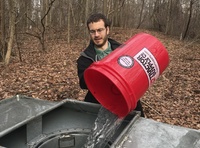
Northeast Ohio Amish country, where Hopewell is located, is well-known for its maple syrup. Hopewell’s woods teem with maple trees and the property has its own sugar house, built in 2014 with philanthropic support. Though sugaring is labor-intensive, it is one of our residents’ favorite winter farm activities.
In mid- to late winter, maple trees are tapped to capture sap, a clear fluid that carries nutrients and minerals into the branches when new buds are forming. Sap is drawn into the roots in the evening and the warmer morning allows it to ascend. It detours into spouts (taps) protruding from the tree trunks and is collected in clear plastic bags.
Staff and residents remove the bags and empty the sap into a 200-gallon container an average of nine times during the sugaring season. At the sugar house, excess water is boiled out over a large stove. It takes 55 gallons of sap to make one gallon of syrup.
Celebrate our 25th anniversary at home by indulging in maple treats. Syrup will be available at pop-up shops this spring and summer at local farmers markets.
MAPLE SALMON
1/4 cup maple syrup
2 Tbs soy sauce
1 minced garlic clove
1/4 tsp salt
pinch of pepper
1lb. salmon
In a small bowl, mix together the first 5 ingredients. Place salmon in a shallow glass baking dish and coat with the maple syrup mixture. Cover the dish and marinate salmon in the refrigerator for 30 minutes, turning once. Preheat the oven to 400 degrees. Bake uncovered for 20 minutes or until easily flaked with a fork.
Thank you Jennifer Miller, Hopewell’s Food Service Manager and Wellness Expert.
Happy Anniversary!

Throughout 2021, Hopewell will celebrate twenty-five years of service to adults with serious mental illness. The first resident was welcomed to the farm on February 3, 1996.
Winter 2021: Residents in Transition

Since October 2020, Hopewell residents have had the opportunity to enter our Transition Program in Cleveland’s University Circle neighborhood. This program provides discharged residents with a new, highly effective plan to transition to more independent living in the community, using the skills they acquired while at Hopewell.