Close

Who We Are

Strategic Plan

Board of Directors

Staff

Annual Reports

Overview

Transition Services

Sample Daily Schedule

Facilities Tour

Overview

Measuring Success

Success Stories

For Caregivers

For Professionals

Fees for Service

Apply

Corporate Partners

Planned Giving

Donate

Wishing Well

Summer Solstice 2027

Exploring Mental Health 2026

Group Therapies Support Recovery

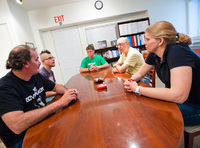
Each week throughout the afternoons at Hopewell, residents have the opportunity to choose from groups that support their recovery in many different ways.

Mental Health Education group is a forum for information and peer support. When residents understand their diagnosis and symptoms, they are more apt to be active in their treatment and consistently take their medication.
Ben (resident): This group helps me understand my diagnosis better, which in turn helps me manage it better.

Dialectical Behavioral Therapy uses mindfulness, emotion regulation and distress tolerance to help residents develop an awareness and sense of control over their emotions and behavior.
Adrienne (resident): We go through four sets of skills and when we’ve completed each one we get a laminated card to take with us. I have all four cards but continue to go because the group is always fresh and engaging.

Equine Assists Program helps residents explore their emotions and behavior through planned activities with horses. Hopewell staff is certified through the Equine Assisted Growth and Learning Association (EAGALA).
Cassie (resident): It helps me relate. How I act around animals gives me a deeper understanding of my emotions and behaviors.

Mindfulness Meditation teaches people how to be present and aware. Residents use this practice to increase their ability to heal and shift away from depression and anxiety towards happiness, relaxation and emotional balance.
Cathy (resident): I’ve learned to use my mind to relax my body and my spirit.

Nature Based Therapy members take to Hopewell’s beautiful woods and fields to learn about how nature’s changes can mirror our own and how we can find insight and understanding through this knowledge.
Langston (resident): It reinforces that I’m a part of a bigger macrocosm. You look at a problem in a different light and see how big things are and how small your problems are.

Resident Council was established to engage residents in how the Hopewell community functions. Three to five residents, who qualify for membership, make decisions about trips and activities and address community issues as they arise.
Candace (staff): Resident council gives council members the opportunity to provide feedback on what’s happening at Hopewell and to engage their fellow residents in activities everyone enjoys.

Mood Management teaches residents the skills to have greater control over their moods. This very useful group uses cognitive behavioral strategies to help people identify the thoughts and behaviors that influence their moods.
Daniel (staff): Mood Management helps residents explore their emotional reactions to life circumstances and learn to regulate the more intense of these reactions that negatively impact their functioning and relationships.

Post-Traumatic Stress Disorder Education helps residents identify, evaluate and change inaccurate thoughts and beliefs that lead to negative feelings. This group teaches self-management skills that help residents address negative emotions like anxiety, depression, guilt, shame and anger.
Rachel (staff): We all have experienced trauma in some way and need to learn skills that lessen the impact of this ongoing stress in our lives.

Spirituality Group encourages spiritual awareness and celebrates our spiritual/cultural differences. Activities like poetry, art, reading and field trips support residents in finding meaning and purpose in their lives.
Antonio (resident): It is fun, discovering about ourselves and others and it relaxes me.


How Can We Help Facilitate a True Integration of Behavioral Healthcare and Primary Care?

It is the expressed opinion by many that behavioral healthcare remains a fragmented and uneven system of care for individuals experiencing serious and persistent mental illness – both for adults and children-despite the best intentions of those of us in the field to make it more functional.

Funding has been insufficient to meet the range and severity of behavioral healthcare needs facing our communities. Doing “more with less” is a common mantra heard throughout the behavioral healthcare industry. Developing greater operational efficiencies, collecting measureable outcome information and sharing best practices remain works in progress.

The Affordable Care Act (ACA) promises to be an important step forward in serving as a catalyst for implementing new and more comprehensive ways for advancing our healthcare system. The integration of primary care and behavioral health care will be a key factor in helping to achieve a seamless “system of care” where benefits are improved and runaway healthcare costs can be reined in. The next generation of an integrated care model envisioned by many is one where we address the “whole person,” including their bio-psycho-social functioning, their social support systems, spiritual awareness and connection to nature and the environment as a healing resource. The movement is toward “whole and person-centered care, peers as navigators, management of benefits and linkage of social services” (Manderscheid).

Essential to this successful integration, however, will require that behavioral health care be represented as an equal player/ partner in the decision-making process and that care is truly holistic. I believe such a process will require a significant conceptual change as, heretofore; behavioral care has often been positioned in a more adjunct role in the delivery of mainstream healthcare. Integration is needed, but compartmentalization of behavioral healthcare under the guise of a holistic care model will not achieve these goals. Our challenge will be how to stay on course and not settle for something less. Implementation of a truly integrated holistic model of healthcare will require a more egalitarian, horizontal model of care.

The question is how and can we in behavioral healthcare help move this more holistic concept to reality? Some ways I believe this may be possible are:

1.Behavioral healthcare interests must be “at the table” early and often in planning and policy making meetings, at national, state and local levels.

2.Taking an active assertive/advocacy role in these discussions will be essential, for all behavioral healthcare stakeholders. We have considerable knowledge, experience and expertise in delivery systems aimed at the whole person and can share this with a range of others in the healthcare field.

3.We can also listen to the perspectives of others across the industry. It will be important to incorporate ideas about what “person-centered care” will really mean in an evolving healthcare environment.

4.Collecting a range of input from recipients’ and former recipients of behavioral healthcare services will be essential in order to develop a truly comprehensive construct of opinion. Collecting this input may require developing outreach initiatives and more creative means to insure these “voices” are heard.

5.Planning and linking people to critical and/or essential services in a “holistic” model of care means people are receiving the Right service at the Right time at the Right cost by the Right provider.

A fully integrated health care system offers the best opportunity to accomplish this, but only if behavioral healthcare is fully represented in this “comprehensive “array of care. I believe securing an active role and identity in a truly integrated healthcare system will be a challenging, but doable pursuit for the behavioral healthcare industry.

Too often our field has been relegated to ancillary roles in the overall healthcare delivery system, often underfunded, underutilized and sometimes misunderstood. In a system where persons with mental illness go untreated, undertreated or relegated to such inadequate community solutions such as jails/prisons, unemployment rolls, welfare assistance, or settling for substandard housing or less, we can and need to do much better. Those of us in the behavioral healthcare field can be advocates and inspirational guides to insist on achieving better for our communities by playing a lead role in helping to facilitate true healthcare reform that serves the “whole person”

Helping to Heal

Opinions about the most effective approaches to treating individuals with a serious mental illness are many. At Hopewell, we focus on what is called milieu therapy. This means that the community at Hopewell serves as an important and affirming resource for giving and receiving emotional support. It is the primary healing agent.

In my experience, there are four essential elements that are key to understanding and fostering this healing process. They are:

Safe environment – Having a feeling of safety and security allows individuals to work on their inner self and personal goals. They are able to trust others which then allows for greater learning and growing. Providing a safe, peaceful and therapeutic environment is why Hopewell’s rural location was chosen.

Time to Heal – There are few shortcuts to healing from most serious injuries or illnesses. The same holds true for mental illness. Expecting a miracle technique or magical pills to “cure” a mental illness is not realistic. Hopewell holds that sustained holistic treatment is the most effective means to achieving recovery.

Support System – It is essential that individuals with serious mental illness have active professional, peer and family support in order to achieve optimum results. Support can be rendered in many ways, but most importantly, the recovering individual needs to feel valued, respected and actively engaged in the treatment process.

Knowing the Difference Between Healing and Coping – Both are important and necessary for recovery and wellness. Finding ways to cope helps individuals manage their symptoms and maintains their sense of well being. For some people, however, coping may only serve as temporary solution to a more complex condition.

At Hopewell we offer the opportunity for these individuals to truly “heal” through the integration of a holistic mind, body, spirit approach. Our goal is to help residents have the time to achieve and realize a more sustained recovery and to experience more of their unique potential and sense of personal fulfillment.

Thanks to the active support of our Board, staff, volunteers and friends, Hopewell has been able to develop the resources and expertise to help make a positive difference in the lives of the individuals we serve.

The Value of a Therapeutic Community

The primary goal of a therapeutic community is to foster individual change and to eventually help people return to society and live a productive life. This is accomplished through a community of people (at Hopewell – staff and residents) working together to help themselves and each other. Residents learn from one another and learn to rely on each other – a skill that their illness has most likely prevented them from developing.

The usual chain of command with staff at the top making the decisions is not characteristic of Hopewell, or similar programs. There is frequent discussion with residents (including a Resident Council) where decisions are made regarding their individual paths to recovery, off campus trip locations and social activities.

Treatment at Hopewell comes in the form of a structured day filled with meaningful work and creative, social and educational groups. Programming changes with the residents’ needs and seasons, but typically includes mood management, dialectical behavior therapy, medication management, equine-assisted learning, meditation and spirituality, independent living skills and creative expression.

Hopewell’s holistic, therapeutic farm community model of care creates lasting results and positive lifestyle changes. We see this progress every day at the farm through the residents’ decreased psychiatric symptoms, improved social skills and self-confidence.

Hopewell is one of 5 therapeutic farm communities in the country, and the only one of its kind in Ohio. We believe in the healing and recovery that takes place here, and that everyone can experience success, find a life of purpose and feel hope.

Nature’s Healing Power at Hopewell

The wind rustling in the trees. A lake sparkling in the sun. Birds calling through the forest. If these words conjure images that relax you, you’re not alone. Experience in nature has long been recognized as healing. For individuals struggling with mental illness, nature can serve to reduce symptoms and improve health.

With this in mind and with the generous support of the Margaret Clark Morgan Foundation, Hopewell has created a nature-based therapy program. Although Hopewell’s existing programming includes elements of growing food, caring for farm animals and generally enjoying our natural environment, we believe that creating specific experiences and challenges based in nature will help residents heal.

Over the last several months, some of the weekly activities residents have participated in include:

  • Hiking and camping
  • Nature arts projects
  • Wilderness skills training
  • Bird watching and plant identification

Future plans will bring the garden inside for an indoor plant care project, create a Hopewell nature calendar and make sensory trail improvements along the Clara Rankin Trail. On bad weather days, residents learn about local plants and animals, write about nature for the Hopewell resident newsletter and build a Hopewell species database. Daniel Horne, Clinical Manager, says, “Nature is already a significant component of our community. Our hope is that by actively introducing our residents to their natural surroundings and engaging them in explorations of their individual issues within the context of nature, we will have significant and lasting positive impacts on the quality of their lives.”

DONATE