Close

Who We Are

Strategic Plan

Board of Directors

Staff

Annual Reports

Overview

Transition Services

Sample Daily Schedule

Facilities Tour

Overview

Measuring Success

Success Stories

For Caregivers

For Professionals

Fees for Service

Apply

Corporate Partners

Planned Giving

Donate

Wishing Well

Summer Solstice 2027

Exploring Mental Health 2026

New York Times: Talk Therapy Found to Ease Schizophrenia

More than two million people in the United States have a diagnosis of schizophrenia, and the treatment for most of them mainly involves strong doses of antipsychotic drugs that blunt hallucinations and delusions but can come with unbearable side effects, like severe weight gain or debilitating tremors.

Now, results of a landmark government-funded study call that approach into question. The findings, from by far the most rigorous trial to date conducted in the United States, concluded that schizophrenia patients who received smaller doses of antipsychotic medication and a bigger emphasis on one-on-one talk therapy and family support made greater strides in recovery over the first two years of treatment than patients who got the usual drug-focused care.

Summer 2015: When Your World Turns Upside Down

Left at an orphanage in Korea at six months of age, beautiful, healthy little Mariko was adopted a year later by a loving couple who brought her home to Northeast Ohio. Throughout her school years, she excelled at everything. She studied in France during high school and became fluent in four languages. In 2007, she graduated with honors from American University in Washington, DC, with a degree in International Studies and an eye on law school. Mariko’s future was bright.

Weaving Fun into Art

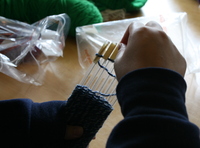
Arts and crafts are regular activities at Hopewell. The residents love the opportunity to be creative and share their talents. Whenever we mention we are going to be working in the Art Room, the residents become visibly excited. They enjoy expressing themselves in the many ways offered by Hopewell. One of our current projects is weaving with straws. The way we weave may be a little nontraditional, but it is easy to do. It is inexpensive to start, and so much fun.

What You Need:

  • 4 to 6 clean plastic drinking straws
  • Yarn (2 colors if possible)
  • Scissors
  • Masking tape

Getting Started:

1. If your straws have a bend, align them and cut them off.
2. Cut a slit in each of the straws on the same end, about 1 inch long.
3. Measure and cut a piece of yarn to about 10 inches longer than you want your finished project to be, for each of your straws.
4. Slide a piece of yarn into each of the straws, about 2 inches past the end.
5. Slide the yarn into the slit in each straw and tape it in place. These pieces of yarn are your cords.
6. Tie a knot around the ends of your cords that are opposite the straws.
7. Align your cord weaving straws.
8. Tie a slip knot with your weaving yarn around your first straw on the left.
9. Start weaving yarn over and under the straws.
10. When you reach your last cord, wrap around the straw. Weave back in the opposite direction to your first cord.
11. Continue to weave back and forth until you reach about 10 rows.
12. Push the weaving tightly together and gently slide it off the straws.
13. Continue weaving groups of yarn together and tightening the groups down the straws until your end product is as long as you desire.

To finish your weaving:

14. Cut the yarn off the straws. Save them for your next project.
15. Cut your weaving yarn about 6 inches longer than your weaving.
16. Knot your weaving yarn around each of your cord pieces of yarn.
17. Once you knot each of the chord pieces, knot a second row back to the first cord yarn.
18. To finish the bottom, knot the cord straws off in pairs. Knot the first and the second cord straws, the second and third cord straws, and down the row until the end is complete.
19. You can trim the cord yarn or leave it as a fringe.

Enjoy your beautiful project. We encourage you to give your hard work to your friends.

If you are not the arts and crafts type, our residents make beautiful weavings. They are available for sale in our Farm & Craft Market. The funds raised by the sale of items in the Market help support our Art Room and projects. Making art in any form is an important part of the healing process at Hopewell. The Hopewell Farm & Craft Market is open Wednesday through Friday from 12:00PM to 4:00PM and Saturdays from 10:00AM to 2:00PM. It is located just two miles south of Mesopotamia Circle, at 9489 State Route 534. Stop by to support healing art and creativity.

Resident Council: Healing from Within

The Hopewell Resident Council was established to support our goals and mission. A charter is in place that explains the purpose, responsibilities, membership, decision-making process and reasons for the establishment of the Resident Council at Hopewell. The main function of the Council is to enhance quality of living and peace across our therapeutic community. The Council implements and improves community functions. At Hopewell, we believe it is beneficial to the development of our residents to stay involved in the decision-making and healing process.

There are certain criteria that must be met by residents who wish to serve on the Resident Council. They must be in the third phase of treatment, and must have transitioned out of the first two phases exhibiting virtuous behavior and personal growth. It is important to set criteria that encourage residents to reach goals they set for themselves.

Equality and cooperation with staff, volunteers and residents are keys to success at Hopewell. These are hallmarks of the Resident Council. We want to ensure our residents feel they are an important part of the Hopewell community. We want them to be engaged, motivated and connected with the farm and staff. The Resident Council has been a success, and we are sharing this success story with other communities with the hope they may emulate this practice for themselves.

Here are some of the core reasons why the Resident Council is so successful.

  • Makes residents a valuable part of the Hopewell community.

The Resident Council allows our residents to gain independence and decision-making power. It is important to allow residents have a say in their own treatment and ensure they are motivated and healing.

  • Promotes understanding of resident needs.

Residents are very communicative with each other. The Resident Council gives the residents a voice to communicate on behalf of fellow residents, and in a timely manner.

  • Teaches responsibilities.

A position on the Resident Council is earned. This prestige gives residents motivation to reach this special level of growth and acceptance. Once on the Council, the members are entrusted to recommend events, plan activities and focus on realistic goals and outcomes for these activities.

  • Turns frustration into energy to solve problems.

Having a problem and no power to solve it can be one of the most frustrating situations any human being may face. The Resident Council gives residents the opportunity to turn their frustration and negative energy into a force for positive problem -solving. When residents are given the power to facilitate change, they are more resilient and able to bring about positive change.

  • Improves morale.

Involvement with successful events has a positive effect on morale. It is wonderful to see the residents pull together to complete a task and enjoy the outcome.

A note to other communities: Peer councils are a wonderful tool to ensure residents feel important and vital to the success of an organization. They are not always easy to establish, and need to be monitored by both the residents and staff. Always ensure residents are patient and understanding with each other through the process. At the end of the day, you will have the opportunity to see resident councils plant their ideas, watch the planning grow and see their resulting happiness bloom.

Hopewell Helps Adults with Mental Illness; Provides Fee Assistance through Fundraising

Mesopotamia, OH – Liza Trela, age 27, is benefiting from both outstanding therapies and access to funding available from the Hopewell therapeutic farm community, according to her mother.

“Our daughter, Liza, could no longer be treated at a short-term crisis management facility because her medication could not be administered there,” said Theresa Piteo Trela, a well-known actress among Cleveland theater-goers.

“Her psychiatrist believed he had exhausted all options. We were convinced Liza would be lost to us forever if the state (Texas) had its way. We intended to fight for her, and we did. The court allowed Liza to be placed with us for a period of six months. If she needed to be hospitalized again during that period, she would be taken directly to the state hospital by the police. We felt we were losing Liza not only to paranoid schizophrenia, but also to a mental health system that would incarcerate her.”

At this point, Theresa Trela was also saddened by the death of Providence Hollander, a friend and fellow cast member of Jacques Brel Is Alive and Well and Living in Paris. The show, directed by Joseph J. Garry, Jr., had been a major part of the comeback of Cleveland’s Playhouse Square in 1973. It was through Mr. Garry and other friends from the production of Jacques Brel that the Trelas learned about Hopewell.

Located in rural Mesopotamia, Ohio, Hopewell’s unique, holistic model of mental health care is based on the healing power of nature, community and meaningful work. Its mission is to provide an opportunity for adults with mental illness to experience a self-reliant and satisfying life through participation in a vibrant therapeutic community. Outcomes studies have shown the Hopewell Model creates lasting results and positive lifestyle changes, allowing individuals to develop the skills necessary to manage more independent living.

“Hopewell eased the clutter in Liza’s mind and affirmed her worth through the dignity of expectations and consequences,” said Theresa Trela. “Through its focus on community, Hopewell provided structure, compassion and opportunity. Its unique setting reset Liza’s circadian rhythms. The sun, sky and light are so important for those whose minds are darkened by their illness and dampened by their medicine.”

“Liza is still our beautiful, gifted daughter. But she deals with paranoid schizophrenia,” said Trela. “We talk to Liza twice each day. She struggles, but because of Hopewell, she can deploy her hard-won and evolving coping skills to push back against that darkness. In Jacques Brel­, I sang about a hope that believed ‘If we only have love….’ At Hopewell, love and hope abide.”

While Hopewell’s daily rate is about one-third that of an inpatient psychiatric hospital – and is based on actual costs, with no mark-up for profit – the cost of care is often out of reach for many families. Residential mental health care is rarely covered by insurance. Fee assistance is Hopewell’s #1 fundraising priority. On an annual basis, about 95 percent of Hopewell’s residents’ families receive some amount of fee assistance.

“Donations to Hopewell really do save lives. This is our daughter’s second time at Hopewell. Our family and our daughter are blessed,” concluded Theresa Trela.

To make a tax-deductible donation to Hopewell, contact the Development Office at 440-247-0912 or visit www.hopewellcommunity.org.

About Hopewell

Hopewell is a 300-acre residential working farm located in Mesopotamia, Ohio, where adults with schizophrenia, bipolar disorder or major depression learn to manage their mental illness and return to independent life. Hopewell is the only therapeutic farm community in Ohio, and one of only a handful in the United States. It is ODMHAS-licensed and CARF-accredited. Hopewell is a member of National Alliance on Mental Illness (NAMI) and the American Residential Treatment Association (ARTA). Information and assessments are available by contacting the Hopewell admissions team at 440.426.2009. Visit www.hopewellcommunity.org.

###

Hopewell Farm Introduces New Website To Provide Information for Families Dealing with Mental Illness

Hopewell, a therapeutic farm community for adults with mental illness, has just introduced a new, mobile-friendly website to provide information for families, caregivers and health care professionals, according to Richard R. Karges, LISW-S, ACSW, Hopewell’s Executive Director/CEO. The URL is www.hopewellcommunity.org.

“Our website contains valuable information to help families and professionals who are looking for an effective alternative for mental health care. It shows the value of a therapeutic farm community as a viable treatment option,” said Karges. “The website provides information about mental health conditions such as schizophrenia, depression, bipolar disorder, anxiety disorder, post-traumatic stress disorder and borderline personality disorder.”

Featuring numerous videos, testimonials and links to other information sources, the website provides easy access to Hopewell’s admissions process and team. “The website quickly displays the underlying holistic philosophies of our mental health care model, as well as descriptions of our program, clinical services and staff,” said Karges.

“Hopewell is the only therapeutic farm community in Ohio and one of only a handful in the country,” notes Karges. “Our website will help families and professionals better understand this treatment alternative. Our outcomes data clearly shows the effectiveness of the Hopewell Model.”

About Hopewell

Hopewell is a 300-acre residential working farm located in Mesopotamia, Ohio, where adults with schizophrenia, schizoaffective disorder, bipolar disorder and major depression learn to manage their mental illness and return to independent life. It is ODMHAS-licensed and CARF-accredited. Hopewell is a member of the National Alliance on Mental Illness (NAMI) and the American Residential Treatment Association (ARTA). A new backgrounder on Hopewell is available. Information and assessments are available by contacting Hopewell’s admissions team at 440.426.2009. Visit www.hopewellcommunity.org.

Individualized Care through Support Groups and Good Cooking

Hopewell focuses on individualized care that helps our residents improve their mental health and thrive. Residents come to Hopewell with different characteristics, skills, experiences and challenges. We work with each of them, one-on-one and in a variety of therapeutic groups, to ensure their treatment is the most effective possible.

Hopewell offers:

  • Group counseling
  • Creative expression
  • Equine-assisted learning and horsemanship
  • Meditation
  • Spirituality
  • Nature studies
  • Education (high school diploma and GED preparation)
  • Money management
  • Independent living skills (meal planning, shopping, cooking, healthy living)
  • Interpersonal relationship skills

Hopewell residents possess a wide range of interests and talents. For some, cooking is a passion. (One of our residents has been a chef.) These individuals especially appreciate Hopewell’s attention to growing, preparing and eating healthy food.

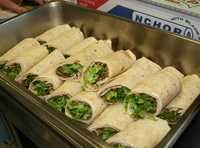
One of our residents’ favorite entrees is a turkey/cranberry chutney wrap. Enjoy this easy, healthy recipe at home.

Turkey/Cranberry Chutney Wraps

(Makes 8 wraps)

Ingredients:

8 Soft tortilla shells

4 cups fresh or frozen cranberries

¼ cup sugar

¼ cup water

¼ cup red wine vinegar

1 cup chopped tart apple (such as Granny Smith)

½ cup dark raisins

1 lb. roasted turkey breast, shredded (to be divided among 8 wraps)

½ cup orange juice

1 cup shredded carrots

¼ chives, chopped

3 Tablespoons extra virgin olive oil

1-1/2 to 2 cups arugula (or as desired)

Mayonnaise as needed (approximately ½ cup)

Directions:

1. Mix together cranberries, sugar, water and vinegar in a large saucepan. Cook over medium heat until berries pop, about 15 minutes.

2. Stir in apples, raisins and orange juice. Simmer uncovered until thickened, about 15 minutes. Adjust sugar to taste (up to ½ cup). Refrigerate until ready to serve. (Note: You may not need entire recipe for these wraps.)

3. In a bowl, mix together carrots, chives, olive oil chopped arugula. Add approximately ½ cup cooled chutney mixture, to taste.

4. To prepare wraps, spread 8 warm tortilla shells with mayonnaise. Top with shredded turkey, then with carrot-chutney mixture.

5. Fold each wrap and serve.

No matter what challenges we face with mental health, it is vital to continue learning, improving and moving forward as individuals.

Memorable Moments: Volunteering at Hopewell

Volunteers are vital to many nonprofit organizations, but not many organizations offer the unique opportunities that may be found at Hopewell. There are many ways to become engaged as a Hopewell volunteer, from occasionally joining daily work crews on the farm to helping the fundraising office plan our annual Summer Solstice benefit. It is also possible to live at the farm while you volunteer.

Hopewell welcomes residential volunteers who live and work at the farm, full-time, for up to two years. These volunteers are given a small stipend as well as room and board. They work side-by-side with the residents (residential clients) and staff to keep the 300-acre working farm functioning well. And they may choose to return later for a second tenure.

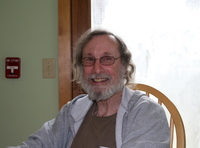
Richard is one of Hopewell’s favorite volunteers. He previously volunteered from 2006 to 2008, returned for a second stint beginning In March 2013, and is just about to depart again. Richard has been a true asset to Hopewell. His caring and loving presence definitely will be missed.

Richard has managed a wide variety of tasks during his time with us. He has transported residents to and from medical appointments, run errands for our nursing staff, transferred supplies and mail, and helped with many other aspects of running the farm.

Richard had his own setbacks in life. Once on his feet again, he decided it was time to “give back.” That is when he started giving his time and energy as a volunteer at Hopewell.

Richard enjoys watching the residents come out of their shells and begin to heal. He notices this while spending time with them, especially while transporting them to and from medical appointments. This is often a scary time for residents because they are leaving the sanctuary of the farm to face the stress of medical procedures. Richard is always very caring and thoughtful as he helps residents relax before and after their appointments.

Richard loves Hopewell’s beautiful farm setting, and especially the livestock. He enjoys watching the pigs in their pen and as they run around chasing the lambs. But the thing he likes most is watching residents helping themselves. Richard is a major advocate of allowing residents to work to their full potential, and of pushing them to better themselves every day. He has a wonderful way of helping residents when they struggle, and of leading them to personal success.

Richard’s favorite memory of his time with Hopewell dates to first stay as a residential volunteer. He had the opportunity to take a resident to New York State. The resident had a wonderful time, and Richard was overwhelmed as he experienced the resident’s growth first-hand. According to Richard, joy and wonder described the trip. Richard said it best when he said he has had “a lot of memorable moments” at Hopewell.

We cannot thank Richard enough for all he has done for Hopewell. He will be sorely missed, and we hope he will visit with us often.

While volunteers are extremely valuable to Hopewell, the act of volunteering may provide important benefits to the volunteer, as well. Here are a few of the benefits of volunteering at Hopewell:

  • Connect with people, every day
  • Improve social skills
  • Expand your network
  • Share your professional experiences
  • Gain new career experiences
  • Increase self-confidence and self-esteem
  • Experience personal satisfaction
  • Combat depression
  • Elevate physical health
  • Enjoy opportunities for fun and fulfillment

Please consider becoming a Hopewell volunteer. The experience may help your own mental health! Call 440.426.2000 or apply at www.hopewellcommunity.org.

A Beacon of Creativity That Improves Mental Health

At Hopewell, we incorporate art projects and group activities into the everyday life for our residents. It is important to the healing process to have an outlet for our residents to express themselves, learn and thrive as a community. Our newest art projects are lighthouses and fairy gardens.

Fairy gardens were first made in the United States around 1890. These fantastic homes for fairies started as bonsai dish gardens. It is thought they gained popularity after bonsai gardens were displayed at the Chicago World’s Fair and were featured in an article by the New York Times. Since the introduction of these small gardens, there have been countless imitations. The gardens change and grow with every Hopewell architect who builds a new home for the fairies.

Fairy Gardens

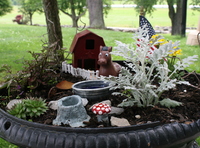
Our fairy gardens are a collection of flowers grown by our residents, original pieces of art and repurposed items. All our fairy gardens are made in planters or containers originally used for a different purpose. We want to ensure useful items are repurposed and given new life. Thanks to the popularity of Pinterest, blogs and other online resources, repurposing and upcycling old items have become easy to do. We are very excited to recycle and repurpose items that still have a lot of life to share.

All the art projects we do at Hopewell are inclusive and are developed in groups to enhance creativity. Our residents come to the farm with a variety of different skills and experiences. We want to make sure they have the opportunity to express themselves and use their abilities to make the world a more beautiful place. We also encourage our residents to communicate and work together as groups to brainstorm and increase the sense of community. When our residents come together as groups, they share their talents and ideas, collaborate to solve problems, connect and accept each other. All of these skills are important for individual growth and improved mental health.

Lighthouses

Lighthouses have been used for thousands of years around the world to serve as beacons for sailors, leading them safely into harbor. One of the oldest American lighthouses, the New London Harbor Lighthouse in Connecticut, has provided safe passage for over 200 years. We experience how our residents can be a beacon for each other to learn, grow and progress during their time with us. Peer support groups and inclusion help our residents heal every day.

Our art projects are not only beautiful and healing, they help support future programs for our residents. Lighthouses and fairy gardens are now for sale in our Farm & Craft Market. The funds the market raises help us keep art as a part of our healing culture. The lighthouses come in different sizes and are either battery- or solar-powered for indoor or outdoor use. The prices vary based on size. The fairy garden prices vary based on the items incorporated into the design. The Hopewell Farm & Craft Market is open Wednesday through Friday from 12:00PM to 4:00PM and is open Saturdays from 10:00AM to 2:00PM. It is located just two miles south of the circle in Mesopotamia at 9459 State Route 534. Stop by to support healing, art and creativity.

Hopewell, Through the Eyes of the Interns

At Hopewell we often employ interns to provide a meaningful and educational experience on our working farm. We recently said goodbye to two wonderful young ladies from the Kent State University, East Liverpool Campus. Kristen and Marlene were real assets, and we were sad to see them go. We took a moment to talk with these ladies about their internships while pursuing a degree in psychology or occupational therapy. They received an inside view of the culture at Hopewell and how it all works.

Kristen and Marlene joined us to meet their required first level of field work assignment. They spent five weeks at Hopewell and made 10 visits. They helped with tasks on the farm, arts and therapy projects and interacting with our residents. It is important when pursuing a degree in occupational therapy that you go into the field and learn about the environment at different facilities.

We love the Hopewell community, and we are not surprised that Marlene and Kristen did as well. We encourage equality and not labeling people. We do not have our staff wear uniforms so everyone feels at home. We make sure everyone who walks into our facility is comfortable. It is important to our healing process to instill the feeling of safety and comfort. Our interns noticed this and great it was to see everyone working side by side. Hopewell also champions teamwork as an essential part of the healing process and both Kristen and Marlene became integral parts of our team.

According to the young ladies, their favorite part of their internship was working with the farm art crew. All of the projects were interesting, and it was great to see the residents working to complete their tasks. The ladies also worked with the residents to add some art to their books. They thought it was important to leave a personal touch behind for the residents, who touched their hearts during their time with us.

Lastly, the interns wanted to share the importance of their first field experience after entering college. Working at Hopewell was an eye opening experience about mental illness. Kristen and Marlene noted that the residents seemed and acted very normal. There was no visual way of telling, who was affected by mental illness, yet they could feel the healing that was taking place.

Although mental illness touches everyone’s lives differently, the ladies learned it is important to remember that mental illness does not debilitate patients to the point of not being able to lead full lives. The patients at Hopewell are living life to the fullest. There are some patients who have severe issues and need intensive treatment for the remainder of their lives. There are also people suffering from mental illness who are thriving every day.

We should do our best everyday to help end the stigma of mental illness. Whether an affliction is visible or not, it is simply an illness. And, if you or someone you love is struggling, don’t view seeking treatment as something to avoid. It is an illness that requires treatment. Don’t be afraid to get help. Do what you can to stop labeling people. A mental illness is not a life sentence and shod not be viewed in negative terms.

We want to send a big thank you to Marlene and Kristen for their hard work! We wish you nothing but the best, as you progress in your careers and lives. At Hopewell, we are always seeking volunteers and interns to help assist us in resident treatments and experiences. If you are interested, you can get more information at www.hopewell.cc/volunteer.

Help us end the stigma of mental illness, remember that whether affected by a mental illness or not, we are all human and “person” is the only label we should ever give to each other.

DONATE