
2015 Outcomes Report
Results from Hopewell’s research continue to show improved outcomes.

Results from Hopewell’s research continue to show improved outcomes.
An article in the Sunday Review section of the January 17 issue of The New York Times (“How Measurement Fails Doctors and Teachers”) described the current fervor regarding outcomes measurement and accountability as possibly jeopardizing the quality of health care and education in the United States. However, the Times states, “We need more targeted measures, ones that have been vetted to ensure they really matter.”
“At Hopewell, that vetting process is paramount,” said Karges, Executive Director/CEO of Hopewell. “Since 2006, Hopewell has gathered and accessed data regarding the effectiveness of its programs and their impact on the recovery of its residents.”
Hopewell’s Outcomes Measurement Team is led by Candace Carlton, LISW-S, Quality Improvement and Compliance Director, and Sherry Bacon-Graves, BA, Outcomes Coordinator. The team also includes Sana Loue, PhD, MSSA, MA, JD, Hopewell’s Research Consultant from Case Western Reserve University. Dr. Loue meets regularly with Carlton and Bacon-Graves, providing training on research techniques and the most effective methods of data analysis.
This team works with the Research Committee of Hopewell’s board of directors to gather, analyze and report the periodic systematic measurements of each resident’s progress as well as the effectiveness of each of Hopewell’s programs as evidenced by the residents’ progress, according to Karges. Over 70% of Hopewell residents have moved successfully into more self-reliant settings.
“Our outcomes measurement results show clearly that the Hopewell Model of care is effective,” Karges continued. “The results lead us to improvement and may lead to programmatic changes. Often, the results indicate the need to replace older measurement tools with newer ones or to create customized tools as new programs are developed.”
Please read Hopewell’s Outcomes Report for measurements and more information.
About Hopewell
Hopewell is a 300-acre residential working farm located in Mesopotamia, Ohio, where adults with schizophrenia, bipolar disorder and major depression learn to manage their mental illness and return to independent life. Hopewell is the only therapeutic farm community in Ohio. It is ODMHAS-licensed and CARF-accredited. Hopewell is a member of the National Alliance on Mental Illness and the American Residential Treatment Association.
Information and assessments are available by contacting Daniel Horne, director of admissions, at 440.426.2009. Visit www.hopewellcommunity.org.
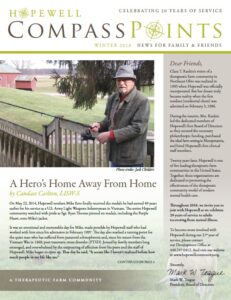
On May 22, 2014, Hopewell resident Mike Erro finally received the medals he had earned 40 years earlier for his service as a U.S. Army Light Weapons Infantryman in Vietnam. The entire Hopewell community watched with pride as Sgt. Ryan Thomas pinned six medals, including the Purple Heart, onto Mike’s jacket.
It was an emotional and memorable day for Mike, made possible by Hopewell staff who had worked with him since his admission in February 1997. The day also marked a turning point for the quiet man who has suffered from paranoid schizophrenia and, since his return from the Vietnam War in 1969, post-traumatic stress disorder (PTSD). Joined by family members long estranged, and overwhelmed by the outpouring of affection from his peers and the staff of Hopewell, Mike began to open up. That day he said, “It seems like I haven’t realized before how much people in my life like me.”
The new motion picture “Touched with Fire” paints a picture of creativity and mental illness depicting how a poet’s genius is impacted by bipolar disorder, according to Rick Karges, Executive Director/CEO.
“Our 20 years of experience with bipolar and other mental illness at Hopewell prove to us every day there is a connection between genius and mental illness when it comes to art, literature, poetry and music,” said Karges. “Movies such as ‘Touched with Fire’ places the public up close to mental illness. Through these types of productions, a better understanding of mental illness is possible.”
While the movie is hardly a documentary, it does underscore how manic episodes have driven poets and painters such as Lord Byron, Emily Dickinson, Van Gogh, Edward Munch, Tchaikovsky, Ernest Hemingway and Virginia Woolf to peaks of artistic expression.
According to one critic, “Katie Holmes delivers a beautifully understated and moving performance as a poet suffering from bipolar disorder, who falls in love with a fellow psychiatric patient with similar creative passions.” Karges agrees.
“There is a difference between the treatment depicted in the ‘Touched with Fire’ psychiatric hospital as compared to the Hopewell approach,” said Karges. “Yet, at a minimum, the movie will be a catalyst for positive discussion about mental illness. It shows how a commitment to medication results in positive outcomes.”
Hopewell has invested time and resources in its annual Exploring Mental Health Speaker Series. This program focuses on improving the public’s understanding of the mentally ill and combatting the stigma attached to mental illness, according to Karges.
About Hopewell
Hopewell is a 300-acre residential working farm located in Mesopotamia, Ohio, where adults with schizophrenia, bipolar disorder and major depression learn to manage their mental illness and return to independent life. Hopewell is the only therapeutic farm community in Ohio. It is ODMH-licensed and CARF-accredited. Hopewell is a member of National Alliance for the Mentally Ill and American Residential Treatment Association. Visit www.hopewellcommunity.org.
Information and assessments are available by contacting Daniel Horne, director of admissions at 440.426.2009. Visit www.hopewellcommunity.org .
Hopewell Therapeutic Farm for adults with mental illness announces the reopening of its completely remodeled and expanded Farm & Craft Market on its campus here, according to Rick Karges, Executive Director/CEO.
“We have created a great store to connect Hopewell to the community by offering produce, crafts and art provided by our farm and residents,” said Karges. “Store hours are Wednesday through Friday from 12:00 p.m. to 4:00 p.m. and Saturday from 10:00 a.m. to 2:00 p.m.”
The new version of the Farm & Craft Market is much larger than our original store and is located just south of Hopewell’s administrative building on Route 534. Hopewell animals are located nearby.
The market sells Hopewell’s award-winning maple syrup, bird houses, cutting boards, artwork, ceramics, soaps, handmade jewelry, farm-fresh eggs, flowers, plants and more. A wood shop makes custom signs. Almost all the items found in the store are made by the residents and staff.
According to Sandy Thomas, Farm and Craft Marketing Manager, “The Market is proud to offer an ever-changing inventory of new items created from the inventive minds of our Hopewell family.”
About Hopewell. Hopewell is a 300-acre residential working farm located in Mesopotamia, Ohio, where adults with schizophrenia, bipolar disorder and major depression learn to manage their mental illness and return to independent life. Hopewell is the only therapeutic farm community in Ohio. It is ODMH-licensed and CARF-accredited. Hopewell is a member of National Alliance for the Mentally Ill and American Residential Treatment Association. Visit www.hopewellcommunity.org
Information and assessments are available by contacting Daniel Horne, director of admissions at 440.426.2009. Visit www.hopewellcommunity.org
To talk with our admissions team, please call 440.426.2009.
ADMISSIONS - Our team is here to help you through every step of the admissions process.
A majority of Hopewell residents receive fee assistance from your donations. Help provide life-changing treatment for those who cannot afford it.
VISIT - Schedule a tour to see if Hopewell is the right setting for you or your family member.