Close

Who We Are

Strategic Plan

Board of Directors

Staff

Annual Reports

Overview

Transition Services

Sample Daily Schedule

Facilities Tour

Overview

Measuring Success

Success Stories

For Caregivers

For Professionals

Fees for Service

Apply

Corporate Partners

Planned Giving

Donate

Wishing Well

Exploring Mental Health

Summer Solstice 2026

News News
Hopewell Promotes Assessments and Tours During May Mental Health Awareness Month

Hopewell Promotes Assessments and Tours During May Mental Health Awareness Month

Hopewell therapeutic farm for people with mental illness is promoting tours and assessments for residential candidates during Mental Health Awareness Month in May, according to Rick Karges, Executive Director/CEO.

“Here is a chance for persons seeking help on their caregivers to determine whether Hopewell is the right place for them. People in northeast Ohio can take a nice ride in the country and visit our farm including our Farm & Craft market,” said Karges. “The proceeds from market sales help to support our residents and the breakthrough work we do to find better ways to deal with mental illness.”

Outcomes studies since 2006 have shown the effectiveness of Hopewell’s program, a model that incorporates a bio-psycho-social orientation to promote wellness and sustained recovery. The healing power of nature, meaningful work and community – along with a caring and high-quality staff – have led to Hopewell’s unique model of mental health care that successfully promotes self-worth, self-confidence and a greater independence for adults dealing with mental illness.

The “Hopewell Model” actually is a newer version of an old methodology called “moral treatment.” Dating back to the early 1800’s in Europe, the concept of moral treatment focused on treating individuals with equality and respect within the context of a healthy living and learning environment. People with mental illness are able to express their feelings and views freely, as well as actively participate in decisions affecting their lives. This is the basis of today’s “therapeutic community.”

Within a therapeutic community the community itself becomes a catalyst for positive change. At Hopewell individuals with mental illness are able to heal and thrive within a compassionate supportive community. As contributing members of that community, they build their self-esteem and learn the skills necessary for more independent living after discharge.

At Hopewell, such skill-building is paired with comprehensive mental health treatment for maximum results. Hopewell’s highly-trained clinical team provides a variety of therapies that have been proven to be successful in treating a range of mental health conditions. These therapies include psychiatric medication management, group counseling, creative expression, equine-assisted learning and horsemanship, nature studies, meditation, spirituality, education (high school diploma program and GED preparation), money management, independent living skills (meal planning, shopping, cooking, healthy living) and interpersonal relationship skills. Job-readiness is emphasized and residents develop vocational skills in their daily work, which may include the resident operated, on-site Farm and Craft Market and wood shop.

About Hopewell

Hopewell is a 300-acre residential working farm located in Mesopotamia, Ohio, where adults with schizophrenia, bipolar disorder and major depression learn to manage their mental illness and return to independent life. Hopewell is the only therapeutic farm community in Ohio. It is ODMHAS-licensed and CARF-accredited. Hopewell is a member of the National Alliance on Mental Illness and the American Residential Treatment Association. Information, tours and assessments are available by contacting Daniel Horne, Clinical Director, at 440.426.2009 or by email at dhorne@hopewell.cc. Visit www.hopewellcommunity.org.

###

2015 Outcomes Report

2015 Outcomes Report

Results from Hopewell’s research continue to show improved outcomes.

Download PDF

Measuring the Effectiveness of the Hopewell Model

Measuring the Effectiveness of the Hopewell Model

An article in the Sunday Review section of the January 17 issue of The New York Times (“How Measurement Fails Doctors and Teachers”) described the current fervor regarding outcomes measurement and accountability as possibly jeopardizing the quality of health care and education in the United States. However, the Times states, “We need more targeted measures, ones that have been vetted to ensure they really matter.”

“At Hopewell, that vetting process is paramount,” said Karges, Executive Director/CEO of Hopewell. “Since 2006, Hopewell has gathered and accessed data regarding the effectiveness of its programs and their impact on the recovery of its residents.”

Hopewell’s Outcomes Measurement Team is led by Candace Carlton, LISW-S, Quality Improvement and Compliance Director, and Sherry Bacon-Graves, BA, Outcomes Coordinator. The team also includes Sana Loue, PhD, MSSA, MA, JD, Hopewell’s Research Consultant from Case Western Reserve University. Dr. Loue meets regularly with Carlton and Bacon-Graves, providing training on research techniques and the most effective methods of data analysis.

This team works with the Research Committee of Hopewell’s board of directors to gather, analyze and report the periodic systematic measurements of each resident’s progress as well as the effectiveness of each of Hopewell’s programs as evidenced by the residents’ progress, according to Karges. Over 70% of Hopewell residents have moved successfully into more self-reliant settings.

“Our outcomes measurement results show clearly that the Hopewell Model of care is effective,” Karges continued. “The results lead us to improvement and may lead to programmatic changes. Often, the results indicate the need to replace older measurement tools with newer ones or to create customized tools as new programs are developed.”

Please read Hopewell’s Outcomes Report for measurements and more information.

About Hopewell

Hopewell is a 300-acre residential working farm located in Mesopotamia, Ohio, where adults with schizophrenia, bipolar disorder and major depression learn to manage their mental illness and return to independent life. Hopewell is the only therapeutic farm community in Ohio. It is ODMHAS-licensed and CARF-accredited. Hopewell is a member of the National Alliance on Mental Illness and the American Residential Treatment Association.

Information and assessments are available by contacting Daniel Horne, director of admissions, at 440.426.2009. Visit www.hopewellcommunity.org.

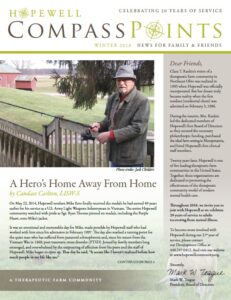
Winter 2016: A Hero’s Home Away From Home

Winter 2016: A Hero’s Home Away From Home

On May 22, 2014, Hopewell resident Mike Erro finally received the medals he had earned 40 years earlier for his service as a U.S. Army Light Weapons Infantryman in Vietnam. The entire Hopewell community watched with pride as Sgt. Ryan Thomas pinned six medals, including the Purple Heart, onto Mike’s jacket.

It was an emotional and memorable day for Mike, made possible by Hopewell staff who had worked with him since his admission in February 1997. The day also marked a turning point for the quiet man who has suffered from paranoid schizophrenia and, since his return from the Vietnam War in 1969, post-traumatic stress disorder (PTSD). Joined by family members long estranged, and overwhelmed by the outpouring of affection from his peers and the staff of Hopewell, Mike began to open up. That day he said, “It seems like I haven’t realized before how much people in my life like me.”

Download PDF

Hopewell CEO Comments on New Film “Touched with Fire”

Hopewell CEO Comments on New Film “Touched with Fire”

The new motion picture “Touched with Fire” paints a picture of creativity and mental illness depicting how a poet’s genius is impacted by bipolar disorder, according to Rick Karges, Executive Director/CEO.

“Our 20 years of experience with bipolar and other mental illness at Hopewell prove to us every day there is a connection between genius and mental illness when it comes to art, literature, poetry and music,” said Karges. “Movies such as ‘Touched with Fire’ places the public up close to mental illness. Through these types of productions, a better understanding of mental illness is possible.”

While the movie is hardly a documentary, it does underscore how manic episodes have driven poets and painters such as Lord Byron, Emily Dickinson, Van Gogh, Edward Munch, Tchaikovsky, Ernest Hemingway and Virginia Woolf to peaks of artistic expression.

According to one critic, “Katie Holmes delivers a beautifully understated and moving performance as a poet suffering from bipolar disorder, who falls in love with a fellow psychiatric patient with similar creative passions.” Karges agrees.

“There is a difference between the treatment depicted in the ‘Touched with Fire’ psychiatric hospital as compared to the Hopewell approach,” said Karges. “Yet, at a minimum, the movie will be a catalyst for positive discussion about mental illness. It shows how a commitment to medication results in positive outcomes.”

Hopewell has invested time and resources in its annual Exploring Mental Health Speaker Series. This program focuses on improving the public’s understanding of the mentally ill and combatting the stigma attached to mental illness, according to Karges.

About Hopewell

Hopewell is a 300-acre residential working farm located in Mesopotamia, Ohio, where adults with schizophrenia, bipolar disorder and major depression learn to manage their mental illness and return to independent life. Hopewell is the only therapeutic farm community in Ohio. It is ODMH-licensed and CARF-accredited. Hopewell is a member of National Alliance for the Mentally Ill and American Residential Treatment Association. Visit www.hopewellcommunity.org.

Information and assessments are available by contacting Daniel Horne, director of admissions at 440.426.2009. Visit www.hopewellcommunity.org .

DONATE