Close

Who We Are

Strategic Plan

Board of Directors

Staff

Annual Reports

Overview

Transition Services

Sample Daily Schedule

Facilities Tour

Overview

Measuring Success

Success Stories

For Caregivers

For Professionals

Fees for Service

Apply

Corporate Partners

Planned Giving

Donate

Wishing Well

Exploring Mental Health

Summer Solstice 2026

News News
Summer 2017: A Time of Transition

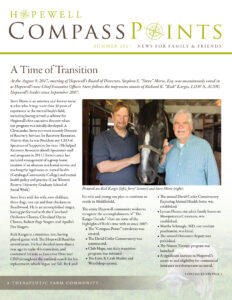
Summer 2017: A Time of Transition

At the August 9, 2017, meeting of Hopewell’s Board of Directors, Stephen S. “Steve” Morse, Esq., was unanimously voted in as Hopewell’s new Chief Executive Officer. Steve follows the impressive tenure of Richard R. ‘Rick” Karges, LISW-S, ACSW, Hopewell’s leader since 2007.

Download PDF

Hopewell’s 2016 Annual Report Traces 21 Years of Accomplishments at the Ohio Therapeutic Farm Community

Hopewell’s 2016 Annual Report Traces 21 Years of Accomplishments at the Ohio Therapeutic Farm Community

Hopewell’s 2016 Annual Report Traces 21 Years of Accomplishments at the Ohio Therapeutic Farm Community

Places Spotlight on Hopewell’s Holistic Process for Residents with Serious Mental Illness—the key to the success of the Hopewell Model.

Cleveland, Ohio—(July 11, 2017) Hopewell residential therapeutic farm community has just published its 2016 annual report featuring the Hopewell Model as well as 2016 highlights and achievements between 1993 and 2015, according to Rick Karges, Hopewell executive director/CEO.

“We are happy to share this report and the story of Hopewell from its first residential client to the development of a formal art therapy program and release of Clara Rankin’s book,” said Karges. “The annual report includes a timeline covering Hopewell’s highlights over the years. Hopewell’s beauty is reflected throughout the report with pictures of its landscape, buildings, people and animals.”

Hopewell’s 2016 financials are included as well as a list of donors. Hopewell is a nonprofit, private-pay mental health facility. According to the report, 95% of residents receive fee assistance. A success rate exceeding 70% has been achieved among past residents.

This annual report captures Hopewell as a true working farm, one of only five residential therapeutic farm communities in the United States and the only one in Ohio. A wide range of therapies are featured at Hopewell including a nature studies group, equine-assisted learning, interpersonal relationship skills, spirituality, art, music and meditation.

“We are excited to feature the Hopewell Model through our annual report,” Karges said. “We wish to express our gratitude to our sponsors for supporting our mission, our work and Hopewell’s commitment to advances in mental health care.”

Download the annual report at www.hopewellcommunity.org/news/category/annual-report .

About Hopewell

Hopewell is a 300-arce residential therapeutic working farm located in Mesopotamia, Ohio, where adults with schizophrenia, schizoaffective disorder, bipolar disorder and major depression learn to manage their mental illness and return to independent life. Hopewell is the only therapeutic farm community in Ohio. It is ODMHAS-licensed and CARF-accredited. Hopewell is a member of the National Alliance on Mental Illness and the American Residential Treatment Association. Information, tours and assessments are available by contacting Laura Scarnecchia, LPCC, Clinical Manager, at 440.426.2009 or by email at admissions@hopewell.cc Visit www.hopewellcommunity.org.

Hopewell 2016 Outcomes Report Shows High Rate of Resident Satisfaction, As Well As Improvement in Psychological Functioning

Hopewell 2016 Outcomes Report Shows High Rate of Resident Satisfaction, As Well As Improvement in Psychological Functioning

Mesopotamia, OH (June 21, 2017)—The 2016 Hopewell Outcomes Report is available for review by interested healthcare professionals, families and individuals who may be evaluating residential options for adults dealing with severe mental illness.

With support from The Margaret Clark Morgan Foundation and in consultation with Hiram College faculty, Hopewell began a systematic data collection program of outcomes research to guide its efforts to help the seriously mentally ill. As part of this program, Hopewell tracks attendance and participation of each resident on a daily basis and collects periodic systematic measurements of each resident’s progress. The data recorded includes participation in work crews, therapeutic clinical groups, social activities, exercise and community meetings.

Measures

According to Rick Karges, Hopewell executive director/CEO, “Hopewell typically has improved Global Assessment of Functioning (GAF) assessments more than 20% (9 points) for both men and women residents, while generating a resident satisfaction rating of 91%.”

When residents are admitted to Hopewell, a baseline of information is collected for assessing outcomes, including GAF scores, Individual Service Plan goals, Diagnostic Assessment information, medications, living situation, gender and diagnosis. Every three months, residents are administered Hopewell Satisfaction Surveys, Brief Psychiatric Rating Scales, Camberwell Assessment of Needs, Quality of Life Assessment and Hopewell Outcomes Worksheets. The GAF is completed at admission, periodically throughout the resident’s stay and at discharge.

Length of Stay and Phase System

Evaluating the appropriate length of stay, in close consultation with the resident and his/her family, is one of the primary ongoing tasks of the Hopewell staff. Length of stay averages: Autism Spectrum Disorders, 18 months; mood disorders, 6-9 months; schizophrenia/schizoaffective disorders, 20 months. Length of stay is sometimes short of optimal because of individual circumstances. The overall average length of stay at Hopewell is 6-9 months.

Hopewell’s system for encouraging and rewarding socially positive behaviors is a four-phase system where new admits start at the entry phase, the most restricted in terms of privileges. Starting at the entry phase allows the newly admitted to be safe in the community while the staff and other residents get to know them. Residents earn the right to move into other phases by higher levels of attendance and participation in community activities, and attention to activities of daily living, such as eating, bathing, dressing, toileting, transferring (walking) and continence. Utilization of basic social values and modeling of behaviors for other residents are needed to move from entry phase to phase 1, 2, 3 and eventually transitional phase.

Preliminary Study Implications

Preliminary results indicate that measurable improvements are being experienced by most of the residents at Hopewell. The observed improvements include a general reduction in negative psychiatric symptoms, an improvement in overall social functioning and a greater readiness for community reintegration. Specific examples of improvements include successful integration of residents into their homes and families while securing employment, advancing their education and building new social relationships.

With a foundation in nature, the therapeutic farm setting offers a safe, tranquil and work-based environment. Hopewell is able to successfully incorporate concepts of the mind-body-spirit philosophy found in early “moral-based treatment” to provide a modern recovery-based healing model. In conjunction with effective medication, this research supports the conviction that Hopewell and similar therapeutic communities can, in fact, effectively generate measurable and positive recovery results for individuals experiencing serious mental illnesses.

Summary/Findings

“Hopewell 2016 outcomes report documents the treatment benefits of Hopewell,” said Karges. “Ongoing studies and data collection will continue to explore and refine these impressions, which in turn will drive future modifications to our treatment model. Our conclusion at this point is that, factoring in costs and other issues, Hopewell offers a financially advantageous and powerful alternative for delivering highly effective treatment to those with serious mental illness, and that persons with serious mental illness can optimistically and realistically, with help, look forward to self-satisfying and socially effective lives.”

About Hopewell

Hopewell is a 300-acre residential working farm located in Mesopotamia, Ohio, where adults with schizophrenia, schizoaffective disorder, bipolar disorder and major depression learn to manage their mental illness and return to independent life. Hopewell is the only therapeutic farm community in Ohio. It is ODMHAS-licensed and CARF-accredited. Hopewell is a member of the National Alliance on Mental Illness and the American Residential Treatment Association. Information, tours and assessments are available by contacting Laura Scarnecchia, Clinical Manager, at 440.426.2009 or by email at lscarnecchia@hopewell.cc. Visit www.hopewellcommunity.org.

Spring 2017: A Path of Healing

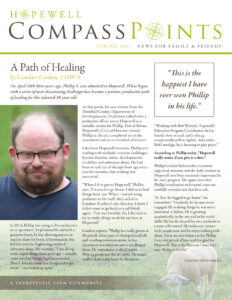
Spring 2017: A Path of Healing

On April 10th three years ago, Phillip S. was admitted to Hopewell. What began with a series of near-devastating challenges has become a positive, productive path of healing for this talented 30-year-old.

Download PDF

Hopewell Promotes Tours, Assessments and Farm Market Visits During May Mental Health Awareness Month

Hopewell Promotes Tours, Assessments and Farm Market Visits During May Mental Health Awareness Month

Mesopotamia, Ohio (April 20, 2017) Hopewell therapeutic farm for people with mental illness is promoting tours and assessments for residential candidates along with trips to its Farm & Craft Market during Mental Health Awareness Month in May, according to Rick Karges, Executive Director/CEO.

“Here is a chance for people to visit Hopewell. Persons seeking help or their caregivers can determine whether Hopewell is the right place for them. People in northeast Ohio can take a ride in country and visit our farm including our Farm & Craft Market,” said Karges. “The proceeds from market sales help to support our residents and the breakthrough work we do to find better ways to deal with mental illness.” The market is open Thursday through Sunday from 12 to 4 p.m.

Outcomes studies since 2006 have shown the effectiveness of Hopewell’s program, a model that incorporates a bio-psycho-social orientation to promote wellness and sustained recovery. The healing power of nature, meaningful work and community – along with a caring and high-quality staff – have led to Hopewell’s unique model of mental health care that successfully promotes self-worth, self-confidence and a greater independence for adults dealing with mental illness.

The “Hopewell Model” actually is a newer version of an old methodology called “moral treatment.” Dating back to the early 1800’s in Europe, the concept of moral treatment focused on treating individuals with equality and respect within the context of a healthy living and learning environment. People with mental illness are able to express their feelings and views freely, as well as actively participate in decisions affecting their lives. This is the basis of today’s “therapeutic community.”

A shopping trip to Hopewell Farm & Craft Market will not be something you will soon forget. Please take a scenic drive and visit this market for one-of-a-kind gifts that teach invaluable skills and healing.

“One of the many ways Hopewell encourages treatment and healing is through arts and a structured work environment,” said Karges. “These two aspects perfectly align with healing on the therapeutic farm and are highlights in the Farm & Craft Market.”

All of the wares on sale are handmade by or with assistance from Hopewell residents. Natural materials from the farm are used as much as possible. These include dried herbs, flowers, rock, slate, wood, feathers and more. Some of the other items that can be purchased include birdhouses, artwork, jewelry, candles and organic soap. Depending on the season, eggs and syrup can also be found.

About Hopewell

Hopewell is a 300-acre residential working farm located in Mesopotamia, Ohio, where adults with schizophrenia, bipolar disorder and major depression learn to manage their mental illness and return to independent life. Hopewell is the only therapeutic farm community in Ohio. It is ODMHAS-licensed and CARF-accredited. Hopewell is a member of the National Alliance on Mental Illness and the American Residential Treatment Association. Information, tours and assessments are available by contacting Laura Scarnecchia, clinician/admissions coordinator, at 440.426.2009 or by email at lscarnecchia@hopewell.cc. Visit www.hopewellcommunity.org.

DONATE